



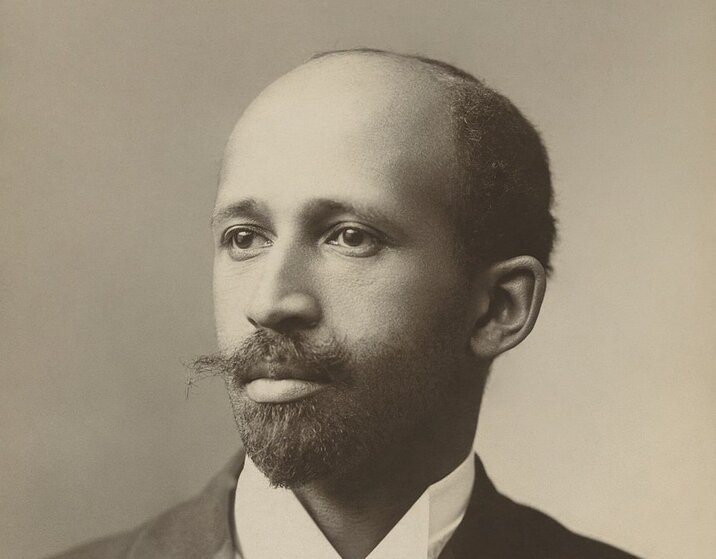
The African Diaspora Art Museum of Atlanta unveiled a new exhibit dedicated to writer and activist W.E.B. Du Bois this weekend.
On display until May 2, the exhibit, titled “W.E.B. Du Bois Revisited,” builds upon a display curated by Du Bois for the 1900 Paris Exposition. Comprising hundreds of photographs and infographics, Du Bois’ exhibit celebrated the achievements of Black Americans over a span of less than 40 years.
With the latest “revisited exhibit,” reporters Mirtha Donastorg, Natrice Miller, and Ernie Suggs from the Atlanta Journal-Constitution contemporized the photos, pairing modern subjects with their counterparts from Du Bois’ exhibit to showcase present-day Atlanta. The data provided by Du Bois was also updated to reflect contemporary Atlanta data.
The idea for the exhibit first initially stemmed from the Atlanta Journal-Constiution’s Black History Month series. In December 2025, the reporters began developing the project, which eventually debuted at Clark Atlanta University in February.
“I just kind of wanted to find people that represent contemporary Atlanta, and that’s from doctors to scholars, entrepreneurs, artists,” said Miller per The Atlanta Voice. “Kind of finding different people that reflect the people Du Bois wanted to share in the past and what contemporary Atlanta looks like right now.”
Born in 1868 in Massachusetts, Du Bois is considered to be a civil rights pioneer, shining a light on Black Americans through landmark works such as “The Souls of Black Folk.”
A graduate of Fisk University, he attended Harvard University in 1895, becoming the first Black American to receive a doctorate from the university. Also a historian, Du Bois took a deep interest in sociology, studying the conditions of Black people in the U.S. and publishing 16 research monographs. His 1899 social study marked the first time a case study on the Black community was conducted in the U.S.
Also a professor at institutions such as Atlanta University, Du Bois is considered to be the founder of the Niagara Movement. The organization was created to oppose the teachings of Booker T. Washington and is considered to be a forerunner of the NAACP, which Du Bois also helped found in 1909.
Simultaneously, Du Bois helped lead the NAACP and wrote for The Crisis, a monthly magazine. Although he left the NAACP in 1934, he returned to the NAACP from 1944 to 1948 as the director of special research.
Du Bois was also a supporter of Pan-Africanism, participating in the First Pan-African Conference in 1900 and helping coordinate four Pan-African Congress meetings.
With funds from the government of Ghana, he set out towards the end of his life to create an encyclopedia on the African diaspora. Du Bois passed away on Aug. 27, 1963, before completing the project.