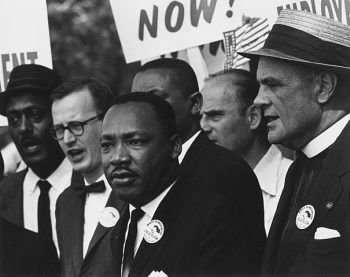




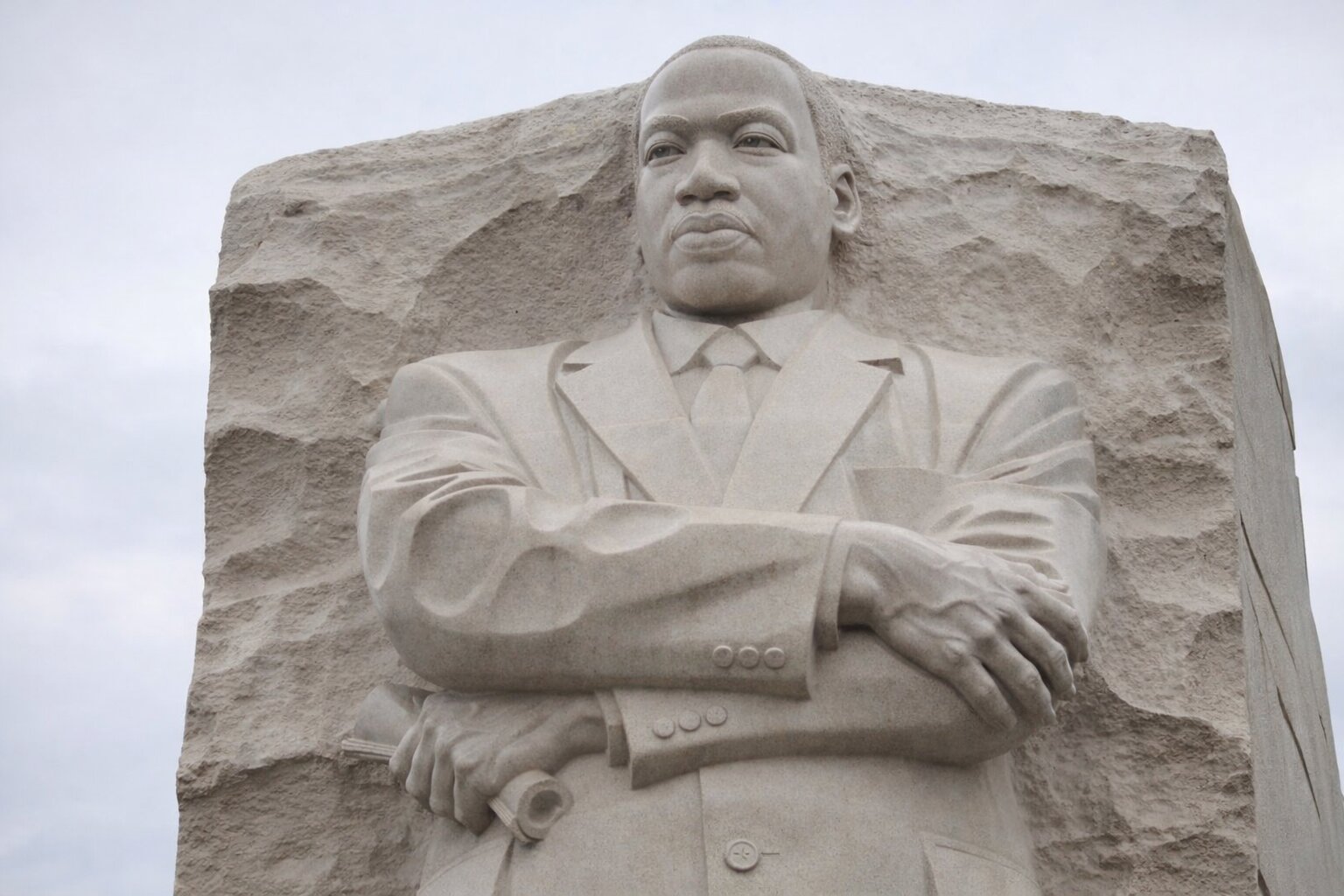
Ask anyone in the 60s about MLK, and the perspectives could vary. One thing was invariable: he cared about humanity. The 1964 Nobel Peace Prize recipient took a backseat to no one, regardless of their title. On that ill-fated day in April ‘68, the sports world should have come to a screeching halt without any deliberation.
FORGET EVERY SINGLE RUMOR YOU HEARD
Do you know him? Did you study him, or, like many, do you accede to the prevailing shoal vignette of the man? It’s different now. Today, there are Martin Luther King holidays, recitals, monuments, textbooks, and celebrations. In the turbulent 1960s, a sizable segment of the population, including Melanated folks, held a dim view of the ostensibly placid, yet internally passionate Civil Rights icon. A segment deemed him a provocateur, and others appraised his beliefs regarding nonviolence as unrealistic, if not categorically invertebrate.
Nevertheless, no one, associate or adversary, disregarded his influence and impact. Contrary to the prevailing axiom, there was more to the man than “having a dream.”
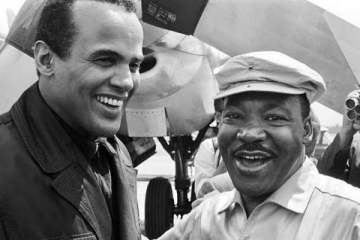
Author Mike Jones of the St. Louis American wrote: “What would the MLK holiday ceremonies look and sound like if we understood his growth and political evolution over the arc of his too-short life? Let’s remember what he said to Harry Belafonte, shortly before his assassination: ‘I have come upon something that disturbs me deeply. I’ve come to believe we’re integrating into a burning house. I’m afraid America may be losing what moral vision she had. Until we assure the underclass has justice and opportunity, we will continue to perpetuate the anger and violence that tears at the soul of this nation.’” [1]

THE PLAYOFF DILEMMA
The Reverend Dr. Martin Luther King had been slain in Memphis, Tennessee, on April 4, 1968, at 7:01 PM EST.
The quagmire for the National Basketball Association: the defending champion Philadelphia 76ers were scheduled to host their longtime archrival, the Boston Celtics, the following evening in game one of the 1968 Eastern Division Finals. Many of the players, particularly the African-Americans, oscillated between fear, shock, incredulity, anger, despair, and an overall yearning to do anything but play basketball.
In the latter half of that decade, only select superstars (and top rookies who were awarded big bonuses before proving themselves) began to eclipse the then-magical $100,000 annual salary mark in the NBA. For most, the “bag” for making it to the league was a Ziploc, easily permeable, and “half-a-sandwich” sized. The majority of players held off-season jobs. The players’ union, just recently recognized by a show of force in 1964, was relatively infantile but emerging.
Professionalism aside, many NBA players, despite the perils and hazards of being outspoken, were far from milquetoast when bargaining with the entity’s establishment. Just a few seasons prior, at the 1964 NBA All-Star Game, both the East and West rosters barricaded themselves in the locker room at the Boston Garden. This was mere
hours before the scheduled start. Armed guards were posted outside the door at the players’ request as they sent their demands to their employers. The employees, rightfully apoplectic with their respective franchise bosses, demanded recognition of their NBA Players Union, a guaranteed pension plan, an athletic trainer for each roster, and better scheduling (fewer back-to-back games) and playing conditions. With a major network (ABC) sweating at the potential last-second boycott, and TV dollars on the line, Los Angeles Lakers owner Bob Short slid as close to the makeshift players’ quarters as possible, demanding that his players acquiesce.
BOB SHORT: “Tell Elgin Baylor and Jerry West that if they don’t get out there, they’re finished!”
ELGIN BAYLOR: “Tell Bob Short to go F**K himself.” [2]
Under the circumstances, it was ownership that ultimately gave in. Somebody built those 1960s players differently.
In the New England vicinity, professional hoops took a relative backseat to the Boston Bruins (hockey) and the Red Sox (baseball), despite an eight-year run of consecutive NBA titles from 1959 to 1966. The city of Boston was replete with racial and social issues. Yet the Celtics organization, spearheaded by Red Auerbach, was forward-thinking and bold. Red had drafted the first African-American player (Chuck Cooper of Duquesne University), started five Black players in a league laden with racial quotas, and named Bill Russell (still an active player) as his successor and the first African-American NBA coach in 1966. Russell, a staunch supporter of his people, once commented on King, saying, “[Russell] was the rare figure who both admired King while also joking that [I] would join the Nation of Islam if it weren’t for the group’s prohibition against eating pork.” [1] The veteran center was born in Jim Crow (Monroe, Louisiana), raised in Oakland, California, matriculated at the University of San Francisco, and spent his entire career in the not-so-warm-and-cozy confines of Boston. Success notwithstanding, he had seen and endured much once off the hardwood. Such events can understandably change one at the cellular level.
Dubbed “Russ” by teammates (William Felton Russell—government name), he was an unapologetic activist off the court. As a result, FBI Director J. Edgar Hoover kept a file on the superstar (seemingly a rite of passage for any celebrity with hair growing toward the sun), which read in part, “An arrogant Negro who won’t sign autographs for white children.” [3]. At that particular juncture, Bill Russell was not signing for anyone—including teammates. Here’s a handshake, take it or leave it.
Unpolished local reporters often referred to him as “Felton X.”
With game one of the 1968 Eastern Division Finals fast approaching, Auerbach again exercised his discernment and informed his players (on the night of the assassination) that they, not management, should decide whether to proceed with the scheduled contest. Conversely, the 76ers’ GM, Jack Ramsey (later enshrined in the Hall of Fame as a coach), in a paternalistic fashion, decided single-handedly that the Philadelphia squad would play. Ramsey’s edict, reached without consulting a single participant, set off a maelstrom of events.
Regarding the delay on Sixers management’s part, given the turbulent times, this should not have been tantamount to rocket science. Honestly, it wasn’t even Tic-Tac-Toe. It should’ve been a matter of common sense, and with the sands in the hourglass winding down before tip-off, folks getting off of work, and nearly 15,000 fans headed to the Philadelphia Spectrum for the opening contest on that Spring evening, it was crunch time.
Early that evening, Bill Russell called Wilt Chamberlain directly. Russell hadn’t slept, nor had Chamberlain. Neither wanted to take the floor, and there was still no official word on the Philadelphia player’s stance. Chamberlain contacted Ramsey and let him know he did not want to play. Still, the Philadelphia general manager retorted in no uncertain terms that he and his teammates were professionals and were expected to be on the court. Furthermore, to buttress his stance, Ramsey had “crassly invoked contractual obligations, and the late hour as reasons that a postponement was impossible.” [3] With that, an angry Wilt Chamberlain ordered everyone other than the Philadelphia players out of the locker room.
‘HOWELL’ DARE YOU
Bailey Howell was a vital cog on the late 60s Boston Celtics. The 6’8” power forward was a tough, high-scoring player who hit the glass ferociously, particularly on the offensive end. For most nights, a statistician could pencil in 20 points and 10 rebounds next to his name. Howell eventually became both a professional and a collegiate basketball Hall of Famer. The Middletown, Tennessee native had also starred in the segregated SEC at Mississippi State, where his number is retired. During the Celtics’ players-only meeting before the series, a moment occurred that could have fractured team chemistry. With the atmosphere already heightened in the aftermath of MLK’s murder, and the majority of the Boston roster being Black, Bailey seemed perplexed by all of the spirited mediation. To him, the idea of a postponement was both unwarranted and nonsensical. In the midst of the symposium, his Mississippi roots materialized.
Howell stated, “What was King’s title? Why should we call off the game?” [3]
The tense closed-door gathering ended with the Black Celtic players incensed. By some accounts, and after some reflection, Bailey reportedly regretted those sentiments years later. However, at that juncture, with the NBA grapevine as it was, the damage was done. Yet Russell, as head coach and a player, galvanized his squad to focus on the task at hand.
Player-coach Bill Russell (6) clears out the area while fiercely corralling a rebound for the Boston Celtics. Assisting him in dominating the paint is teammate and fellow Hall of Famer Bailey Howell (18) (PHOTO CREDIT: The Modern Encyclopedia of Basketball, 1972)
Howell certainly wasn’t alone with his sentiments. An NBA executive at the time, upon hearing of a conjectural postponement, commented candidly, “It’s not like [Martin Luther] King was the President of the United States or something.” [3]
Immediately following the 1963 assassination of President John Fitzgerald Kennedy in Dallas, both the NFL (National Football League) and AFL (American Football League) had a slate of games scheduled. The older established league went ahead with its contests. The AFL did not. Fans nationwide were irate, and some acted as if the Dallas Cowboys franchise was in on the conspiracy!
“Many blamed Dallas, a hotbed of far-right extremism in the early 1960s, for JFK’s death—and by extension the city’s National Football League team. ‘We did not feel welcome throughout the United States, no matter where we played, for quite a while,’ Pettis Norman, a Cowboys tight end, recalled years later.” [4]
The National Football League hierarchy soon learned that it had made a colossal error in judgment.
“Although the nation was enveloped with grief, NFL commissioner Pete Rozelle ignored advice and ordered the full schedule of seven Sunday games to be played—a decision he later called a mistake. Meanwhile, the rival American Football League canceled all its games out of respect for the fallen president.” [4]
Howell’s sentiments were—at the least—insensitive, and anything but astonishing. He gets partial credit for speaking his mind. Nevertheless, it would’ve been prudent for him to read the room: seven of the Celtics regulars were African-Americans, as were six of the members of the Philadelphia team.
Like Howell, Jack Ramsay would ruminate over his reasoning in the heat of the moment, decades later. When asked if he would have done things differently during an interview in 1999, Ramsay (by then Dr. Jack Ramsay) noted that, “Today, you would have done something different [canceled immediately]. But there were difficulties in rescheduling, and we decided to go with the game.” [6]
MEETING OF THE MINDS
While both Wilt and Russell were reluctant to play, they acknowledged that a last-minute cancellation could spark civil unrest in an already on-edge “City of Brotherly Love.” The Sixers voted, and largely for that reason, elected to play. The final tally was 7–2 in favor of taking the court that night. Chamberlain and starting guard Wali Jones voted against it. All-Star forward Chet Walker—distraught over the whole process—abstained from voting, stating, “I couldn’t bring myself to participate in this dreary charade. Everyone knew where I stood. If we had met earlier in the day and voted then, the results may have been reversed.” [5]
Fellow All-Star teammate Hal Greer was opposed to playing as well, but agreed that it would cause a substantial predicament if they canceled on fans on the way to the stadium. The previous night, just after the announcement of King’s assassination, Greer had told his wife, “There’s no way possible we’ll play tomorrow.” [6]
It was a foggy night outside in Philadelphia. Still, a virtual haze hung over the court during the game. The face-off, while described as subdued and low on contact, ended in a Boston Celtics blowout of the defending champions. The visitors from “Beantown” took the opener by a final score of 127–108. In the process, the Celtics scorched the nets as six players shot over 50% from the field, three over 60%, and one hit 75%. Russell put aside the insomnia and distractions to haul in 22 key rebounds. John Havlicek led the underdogs with 35 points, and Sam Jones chipped in with 28.
Chamberlain and Chet Walker, in anguish, still managed to score 33 and 31 points, respectively, for Philly.

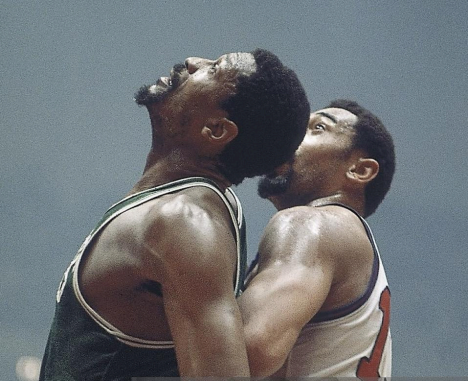
To honor Dr. King, game two (originally scheduled for April 7) was postponed and rescheduled (for Wednesday, April 10). The delay allowed players on both rosters to attend King’s memorial services in Atlanta, Georgia. NBA officials made the announcement just before game one commenced.
When the series resumed, Philadelphia won the next three games to take a commanding 3–1 series lead. At that point, with some soul-searching, player-coach Russell regrouped his guys in Boston, overcame the series deficit, and took game seven, once again on the road at the Spectrum, and advanced to the NBA Finals. There against the seemingly perennial bridesmaids, the Los Angeles Lakers, the Celtics triumphed in six games. The victory gave Russell his 10th championship ring as a player and his first title since taking the reins as Boston’s head coach.
Other prominent NBA stars continued to pay homage to King that summer. More than a handful had either met or knew the minister personally.
“At season’s end, the NBA players will not have finished honoring Martin Luther King. NBA Player Association representative and perennial all-pro, Oscar Robertson, organized an exhibition that summer. The contest took place at the Singer Bowl in Queens, New York, in August 1968.” [7]
A plethora of stalwarts–of various skin tones–enthusiastically participated. Back then, all-star and exhibition games were extremely competitive.
“Nearly thirty players committed to feature in the Pro Basketball All-Star Benefit Game at the Singer Bowl in Queens with the same East vs. West format as the NBA All-Star Game. The game transcended all ordinary matchups, as icons like John Havlicek and Bill Russell readily came off the bench. Furthermore, despite featuring other legendary names like Jerry West, Elgin Baylor, Wilt Chamberlain, Dave Bing, and Lenny Wilkens, among others, ticket prices ranged from $2 to $5, with all proceeds going to King’s Southern Christian Leadership Conference and the Mayor’s Youth and Physical Fitness Fund.” (Singers) [7]
Simultaneously, they ran a telethon during the locally televised broadcast, raising an additional $85,000.
YOU DON’T KNOW MARTIN LUTHER—‘THE KING’
King was not the president of the United States. That title was not necessary for him. He, like any human being, was not irreproachable. Even today, individuals known for promoting detestation and divisiveness are afforded acclaim, and occasionally, flags are kept at half-mast following their transition. In contrast, as a man who promoted unity and kept humanity at the forefront of his cerebrum, Dr. King deserves every honor he has received, and then some. History has shown him to be anything but communist or one worthy of loathing. And, in some perverse twist, individuals, full of hate and vitriol, love to quote him, without a full understanding of his evolution or his speeches in their entirety.
During the historic March on Washington in 1963, several NBA stars were in attendance: Chamberlain, Elgin Baylor, Russell, Walt Bellamy, to name a few. Some fully abetted his views; others supported a mix of his ethos along with those of Malcolm X. Some were more aligned with SNCC, the Deacons of Defense, the Olympic Project for Human Rights, or the Black Panthers. Nevertheless, Dr. King will forever remain in high esteem.
According to Russell, speaking just after the tragedy, “Martin Luther King had been the last buffer between hope and rage. ‘Stuff that I said 10 years ago, that everybody dismissed as an angry Negro talking, is coming out today,’” said Russell. Now, everyone realized the depths of Black despair, but it was too late. ‘We are on a collision course,’ he predicted, a desperate assessment in a desperate time.” [3]
The AFL understood. The NBA understood (honoring King annually to date). In particular, Mr. Russell, Mr. Chamberlain, and Mr. Auerbach certainly absorbed the message. All three possessed a conscience. They saw the big picture, and each was built differently.
Some don’t know him, and others don’t care to know him, even in the face of unmitigated data. It is crucial to note that a person, such as MLK, who perpetually chooses peace can also be ready for confrontation. But King’s legacy is well-established, unable to ever be minimized or eradicated by any form of legislation or rhetoric, regardless, and it stands taller than any game.
If Dr. King were alive today, he would certainly denounce war (as he did regarding Vietnam) and corruption or discrimination against any group. In addition, he would support the promotion (in any corporate or military strata) of any qualified person regardless of phenotype. He would protect children, lead economic boycotts, and demand healthcare. Without question, King would abhor the immoral round-up, trafficking, enslavement, and sale of human beings. Those aforementioned principles alone would catapult him light-years above those occupying the Oval Office and adjacent cabinets.
Above all, Dr. King would ardently endeavor to extinguish the burning house in which humanity is currently engulfed. For this, he would certainly be feared by some, yet placed on a plinth, overtowering and eclipsing anyone choosing to renovate public properties, yield to elites, grift at will, and massacre for sport.
MLK’s spirit lives on, immortally elevated to higher ground.
REFERENCES
1. Jones, Mike. “Integrating Into a Burning House: Remembering the Other MLK‘s.” The St. Louis American. January 17, 2020
2. Baylor, Elgin, & Eisenstock, A. “Hang Time: My Life in Basketball.” Hilton, Mifflin, Harcourt. New York (2018). P. 229
3. Goudsouzian, Aram. “The King of the Court: Bill Russell and the Basketball Revolution.“ University of California Press. Berkeley (2010). P. 217
4. McManamon, Pat. “Two days after JFK‘s assassination, the Dallas Cowboys faced backlash.“ history.com. November 8, 2021
5. Cherry, Robert. “Wilt: Larger Than Life.“ Triumph Books. Chicago (2004). P. 191
6. Lynch, Wayne. “Season of the 76ers: The story of Wilt Chamberlain and the 1967 NBA Champions.” Thomas Dunn Books/St. Martin’s Press. New York (2002). P. 207
7. Bhargava, Yakshpat. “Oscar Robertson Went Above and beyond to honor Martin Luther King Jr,” Basketball Network. April 22, 2024.