



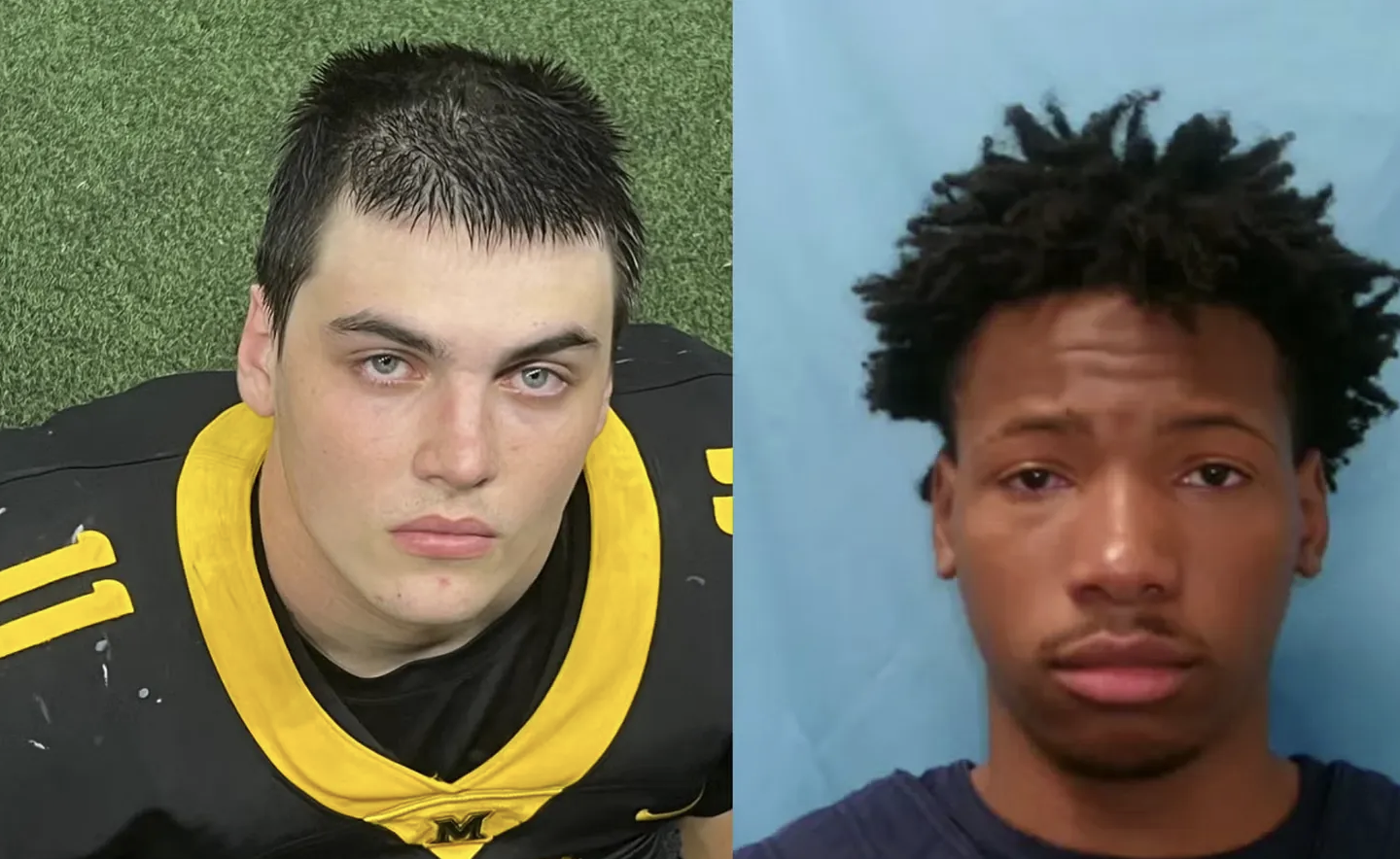
The Karmelo Anthony case, racial trespass, and why Black youth are punished for saying their bodies belong to them.
The prosecution has rested in the murder trial of Karmelo Anthony, the Black Texas teenager accused of fatally stabbing Austin Metcalf, a white teenager, during a high school track meet in Frisco back in April 2025. Anthony has pleaded not guilty and is claiming self-defense. Now, as the defense presents its case, the public trial is going down outside the courtroom.
On Facebook, TikTok, X, YouTube, podcasts, and in comment sections, people are arguing with the same ferocity that erupted when this story first hit the news. But beneath all the noise, I’m noticing some racial assumptions being smuggled into the discourse. Two things especially are not being discussed seriously enough.
First, the racists are obsessing over the phrase reportedly attributed to Anthony: “Touch me and see what happens.” Why do people hear a Black teenager’s warning to not trespass against his body as proof of criminal intent?
So a Black teenager can say, in the language available to him, “Do not touch me,” and half the country will hear a threat. Suddenly everybody and they mama is now a forensic linguist out here tryin’ to parse tone, slang, posture, volume, facial expression, attitude, and physiognomy.
Second, almost nobody is interrogating the racial entitlement embedded in the idea that a white teenager had the authority to remove a Black teenager from a space in the first place. That shit is maddening to me. Folks wanna analyze the Black teen’s words, but about the white teen’s presumption of power.
Why?
Because that would force folks to ask: who taught this white boy that he had the authority to decide where a Black boy could sit, stand, belong, or exist? Why did a white teenager feel entitled to put his hands on Anthony? Why did multiple athletes think they could decide who belonged under that tent. We need to ask why “he was told to leave” is being treated like a lawful order instead of a teenage power play backed by racial entitlement.
Seriously, Y’all. I wanna know why a white teenager’s attempt to remove a Black teen from a space get treated as a normal thing? Why is “he was told to leave” accepted so casually, as though one teenager’s command automatically creates another teenager’s obligation? Those are the real questions folks need to be asking. But that is a conversation folks don’t wanna honestly have. Because the moment you ask these questions, we are no longer talking about just one fight. We are talking about the racial training of American childhood and Jim Crow’s afterlife in a school tent.
But here we are with folks treating “touch me and find out” like its Karmelo Anthony’s confession or a damn murder manifesto. They are pretending the phrase means, “See! I came here planning violence at this track meet.”
Nah.
In Black speech, street speech, youth speech, and everyday conflict language, “touch me and find out” usually means: “You are too close.” “I’m warning you.” It means: “Do not put your fucking hands on me!” “You do not have permission to grab me, shove me, move me, or lay hands on my body.”
Of course it ain’t polished courtroom English or a carefully crafted sentence for a jury. But it is a boundary. And that is exactly why so many racist people are offended by it. Because Black children and youth are not allowed to set boundaries around their own bodies. They are not allowed to say, “This body is mine,” without America asking, “Since when?” And that is the sickness underneath all of this.
Black children are treated as if they cannot own themselves. As if their bodies are public property and their skin is a site of suspicion before it is a site of personhood. Their very presence is already a violation waiting to be corrected. In the racist mindset, Black children and teenagers commit trespass in their own goddamn bodies!
That is what this country has always taught them. That Blackness itself is out of place. You’re too loud. Too close. Too visible. Too resistant. Too much. So even when a Black youth is sitting, standing, waiting, existing, breathing, America can still decide he is somewhere he does not belong. And if he refuses to be moved, if he says no, and if he draws a line around his own flesh, then suddenly the boundary becomes the crime.
That is how anti-Blackness works. It does not simply punish Black children for what they do. It punishes them for how they protect themselves, for how they sound when they are afraid, and for not making their fear gentle enough for white interpretation. Black children in America are not granted the same bodily autonomy as other children. Their bodies are treated as public property, disciplinary projects, threats in motion, objects to be corrected, removed, searched, restrained, surveilled, punished, and murdered.
In schools, Black children are suspended, expelled, handcuffed, dragged out of classrooms, slammed to the floor, searched, and criminalized for behavior white children are allowed to outgrow. In stores, they are followed. In neighborhoods, they are questioned. In parks, they are policed. In public spaces, they are treated as if their presence requires explanation.
So when a Black teenager says, “Do not touch me,” this country hears, “How dare you?” How dare you claim your body? How dare you speak as though you have the right to refuse? How dare you tell someone where your skin begins and their authority ends? That is the real scandal.
And I am sick of people acting mystified by the knife. “Why would he bring a knife to a track meet?” I dunno. Maybe because Black boys in America do not grow up in theory. They grow up watching this country turn Black children into cautionary tales.
They grow up with Trayvon Martin, Mike Brown Jr., Tamir Rice, Jordan Davis, and, and, and so many others in the cultural bloodstream. Every Black child who learned that looking suspicious, standing somewhere, walking home, playing in a park, sitting in a car, knocking on a door, or being perceived as “out of place” could get them killed. And then America has the nerve to act confused when a Black teenager carries fear on his person. FOH!
Racist people cannot imagine why a Black boy might feel unsafe, because imagining his fear would require them to imagine his humanity. They would have to admit that Black children are not moving through this country with the same assumptions of safety, softness, and protection as white children. They would have to admit that Black childhood is lived under threat long before any courtroom decides what counts as reasonable fear.
And then there is the audacity of white teenagers feeling entitled and empowered to remove a Black teenager from a space. Where does that audacity come from?
White children are not born believing they are the managers of public space. They are taught that. They absorb it from parents, schools, neighborhoods, police, media, sports culture, and a society that trains them to experience Black presence as disorder. They learn early that whiteness comes with the power to question. Why are you here? Who invited you? This is not your seat. This is not your neighborhood. This is not your school. This is not your tent. This is not your space.
This is what racial socialization looks like. White children are taught entitlement to space while Black children are punished for asserting ownership over their bodies. Before there’s any physical confrontation or weapon, there is a presumption and a racial script already running in the background. One boy believes he can tell another to leave, that he can enforce belonging, and the space is his to defend. And the Black youth is expected to absorb the command, swallow the humiliation, obey the removal, and make no scene.
This is the old logic of Jim Crow in our modern moment. Jim Crow wasn’t just signs over water fountains, pools, and bathrooms. It was a social order that deputized ordinary white folks to police Black movement, rest, joy, proximity, and refusal. It taught white people that their discomfort was evidence, that their fear was authority, and that Black people had to shrink themselves before white people decided to make an example out of them. Now it shows up in school discipline, neighborhood watch culture, viral panic, police calls, “suspicious person” reports, and the casual confidence of white youth who believe they can tell a Black peer to get out.
We need to stop pretending this case is only about one terrible moment between two teenagers. It is also about the racial education of children in America. Do not start the moral clock at Karmelo Anthony’s knife. Start it with Austin Metcalf’s command. Start it at the presumption. Start it at the moment a Black teenager sitting under a tent in the rain was treated like a problem to be removed.
Folks want to talk about what Karmelo Anthony should not have had. But let’s talk about how Austin Metcalf should have minded his own business.
So yeah, ask why Karmelo Anthony had a knife. But do not ask that question like Black fear is irrational. Do not ask it like Black children have been raised in some magical America where Trayvon made it home, Tamir got to grow up, Mike Brown Jr. made it to middle age, and every Black boy who was told he looked dangerous was simply allowed to live.
Thanks for reading. If this piece resonated with you, then please consider becoming a paid subscriber. Paid subscriptions help keep my Substack unfiltered and ad free. They also help me raise money for HBCU journalism students who need laptops, DSLR cameras, tripods, mics, lights, software, travel funds for conferences and reporting trips, and food from our pantry. You can also follow me on Facebook!
We appreciate you!