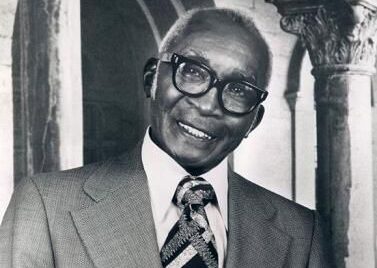







On this day in 1909, writer Chester Bomar Himes was born in Jefferson City, Missouri. Over the course of his life, Himes turned personal hardship, racial injustice and his years in prison into a body of work that helped reshape American crime fiction.
Himes grew up in a middle-class family and his father, Joseph Sandy Himes, taught industrial trades at a Black college, while his mother, Estelle Bomar Himes, had worked as a teacher before their marriage. His brother, Joseph Jr., was badly injured during a school gunpowder demonstration and the nearest hospital refused to treat him because of Jim Crow segregation, an experience Himes later described as one of the most painful moments of his life.
His family eventually settled in Cleveland, where Himes attended East High School and later enrolled at Ohio State University. After being expelled, Himes was then arrested for armed robbery in 1928 and sentenced to 20 to 25 years of hard labor.
While incarcerated at the Ohio Penitentiary, Himes began writing short stories and his work appeared in national magazines, including The Bronzeman and Esquire.
Himes was paroled in 1936 and continued writing while working a series of part-time jobs. Langston Hughes helped introduce him to publishers and other literary figures. In the 1940s, Himes moved to Los Angeles, where he worked briefly as a screenwriter and published “If He Hollers Let Him Go” in 1945 and “Lonely Crusade” in 1947. Both novels examined racism, labor and the experiences of Black workers during World War II.
In the 1950s, Himes relocated to France, where his writing found a wider audience. He became best known for his Harlem Detective series, which followed Black police detectives Grave Digger Jones and Coffin Ed Johnson. The novels included “A Rage in Harlem,” “The Real Cool Killers,” “The Heat’s On” and “Cotton Comes to Harlem.” In 1958, Himes received France’s Grand Prix de Littérature Policière.
Several of his novels were later adapted for film, including “Cotton Comes to Harlem,” directed by Ossie Davis in 1970, and “A Rage in Harlem,” directed by Bill Duke in 1991.
Himes died in Spain in 1984 at age 75.