




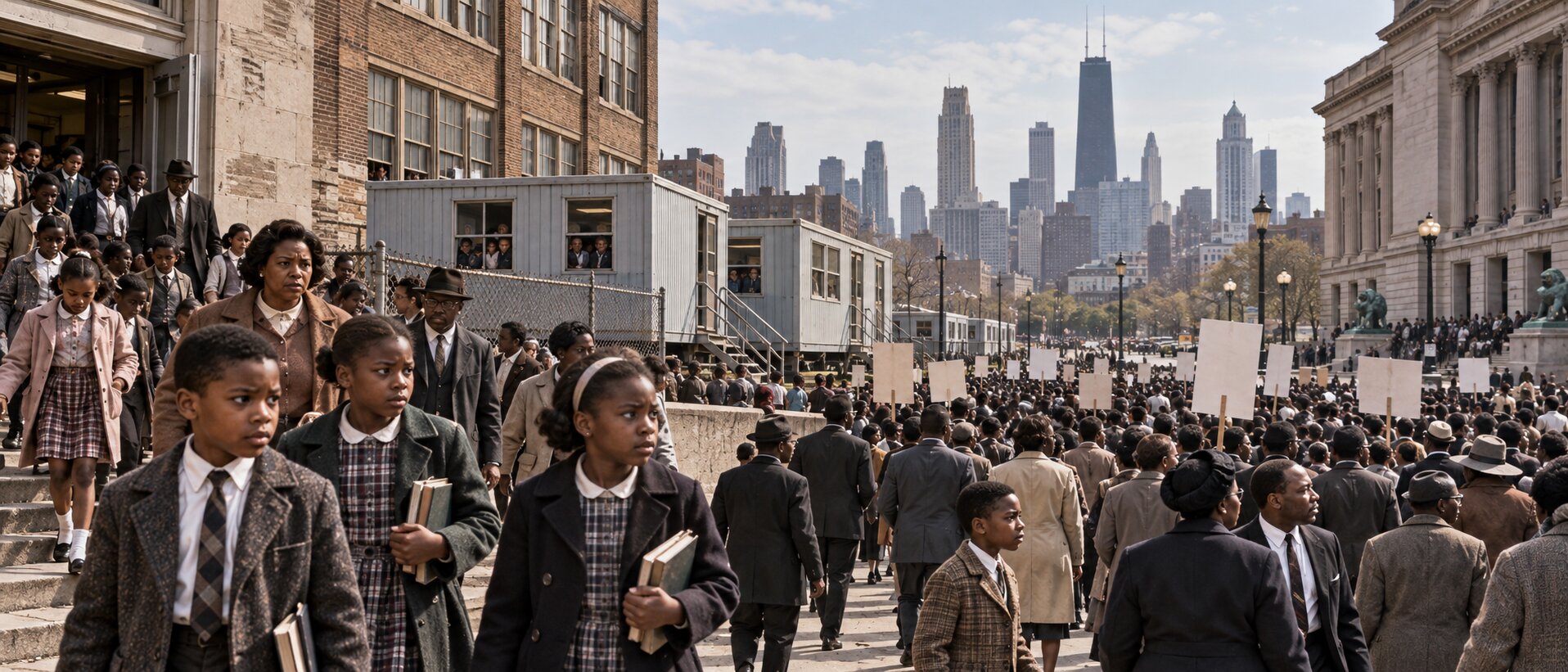
On this day in 1963, a coalition of civil rights groups and students organized Freedom Day.
Set in Chicago, Freedom Day was a mass boycott against segregated schools and a mass protest against the lack of resources for Black students. Following the landmark 1954 Brown v. Board of Education ruling, which found that segregation in public schools was unconstitutional, the Chicago Board of Education failed to implement the outcome in its school system and denied integration within the classrooms.
By the early 1960s, Chicago began to rapidly expand and, as a result of redlining, soon the population for Black Chicago residents soared to over 800,000 people.
Although the government attempted to address the overcrowding with new buildings and up to 200 aluminum mobile school units that they claimed were temporary, the segregated schools were overcrowded with students. Classrooms were so crowded that students had to attend in shifts to get an education. Nearly 33,000 Black students attended school for only four hours to make space for other students. All space was utilized, including basements, cafeterias and auditoriums, and supplies were extremely limited.
Civil rights groups, neighborhood organizations and parents continuously attempted to address the issue, highlighting the fact that many white schools still had empty seats for students.
However, the school board, led by superintendent Benjamin Willis, vehemently denied this, refused to integrate schools, and insisted on maintaining zone-based schools. For the next three years, students continued to speak out about the conditions.
While white students had improving conditions in their schools, classrooms continued to grow to 25% over capacity, with over 40 students at a time. Expenditures also mostly went to white schools. Schools that educated Black students received only two-thirds of what majority-white schools received.
By 1963, tensions culminated in the Freedom Day protest. Community members had previously protested against Willis outside his home and burned the aluminum mobile school units before the Freedom Day protest. With the Freedom Day protest, however, they successfully revealed the conditions students faced.
Supported by Rev. Dr. Martin Luther King Jr., the boycott included 225,000 students, representing 50% of the school district. On Oct. 22, 1963, they stayed home despite threats from school administrations. Thousands of people descended on City Hall and the Board of Education building to demand integration.
Despite the protest’s size, school conditions did not improve. Although the conditions were being discussed, Willis remained in office until 1966 and the tenures of successors reaffirmed their devotion to his policies. Each year, the conditions in majority-Black schools worsened with the buildings visibly aging. Windows, lamps and hallways showed visible distress.
At the same time, the number of white students enrolling in schools dropped drastically by 75%.
Chicago’s first desegregation plan officially took effect in 1980. The Chicago Board of Education and the U.S. Justice Department agreed after the court placed Chicago Public Schools under a consent decree and ordered it to implement a desegregation plan.
They implemented voluntary practices and, by 1989, 75% of Black students were still studying in segregated schools.
After three decades, in 2009, Judge Kocoras ruled to put an end to the decree after reports that it led to a limited amount of relief. Following the removal of the decree, civil rights groups such as the American Civil Liberties Union revealed that they would have preferred that the Court maintained the decree until a proper plan was presented on how to ensure fair access to schools.
“Testimony in this case revealed that the Chicago Board of Education intends to eliminate the use of race as a factor in guiding admissions to the City’s most attractive educational opportunity – the selective enrollment, gifted and magnet schools,” said Legal Director Harvey Grossman. “This proposed scheme – using only socioeconomic status factors in enrollment – may well result in African American and Latino students in Chicago having less access to the best, highest-quality educational opportunities within the system and less diversity at magnet, gifted, and selective enrollment schools.”
To this day, Chicago’s education system remains divided, driven largely by current policies and funding gaps.