


This day in history, February 17, 2026, the Rev. Jesse Louis Jackson, the civil rights leader, ordained Baptist minister and two-time Democratic presidential candidate, died early Tuesday at 84, his family said in a statement.
The family said he had been battling Progressive Supranuclear Palsy, or PSP, a neurodegenerative disorder that affects balance, swallowing and walking. There is no cure, and symptoms are managed.
“Our father was a servant leader, not only to our family, but to the oppressed, the voiceless, and the overlooked around the world,” the statement said. “We shared him with the world, and in return, the world became part of our extended family.” The family asked supporters to honor his memory by continuing the work for justice and equality.
Born October 8, 1941, in Greenville, South Carolina, Jackson began organizing as a young man in the era of Jim Crow segregation. In July 1960, he joined seven other Black students in a sit-in at the whites-only Greenville Public Library, a protest that became known as the Greenville Eight case and helped push the desegregation of public facilities.
Jackson went on to become a close aide to the Rev. Martin Luther King Jr., traveling with King during the 1965 Selma-to-Montgomery march for voting rights in Alabama. He later described those years as “a phenomenal four years of work.” He also said he was with King when King was assassinated in 1968.

After King’s death, Jackson built an independent base in Chicago. He helped spearhead the Southern Christian Leadership Conference’s Operation Breadbasket, a program aimed at improving economic conditions in Black communities through job access, business pressure campaigns and organized consumer boycotts. In the early 1970s, he formed Operation PUSH, People United to Serve Humanity, and later organized the Rainbow Coalition. In the mid-1990s, the groups merged as the Rainbow PUSH Coalition, his flagship civil rights and social justice organization.
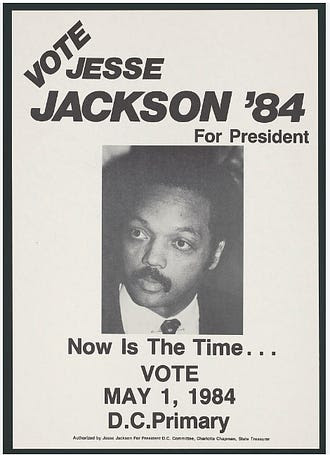
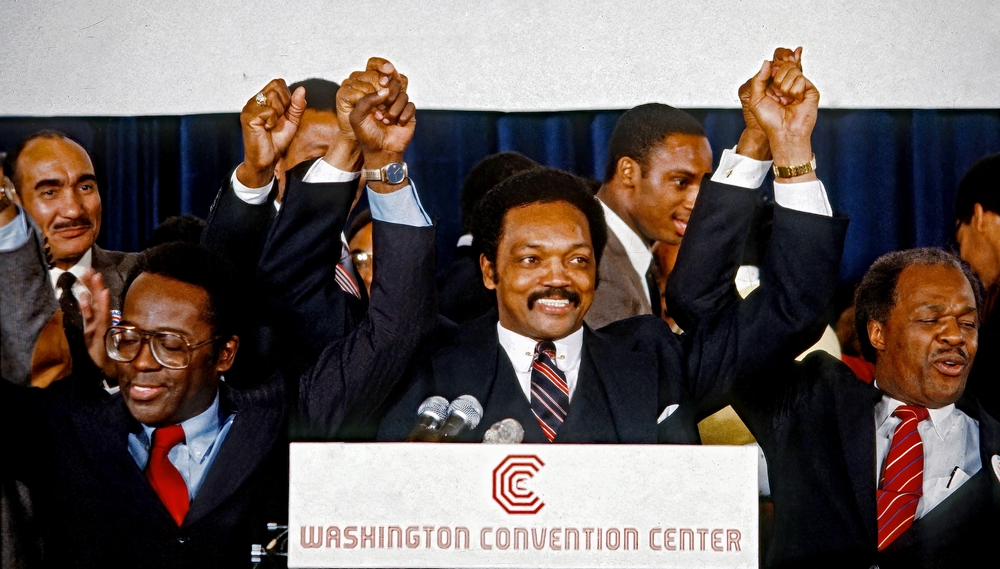
Jackson’s influence expanded from street-level organizing to national politics. He ran for president twice as a Democrat, in 1984 and 1988. He lost the 1984 primary contest to former Vice President Walter Mondale. In 1988, he lost to Massachusetts Gov. Michael Dukakis, but won 13 primaries and caucuses and drew nearly 7 million votes. “Part of my job was to sow seeds of the possibilities,” he told The Associated Press.

From 1991 to 1997, Jackson served as a District of Columbia shadow senator, an unpaid position focused on advocacy for D.C. statehood. In 2000, he received the Presidential Medal of Freedom.
In 2008, Jackson was caught on a microphone criticizing then-Sen. Barack Obama, but later appeared tearful in Chicago’s Grant Park on election night as Obama became the nation’s Black president. Jackson later told the AP he was thinking of leaders such as Martin Luther King Jr. and Medgar Evers as he watched the crowd.
Jackson is survived by his wife, Jacqueline Lavinia Brown, and their five children, Santita Jackson, former Rep. Jesse L. Jackson Jr., Jonathan Luther Jackson, Yusef DuBois Jackson and Jacqueline Lavinia Jackson Jr.