





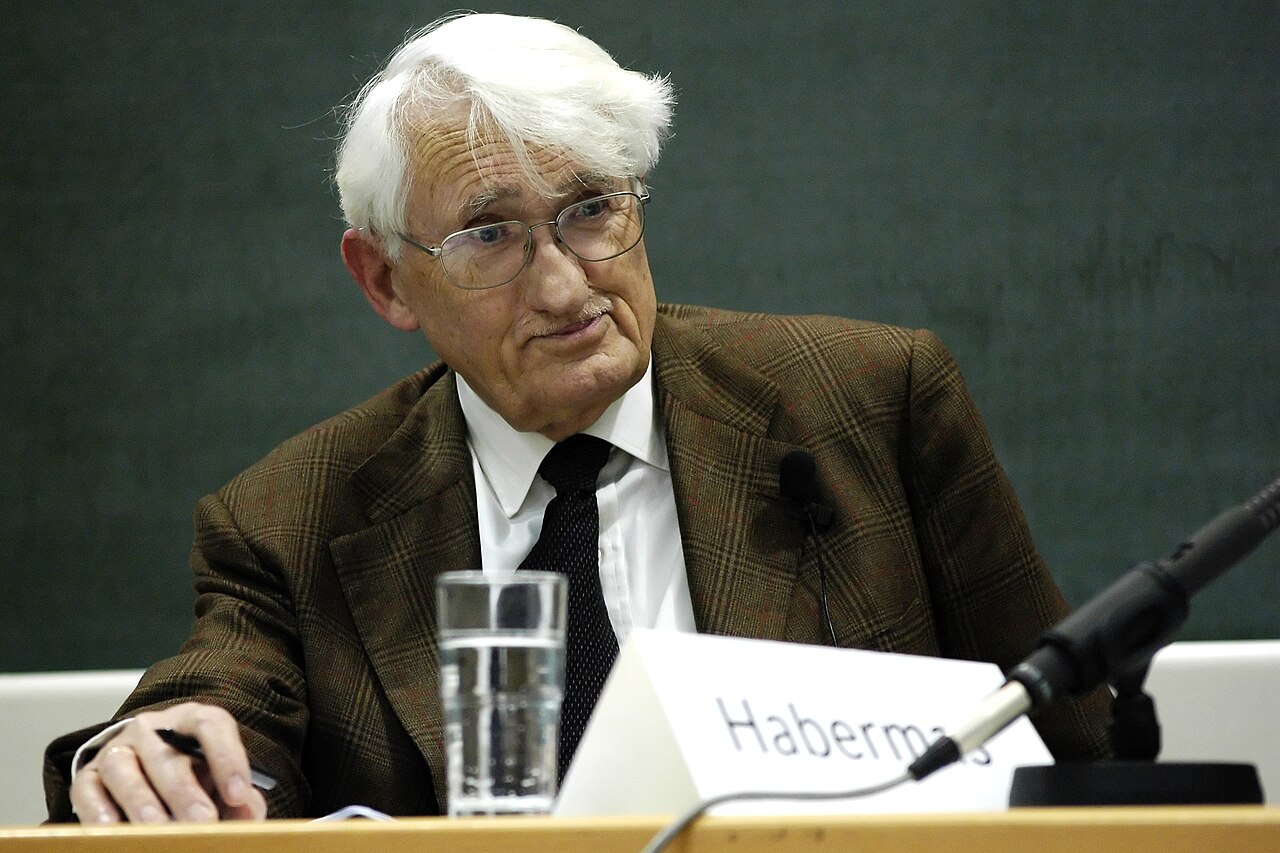
Y’all, Habermas died over the weekend. He was 96. Some of you are reading this and probably squinting like, “Haber-who?”
And honestly, that reaction makes perfect sense if you didn’t spend several years of your life trapped in a graduate-school seminar reading dense-ass European theory at two o’clock in the morning while trying to convince yourself that the paragraph you just read eleventeen times actually meant something.
Jürgen Habermas was one of the most famous philosophers of the twentieth century, and he was a German intellectual associated with what’s called the Frankfurt School of Critical Theory. In academic circles, he’s known for big ideas about the “public sphere,” “communicative rationality,” and how democratic societies are supposed to reason together.
Which, translated into regular human language, basically means Habermas wrote thousands of pages explaining how people in a democracy are supposed to talk to each other in ways that are rational, fair, and guided by good arguments instead of power or manipulation.
Now the irony, bless his heart, is that he explained this in sentences so friggin’ long and so dense that the average graduate student needed three rereads, two cups of coffee, a flashlight, a pair of tweezers, and a minor spiritual crisis just to locate the verb. So yeah, his life’s work was about communication. But the first challenge was surviving the communication part.
For many of us who went through humanities doctoral programs, the first and most enduring memory of Habermas was not enlightenment. It was confusion. So when I heard Habermas went on to ‘glory,’ I was a little surprised because I genuinely thought he had been dead for my whole life. Not metaphorically dead. I mean historically dead. Like Hegel-dead. Kant-dead. Dust-in-a-footnote dead.
Apparently not.
Habermas was a special kind of torture. You would open one of his essays and the first sentence would look something like this: “The procedural presuppositions of communicative rationality within the lifeworld constitute the normative grounds upon which discourse ethics may be articulated.”
Sir . . . if your whole theory is about people understanding each other, why are these sentences acting like they don’t want to be understood? You could have just said: “People should talk to each other honestly and listen.”
But nahhh. Instead we got a whole paragraph that sounds like it was assembled in a German philosophy laboratory using twelve abstract nouns and a deep personal hatred of normal sentences. Graduate school taught me that somewhere along the line a group of European men decided that the more incomprehensible your writing was, the more “profound” people assumed you were. And Habermas wasn’t even the worst offender.
Reading Georg Hegel felt like sitting at your kitchen table with a highlighter, a dictionary, and a growing suspicion that this man was purposely stacking words on top of each other to see how long he could keep the sentence alive. You start the paragraph looking for the subject. Halfway through you’re still looking for the verb. By the end of the page everybody in the sentence done wandered off and you’re left sitting there like: “Now who exactly is doing what to whom in this damn paragraph?” Because Hegel writes like the subject, the object, and the verb got into a family fight and ain’t nobody speakin’ to each other.
Then there’s Michel Foucault.
Now lissen, I know people love Foucault. I know the word “discursive” has paid a lot of academic mortgages. Whole careers have been built off that one word. But as a doctoral student I would sit there with this man’s book open thinking: “Okay… so power is everywhere. It’s like a ghost. It’s floating around the room, touching everybody, and influencing everything. Power is in the institutions. Power is in the discourse. Power is in the body. Power is . . . circulating.”
Fine. I get it.
But after twenty pages I’m still sitting there like: “Okay but can somebody just say it plainly? Who got the power and what exactly is they doin’ wit’ it?”
And somehow the classroom conversation would unfold like this: White guy in the seminar: “Foucault is destabilizing the epistemic authority of institutional knowledge production.”
The fuck?
Me, internally: You and Foucault are destabilizing my ability to finish this reading before class tomorrow.
And the wild part is the white dudes in the room would say this stuff with so much confidence. With no hesitation or stuttering. Just sittin’ there like they personally helped Foucault edit the manuscript. Meanwhile I’m looking around the table thinking: Are y’all really understanding this, or did y’all just grow up in households where people talk like this over dinner?
Because sometimes it really did feel like only white men had the decoder ring for that kind of language. They’d lean back in their chairs and start throwing around phrases like “problematizing the discourse” and “interrogating the epistemology,” and I’d be sitting there thinking: Are we really learning something right now or are we just stacking fancy words on top of each other like intellectual Jenga?
Honestly, I am convinced that real performance in graduate school wasn’t understanding these men. The real performance was pretending you did. Everyone would sit around the seminar table nodding thoughtfully like we were all participating in some sacred intellectual ritual. Somebody would quote Hegel. Somebody else would invoke Habermas’s “public sphere.” Someone else would start talking about Foucault’s “genealogy of power.”
And I would be sitting there thinking: Lawd, can somebody please bring Harriet Tubman into this conversation so she can translate what the hell is going on? Or Toni Morrison. Or Du Bois. Just one Black person who speaks in full, complete sentences that actually land on the ground somewhere. Because at that moment I didn’t need another man explaining “the discursive construction of institutional power.” I needed somebody to lean over and say it like a Black auntie or church deacon: “Baby, what they tryin’ to say is . . .”
Because when you come from the world I came from—foster care, working-class, striving, house proud, religious Black communities, people trying to survive—you learn very quickly that language is supposed to do something. It is supposed to explain, clarify, illuminate, solve problems, and connect ideas to real life. But academic theory, especially European theory, often felt like a competitive sport where the goal was to see who could make the simplest idea sound the most incomprehensible.
Habermas and those other philosophers built an entire career explaining communication in language that made communication almost impossible. And yet these men became the intellectual gatekeepers of the humanities. You could not get a PhD without proving you had wrestled with them. It didn’t matter if your research was about Black communities, or journalism, or children, or racism, or public life. At some point you had to march through the Great European Theory Obstacle Course and demonstrate that you had at least pretended to understand what Habermas meant by “communicative rationality.”
Why? Who decided this? Who looked at a shelf full of dense German philosophy and said: “Yes. This. This is the universal intellectual standard for humanity.”
Because I’ll tell you what I remember from those years. I don’t remember Habermas’s theoretical framework. I don’t remember Foucault’s precise definitions. I don’t remember whatever Hegel was doing with dialectics on page 437.
What I remember is sitting there as a Black woman thinking: If scholarship requires this level of unnecessary confusion, maybe the problem isn’t me. Maybe the problem is the tradition.
Because after a while you start noticing something. A lot of this elaborate, million-dollar vocabulary isn’t actually clarifying anything. It’s performing sophistication. It’s a style of writing that rewards obscurity and treats clarity like it’s beneath serious thinkers. And scholars inside the humanities have been critiquing this for decades. People have pointed out again and again that whole fields sometimes develop a habit of mistaking density for depth, of assuming that if something is difficult to read it must therefore be profound.
But sometimes it isn’t profound. Sometimes it’s just confusing. And sometimes it’s just bullshit.
And some academics lean into that confusion because it protects them. When your writing is wrapped in layers of jargon and abstraction, it becomes harder for anybody to challenge what you’re actually saying. If nobody can clearly translate the argument, nobody can easily point out when the argument is thin. So the performance becomes the point.
But the work I care about now, the work I write, the work people actually read, the work that helps people understand the world, operates on a much simpler rule. If people can’t understand what the hell you’re saying, you’re not being brilliant. You’re just being confusing. And confusion has been one of the most reliable intellectual exports of European philosophy for about three hundred years.
Now before the angry academics arrive in my comments section with their tweed jackets half-buttoned, let me say that yes, these men absolutely influenced important intellectual debates. Habermas shaped conversations about democracy and public debate. Foucault made people think about how institutions like prisons, hospitals, and schools exercise power. Hegel influenced generations of thinkers trying to understand how history changes. Scholars have built entire fields around those ideas.
Indeed.
But there’s a question I always come back to. If these thinkers are supposedly so foundational to understanding modern society, why are their names almost completely absent from everyday life? Why can’t a barber, a bus driver, a church mother, and a high school student all explain their basic ideas?
It’s not because ordinary people are unintelligent. It’s because some traditions of scholarship developed a habit of writing in ways that ordinary people were never meant to access. And that, to me, is the real issue.
Because the scholars who actually changed how everyday people understand the world did something very different. They wrote so that people could recognize themselves inside the argument. You didn’t need a seminar table and a glossary to understand them. You just needed to be alive in the human condition.
So rest in peace, Habermas.
Your ideas about democracy, public debate, and communication traveled around the world and filled a whole lot of seminar syllabi. But I still suspect that somewhere in that great philosophical afterlife there’s a Black auntie leaning over your shoulder saying: “Baby, all that just to say people need to talk to each other and listen?”
Rest easy, Habermas, having now entered a realm where the procedural presuppositions of eternal rest and uninterrupted reflection finally constitute the normative conditions under which even the longest sentence may find its peace.
Thanks for reading. If this piece resonated with you, then please consider becoming a paid subscriber. Paid subscriptions help keep my Substack unfiltered and ad free. They also help me raise money for HBCU journalism students who need laptops, DSLR cameras, tripods, mics, lights, software, travel funds for conferences and reporting trips, and food from our pantry. You can also follow me on Facebook!
We appreciate you!