



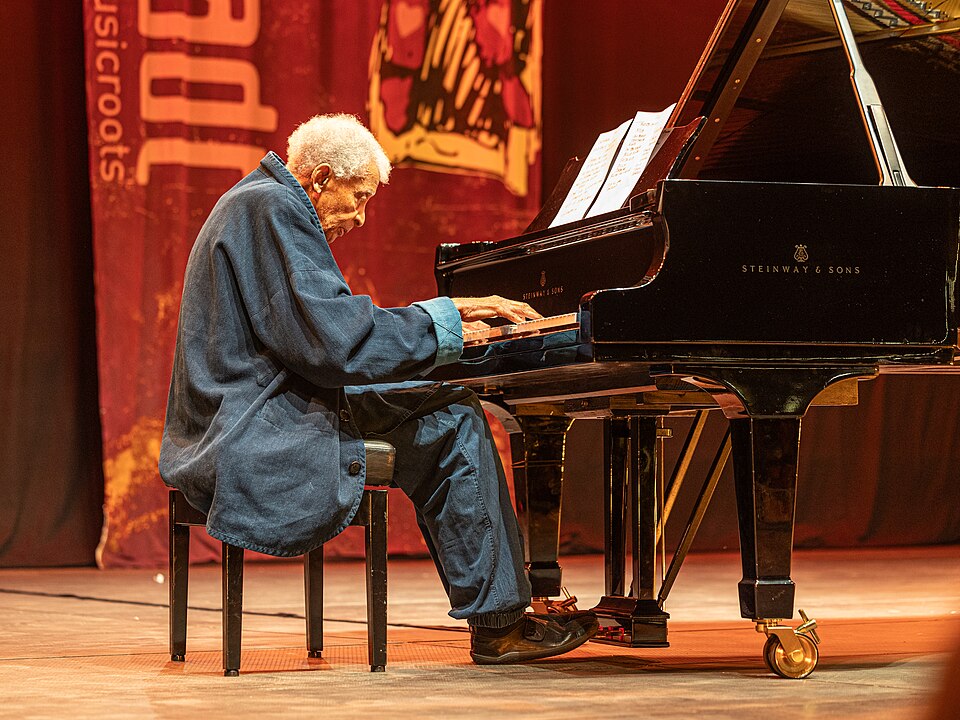
The music that once defied the brutal tyranny of oppression has lost its master architect.
Abdullah Ibrahim, the iconic jazz pianist who has made an indelible impact on the jazz canon for more than seventy years, as well as on the worldwide struggle against apartheid, died in Germany on Monday after a brief illness.
He was 91.
Mr. Ibrahim, known as Dollar Brand before converting to Islam in the 1960s, performed at Nelson Mandela’s 1994 presidential inauguration and was celebrated by the leader as “our Mozart”. Perhaps it was because he wasn’t just a musician; he was a powerful advocate for everyday people and he used his art to inspire and uplift during some of the darkest times in South African history. His performance at President Mandela’s induction was a defining moment that symbolized hope and unity.
Although he was a prominent figure in Cape Town’s jazz scene, in 1962, he made the bold move to flee South Africa for Zurich, primarily to escape the escalating violence, severe political repression and creative censorship imposed by the apartheid government, taking his unique sound with him. His music, particularly acclaimed tracks like Banyana – Children of Africa, Mannenberg, The Mountain and The Wedding from the more than 70 albums that he released, were hailed for their blend of spiritual essence and the political pride of his homeland.
One of the most memorable moments of his career came when the legendary Duke Ellington caught one of his performances at Zurich’s Africana Club during a European tour in 1963. Ellington was so moved by Ibrahim’s artistry that he sought to help him record an album titled Duke Ellington Presents the Dollar Brand Trio, released in 1964, which touched off what would showcase Ibrahim’s talent and the dynamic sounds of South African jazz on international stages.
As the apartheid government fell apart, Mr. Ibrahim was allowed to return to South Africa. For the rest of his life, he lived part-time in Cape Town, New York and Germany. In 2019, he was honored as a Jazz Master by the National Endowment for the Arts.
Adolph Johannes Brand was born on October 9, 1934, into a complicated family dynamic shaped by the harsh realities of apartheid in South Africa. His father, Sentso, was a Sotho man whom he never had the chance to meet and his mother, Rachel Brand – she was of mixed race – was classified as “colored” under the apartheid system. When Adolph was just 4 years old, his father, a house painter, died under mysterious circumstances – an event that was kept from him for years. As he grew older, he uncovered even more startling truths: the woman he had thought was his mother was actually his grandmother. He was also told that Rachel was his sister.
“My grandparents gave me their name so I’d be classified as colored,” a label that afforded them a higher social status than if they had been deemed Black, Ibrahim explained to The Guardian in 2001.
He continued: “That code of silence was created by the system. I was saddled with a lot of bitterness at an early age.”
The apartheid system didn’t just strip people of their basic rights; it also snatched away their self-determination.
“We were robbed of our traditional belief system,” he told the N.E.A. in an interview. “The A.M.E. Church served as a home for our vision, for our perspective of freeing ourselves and expressing our spirituality in our own tradition.”
Adolph’s musical journey began in the heart of Kensington, where his grandmother played a pivotal role in founding the local A.M.E. Church. The sanctuary not only served as a place of worship but also became a nurturing ground for young Adolph’s burgeoning talent. His grandmother and mother infused the church with their musical gifts, playing the piano and singing and Adolph was deeply inspired by the musical environment. By age seven, he was already taking piano lessons and his passion for music blossomed as he began to craft his own songs.
By the time he reached 15, Adolph was stepping into the limelight, performing as both a singer and pianist with big bands. In 1958, he formed the Dollar Brand Trio, collaborating with Johnny Gertze on bass and Makaya Ntshoko on drums. Their goal was to create a unique fusion of Cape Town’s musical heritage with the improvisational flair of American bebop. This trio soon joined forces with renowned horn players from Johannesburg, including Kippie Moeketsi, Hugh Masekela and Jonas Gwangwa, who shared a similar vision. Their collaboration, known as the Jazz Epistles, not only produced electrifying performances in both cities but also marked a historical moment in South African music with the release of Jazz Epistle Verse 1 in 1960 – the first bebop recording in the country.
Mr. Ibrahim believed that bebop music, particularly the unique piano style of Thelonious Monk, had deep African roots. He mentioned to The Guardian that, “For us, what Monk did was so natural. The rhythmic approach people found weird was totally in the African tradition. When I met him, I said thank you for all the inspiration. He was so surprised; he said, ‘you’re the first piano player to tell me that’”.
That summer, he took the stage for the first time at the prestigious Newport Jazz Festival, but that was just the beginning. He soon graced quintessential venues such as Carnegie Hall and the Village Vanguard in New York City. The following year, he further solidified his reputation by touring with the Duke Ellington Orchestra for five concerts. Not long after, he joined drummer Elvin Jones’s band for a six-month stint, collaborating with some of the era’s most innovative jazz talents, including the likes of Ornette Coleman, Don Cherry and Archie Shepp.
Still, as his career flourished, Mr. Ibrahim faced personal challenges. Confronted with health issues, he made the conscious decision to stop drinking and smoking and instead embraced martial arts as a means of discipline and wellness. When he returned to Cape Town in 1968, he converted to Islam and adopted the name Abdullah Ibrahim. This spiritual journey culminated in 1970 when he made the pilgrimage to Mecca, an experience that deepened his connection to his faith and culture.
This emotional return inspired him to create his most famous piece, Mannenberg, named after the Cape Flats area where many people from District Six had relocated. The tune, which is nearly 14 minutes long, features a lively piano melody and a soft goema rhythm, making it a key piece in the history of what is now known as Cape jazz.
According to The New York Times, after the Soweto uprising in 1976, Mr. Ibrahim left South Africa again to publicly support the African National Congress. He began performing in benefit concerts, promising not to come back until there was democratic rule. The apartheid government took away his South African citizenship and he then moved to New York with Ms. Benjamin and their two children, living for many years at the Chelsea Hotel.
He later mentioned that many U.S. record companies avoided working with him, partly because of his strong political views. Instead, he mostly recorded for Enja, a German label, which continued to be his main connection well into the 21st century.
In 1981, he started his own music label, Ekapa, which means “Cape Town” in Xhosa. Two years later, he created a group called Ekaya, made up of musicians from New York, which became his main band for many years. He wrote and performed the music for the films Chocolat (1988) and No Fear, No Die (1990), both directed by Claire Denis, and for Tilaï (The Law, 1990), directed by Idrissa Ouédraogo from Burkina Faso.
In 1990, Mr. Ibrahim had the life-changing opportunity to meet Nelson Mandela, who had just been released from prison. Mandela’s encouragement for Ibrahim to return to Cape Town was successful and despite the challenges in his personal life, including a divorce from Ms. Benjamin, he found solace and purpose in his work and family.
Mr. Ibrahim is survived by his partner, Marina Umari and his two talented children—Tsakwe, a gifted pianist and guitarist and Tsidi, a rapper known as Jean Grae, who has made her mark in the music industry. In 1999, he established the M7 education center in Cape Town, rooted in the belief that music is a powerful conduit for connecting with ancient wisdom and cultural heritage.
Through this initiative, he sought to inspire and educate the next generation, emphasizing the importance of music as not just an art form but a bridge to understanding our collective history and identity. Mr. Ibrahim’s legacy continues to resonate, reminding us of the enduring power of creativity and the importance of nurturing talent in a supportive environment.
May he rest in power.