





All weekend long, I’ve been scrolling through social media, flipping between cable news clips, and listening to the punditocracy talk in circles trying to explain what they clearly didn’t expect. Americans seem genuinely shocked that Iran hasn’t been crushed by the United States and Israel.
But what exactly were they told to expect?
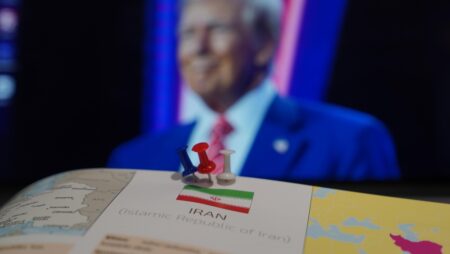
Remember, earlier this month, Donald Trump stood in front of the country and said this war would be over “very soon.” He floated timelines of four to five weeks. At one point, he even declared the war “very complete,” and claimed Iran had nothing left. No air force. No navy. No real capacity to fight.
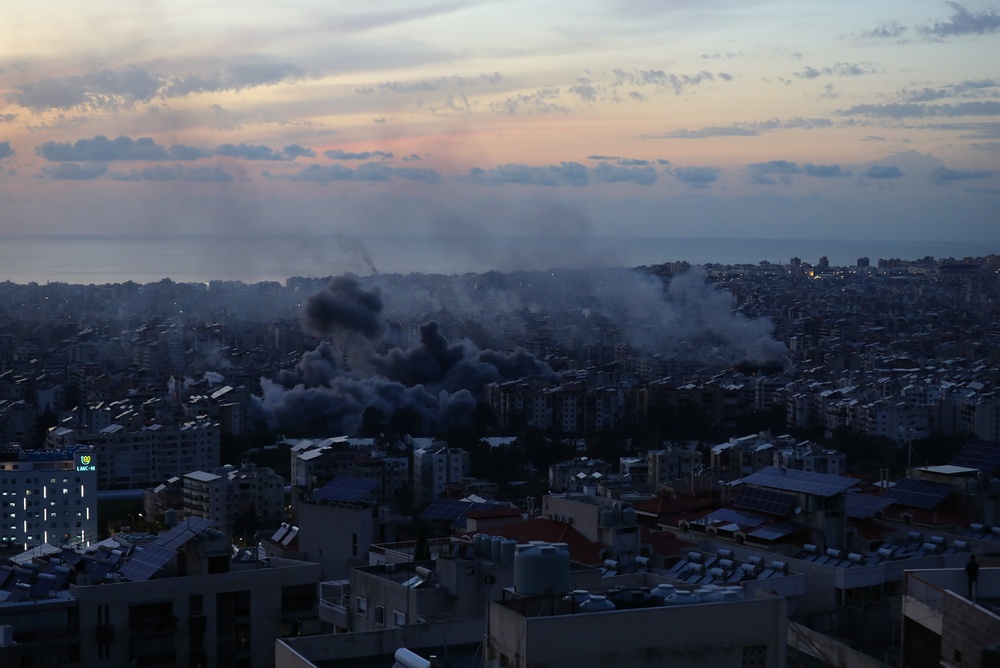
And yet here we are, weeks later, and Iran is still bombing the hell out of Israel and launching long-range ballistic missiles that are hitting cities, striking near sensitive sites, and even reaching toward U.S. and allied bases across the region. They’ve demonstrated extended-range capabilities that can travel thousands of kilometers, putting not just Israel but broader regions, and even European capitals, within reach. They’ve threatened energy infrastructure, escalated attacks across multiple fronts, and made it clear this is not some limited, contained response .
And ain’t just missiles. This war has moved into the digital bloodstream.
Iran-linked actors and aligned groups are launching cyber operations, hacking systems, targeting infrastructure, probing vulnerabilities, and expanding attacks beyond the battlefield into networks, companies, and critical systems. Researchers are tracking phishing campaigns, malware deployment, and coordinated attempts to infiltrate Israeli and regional systems, while officials warn that cyber retaliation is now fully integrated into Iran’s military strategy. Even U.S. companies and tech infrastructure have been flagged as potential targets as this conflict spills beyond geography into code.
So the shock you’re seeing right now didn’t come out of nowhere. It was manufactured. It was fed by a steady stream of overconfidence, premature victory laps, and the same old American habit of assuming that overwhelming force automatically produces surrender.
And now you can hear it in the coverage, in the questions, and the tone. Folks don’t just sound alarmed. They sound baffled that Iran still possesses the military capacity to fight back at all, as if the very idea that this country could sustain a response was never supposed to be part of the script. They say things like Iran’s weapons are “more sophisticated than previously assessed.” Its missile arsenal is “expanding.” Its resilience is something analysts are still trying to “understand.”
Reuters, for example, has run explainers asking how difficult it would be to stop Iran’s missile threat, noting that even after sustained strikes, Iran still has thousands of missiles, underground facilities, and ongoing production capacity. Other reporting points to Iran’s “growing reach” and “expanding strike range,” framing its capabilities almost like a puzzle that needs decoding rather seeing them as the predictable outcome of decades of investment in science, engineering, and military strategy.
Even expert commentary slips into this framing. Analysts keep noting, almost reluctantly, that Iran’s systems are more resilient, more layered, and more intact than previously claimed, with missile infrastructure and operational capacity still functioning despite repeated declarations by Israel and the Trump administration that it had been degraded.
So when you line up all the explainers, global headlines, expert panels, think tank briefs, and social media chatter you start to see the pattern. The language never quite says, “We underestimated them.” Instead, it says “unexpected,” “resilient,” “expanding,” “more advanced than anticipated.” That is all coded disbelief. Because if you really stop and think about it, none of this is actually surprising unless you started from the assumption that a country like Iran was never supposed to be this capable in the first place.
Let’s keep it real, too many people were working from a worldview that had already decided what Iran was. Backward. Primitive. Isolated. Technologically behind. A country to be managed, contained, and, when necessary, subdued. Not a country that could build, adapt, and fight back at this level. And now that reality is colliding with that assumption and the analysis sounds less like understanding and more like people trying to reconcile what they’re seeing with what they were told to believe.
And every time I hear all this talk, I keep thinking: what the hell did y’all think Iran was?
Let’s start with the obvious that somehow isn’t obvious. The United States has one of the most powerful militaries in the world. Yep, that’s true. But somewhere along the way, that fact got inflated into mythology. Folks truly believe that American power is so overwhelming and so absolute, that any country we hit should simply fold. Stop fighting. Stop responding. Stop existing as a threat.
So when Iran keeps launching missiles, when it continues to demonstrate military capacity after being declared “crippled,” people don’t know how to process it. Because the expectation was never grounded in reality. It was grounded in arrogance.
Iran is not some raggedy, backward outpost that just wandered into the 21st century by accident. This is a civilization with THOUSANDS of years of history. Iran has an intellectual, scientific, and cultural tradition that predates America by millennia. Meanwhile, the United States is over here getting ready to celebrate its 250th birthday.
Two and a half centuries old and still relatively new on the global stage, still figuring itself out, still acting like it’s the sole gatekeeper of intelligence, innovation, and power. Two hundred fifty years old and this young empire walks around the world with the audacity to look at a civilization that has survived empires, invasions, collapses, and reinventions and wondering how they possibly have the capacity to fight back like this?
Long before America existed, there were Iranian mathematicians, engineers, architects, and scholars building systems of knowledge on that land. And that didn’t just . . . disappear. You don’t erase centuries of intellectual infrastructure with sanctions. You don’t bomb a population into forgetting physics. You don’t isolate a country and expect it to suddenly lose the ability to produce engineers. If anything, pressure does the opposite. It forces adaptation.
For decades, Iran has been cut off, sanctioned, restricted, and targeted. And instead of collapsing into helplessness, it did what many countries do under that kind of pressure: It built inward. It invested in education. It developed domestic industries. It trained scientists and engineers. It created systems designed to survive without relying on the West.
Iran is not just producing scientists and engineers. It’s producing them at scale. This country has millions of highly educated people. A massive university system. A pipeline where science, engineering, and technical training are treated as national priorities instead of side hobbies for the privileged few.
Meanwhile, over here, we’re watching a country that loves to brag about being the smartest in the room while actively dumbing itself down.
Literacy in the United States is sitting at levels that should embarrass a superpower. We’ve got tens of millions of adults struggling with basic reading comprehension. Schools are underfunded, teachers are burnt out, and entire states are busy banning books instead of building brains. Access to higher education is getting squeezed by rising costs, shrinking aid, and policy decisions that make it harder, not easier, for people to learn. And instead of treating education like infrastructure and national security, we treat it like a luxury.
So while Iran is over there cranking out engineers, scientists, and mathematicians, we’ve got people arguing with librarians, confusing Google with research, and scrolling themselves into intellectual decay. And then we have the fucking audacity to turn around, straight-faced, and ask, How do they have this kind of capability?
And yes, this includes women. Let’s talk about that.
For years, women in Iran have made up a significant portion of university students, particularly in scientific and technical fields. In some cases, they have been the majority in classrooms studying engineering, mathematics, computer science, the physical sciences and likely building the very technical war infrastructure people in the West keep pretending doesn’t exist. Who knows, maybe Iranian women are the ones launching the weapons. Might explain why we don’t hear about them targeting schools and killing babies.
So while American coverage flattens Iran into a one-dimensional story about repression, the reality is more complicated and far more inconvenient. You have a country producing women scientists and engineers at scale, feeding into the same knowledge systems that power everything from infrastructure to defense.
That contradiction doesn’t fit neatly into the narrative, so it gets ignored. But it matters. Because when you’re asking, “How does Iran have this capability?” the answer is not mysterious. It’s human. It’s educational. It’s structural. It’s the result of decades of producing people who know how to build, calculate, design, and innovate.
So no, pundits shouldn’t be surprised. What they should be doing is interrogating the assumptions that made that surprise possible in the first place. Because this isn’t just about Iran. It’s about a broader Western habit of confusing military dominance with intellectual monopoly.
The United States has immense power. But it is not the only place on Earth where knowledge exists. It is not the only place where people understand advanced mathematics, physics, or engineering. It is not the only place capable of innovation under pressure.
And yet, the way this conversation unfolds, you would think it was. There is also a deeper strategic misunderstanding happening here. People keep asking, “If we’re so strong, why are they still fighting?” Because strength doesn’t erase resistance. It never has.
From Vietnam to Iraq to Afghanistan, the United States has repeatedly encountered the same reality that overwhelming force does not automatically produce submission. It produces adaptation. It produces asymmetry. It produces long, grinding conflicts where the goal of the other side is not to win outright, but to endure.
Iran understands that.
Iran is not trying to outgun the United States in a conventional sense. It is trying to remain standing, to retain the ability to respond, and to make any conflict costly, prolonged, and complicated. And as long as it can do that, even imperfectly, it is still in the fight.
Real talk, that’s a brilliant strategy. Because it’s rooted in something Americans keep refusing to understand: time.
This is what happens when a 250-year-old country that’s still young, loud, and convinced it invented intelligence, tries to impose its timeline onto a civilization that has been around for thousands of years. America wants quick wins, clean endings, decisive victories you can package into a press conference. Iran comes out of a civilizational tradition that understands endurance, how to absorb pressure, how to adapt, and how to outlast empires that once looked just as dominant and just as certain of themselves.
And that’s the arrogance sitting underneath all of this. It’s the assumption that power only flows one way. That knowledge only lives here. That history started when America showed up. That other countries are either behind us or beneath us, and therefore incapable of building, learning, strategizing, and surviving at a high level.
This is a stupid and dangerous narrative. Because when you don’t understand history, when you don’t respect how long people have been building knowledge, surviving invasions, and adapting under pressure, you walk right into conflicts expecting obedience and get resistance instead.
So no, Iran continuing to fight back isn’t shocking at all. What’s shocking is how many people are still surprised.
Thanks for reading. If this piece resonated with you, then please consider becoming a paid subscriber. Paid subscriptions help keep my Substack unfiltered and ad free. They also help me raise money for HBCU journalism students who need laptops, DSLR cameras, tripods, mics, lights, software, travel funds for conferences and reporting trips, and food from our pantry. You can also follow me on Facebook!
We appreciate you!