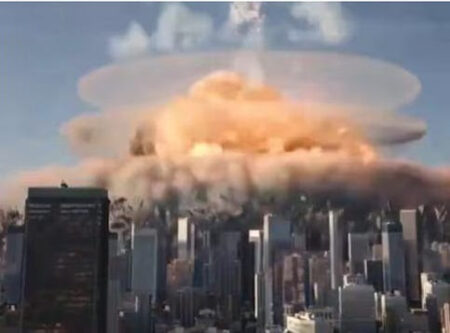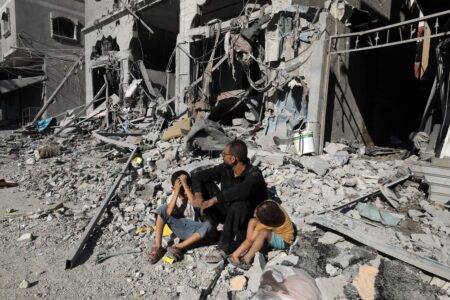






In a stunning escalation, the United States and Israel launched a massive joint operation deep inside Iran reportedly killing senior leadership, hundreds of civilians, and crippling key military infrastructure.
Washington says the objective was to neutralize Iran’s nuclear and missile capabilities even though there is no independent verification that key nuclear facilities were struck or significantly degraded, and international monitors have not confirmed the kind of damage that would justify that claim. Tehran calls it a brutal act of aggression. Iran’s response was swift and deliberate.
Missiles.
Drones.
There have been strikes not just toward Israel, but toward U.S. military installations across the Persian Gulf. Bases in Qatar, the United Arab Emirates, Bahrain, Kuwait, Jordan, and Saudi Arabia have been hit over the past few days. These are sites that host American personnel, logistics, intelligence, and air assets.
From Tehran’s perspective, those countries are not neutral observers. They are nodes in the regional security architecture that just bombed Iranian territory. And so when your defense doctrine is built around American and Israeli military power, the bases in your airspace become extensions of the force that struck. This is not rocket science, Y’all, it’s basic military logic. If you integrate your territory into someone else’s war machine, you don’t get to pretend like you’re just renting out parking space when that machine goes to war.
And so Iran is operating on a deterrence logic that has been clear for years. If you host U.S. assets, align militarily with Washington, or integrate into its strategic framework, then your ass is part of the battlefield. We can debate whether that calculus is wise. We can argue it endangers civilians. But we can’t sit here and pretend it’s inconsistent or surprising. This is how power behaves in war.
So let’s talk about how we got here.
For years, Gaza has been a world in flames while much of the Arab political class perfected the art of televised sorrow and grief.
We have witnessed their condolences, their carefully worded statements, and their diplomatic communiqués saturated with “deep concern.” While Palestinian lives were being buried under concrete and pulverized, the executives of Arab states were busy deepening their military ties with Israel, safeguarding trade reconciliations, renewing lucrative defense contracts, and reaffirming security guarantees with Washington.
Press conference at noon. Weapons deal at three. “We urge restraint” before dinner.
So let’s not dress any of this up as paralysis. All of that was alignment and choice. These Arab states protected their own interests over the mass suffering of human beings.
It was a deliberate decision to stay in Washington’s good graces, to keep the security umbrella intact, the weapons flowing, and the bases humming, even as thousands of civilians in Gaza were wiped off the damn map. These governments picked a side. And alignment in a war zone does not come with immunity.
Seven governments embedded themselves inside Washington’s military architecture. Now they are discovering what alignment actually costs. You don’t just inherit the protections of Empire. You also inherit its enemies.
That is why, when Iran retaliates not just against Israel but against U.S. bases in allied states, those governments suddenly squawk about sovereignty being violated. They denounce Iranian missiles as “blatant aggression,” even as they maintain the very alliances that placed them in the line of fire.
The real tragedy is that civilians everywhere are caught in the gears of these decisions. Ordinary people in Gulf cities are not strategists. They are victims of the same escalatory machine that flattened Gaza and is now setting the region alight. Civilian suffering is real. Civilian loss should always be mourned and opposed.
But there is a vital distinction we must hold: states make strategic choices. People do not.
Preserving American ties while watching Palestinian lives be sacrificially negotiated on international stages was a decision. It was not helplessness. It was not constraint. It was prioritization.
The moral failure was not fear. The moral failure was valuing stability over justice. And stability, as we are seeing now, is a fragile commodity in a war Washington and Israel escalated over the weekend.
If this moment produces a broader regional war, it will not be because Iran is reckless. It will be because the regional order has been built on transactional alliances with Washington’s military apparatus rather than collective security grounded in human dignity.
This does not excuse Tehran’s strikes. It explains them. It does not justify civilian harm anywhere. It condemns it. But it indicts an Arab political class whose moral rhetoric was never matched by moral risk.
History does not remember the most carefully phrased diplomatic statement. History remembers who broke the silence materially, strategically, and at cost.
Let’s keep it 100. Iran does not want to end up like Gaza.
This is not ideological noise. When a state watches another territory reduced to rubble, sees tens of thousands killed, witnesses economic ruin and long-term social trauma, it studies that outcome. It calculates. It fears precedent. That fear is real.
And the world is not stupid. People recognize patterns. They recognize historical continuity when they see it.
For decades, Israel and the United States have not simply “managed security” in the Middle East. They have structured and engineered it. They embedded alliances, installed bases, integrated air defense systems, brokered normalization deals, and systematically isolated rivals to consolidate a regional order centered on their dominance. The architecture is visible.
When the United States withdrew from the 2015 nuclear deal after 2018, the move was framed as countering Iran’s nuclear ambitions. But many analysts argue it was also about restoring strategic primacy. It reinforced an American-Israeli regional order in which Iran is permanently sidelined, contained, encircled, and weakened. The nuclear file was the headline. The balance of power was the subtext.
And the world has seen this movie before.
Settler powers consolidate. They neutralize rivals. They redraw maps. They destabilize, declare regions unfit for self-rule, then “stabilize” them under their own security umbrellas and call it progress. This is an imperial playbook refined in Europe, exported through colonial conquest, perfected through Cold War interventionism, and rebranded as counterterrorism, democracy promotion, and security cooperation.
Call it what it is: geopolitical gentrification.
It is the process by which powerful states destabilize a region, declare it dangerous or irrational, and then reshape it militarily, economically, and demographically to serve their interests. Displace the inconvenient. Criminalize resistance. Fortify the perimeter. Rebrand the project as order and democracy.
That is what much of the Global South recognizes when it watches Gaza flattened. That is what it sees when U.S. carrier groups reposition and missile shields integrate Gulf airspace. That is what it hears when “regional stability” becomes code for permanent military integration under American command.
This is an expansionist vision of regional control backed by U.S. power, rooted in hierarchies that have long determined whose sovereignty is negotiable and whose violence is legitimized. Western powers redraw borders and call it strategy. Others retaliate and it is called barbarism. That asymmetry is historical.
So when Iran looks at Gaza, it does not see an isolated tragedy. It sees precedent.
It sees what overwhelming force can do to a population. It sees how economic strangulation, military siege, and narrative control can reshape a polity. It sees what happens when devastation is normalized under the language of self-defense.
And Iran’s leadership, repressive as it may be at home, understands that if you allow yourself to be boxed into isolation while adversaries build a latticework of bases around you, you risk becoming the next “problem” to be solved.
That is why, when Iran retaliates beyond Israel’s borders by striking U.S. installations and allied states, it is not acting from chaos. It is acting from deterrence.
A brutal, dangerous deterrence logic that says: do not mistake Gaza for a template you can apply everywhere. Do not assume overwhelming force will produce silence. Do not believe encirclement will go unanswered.
This does not sanctify Tehran. It does not absolve repression. It does not justify civilian harm anywhere. But it situates this moment inside a longer arc, one in which empire consolidates, resistance escalates, and ordinary people pay the price.
And the world is watching this not as a new crisis, but as continuation.
Thanks for reading. If this piece resonated with you, then please consider becoming a paid subscriber. Paid subscriptions help keep my Substack unfiltered and ad free. They also help me raise money for HBCU journalism students who need laptops, DSLR cameras, tripods, mics, lights, software, travel funds for conferences and reporting trips, and food from our pantry. You can also follow me on Facebook!
We appreciate you!