





When federal prosecutors accused dozens of people in Minnesota’s Feeding Our Future case of orchestrating a scheme that allegedly stole more than $250 million from a federally funded child nutrition program during the pandemic, the scandal immediately became larger than the courtroom itself. For many Minnesotans, the case raised urgent questions about government oversight, nonprofit accountability and public trust. Prosecutors alleged that businesses and nonprofit operators created fake meal sites, inflated attendance numbers and submitted fraudulent reimbursement claims for children they said were never fed. But inside many Black communities across Minneapolis and St. Paul, another concern emerged alongside the outrage: what happens when public distrust generated by one scandal begins spilling over onto long-standing organizations that entire neighborhoods rely on for stability?
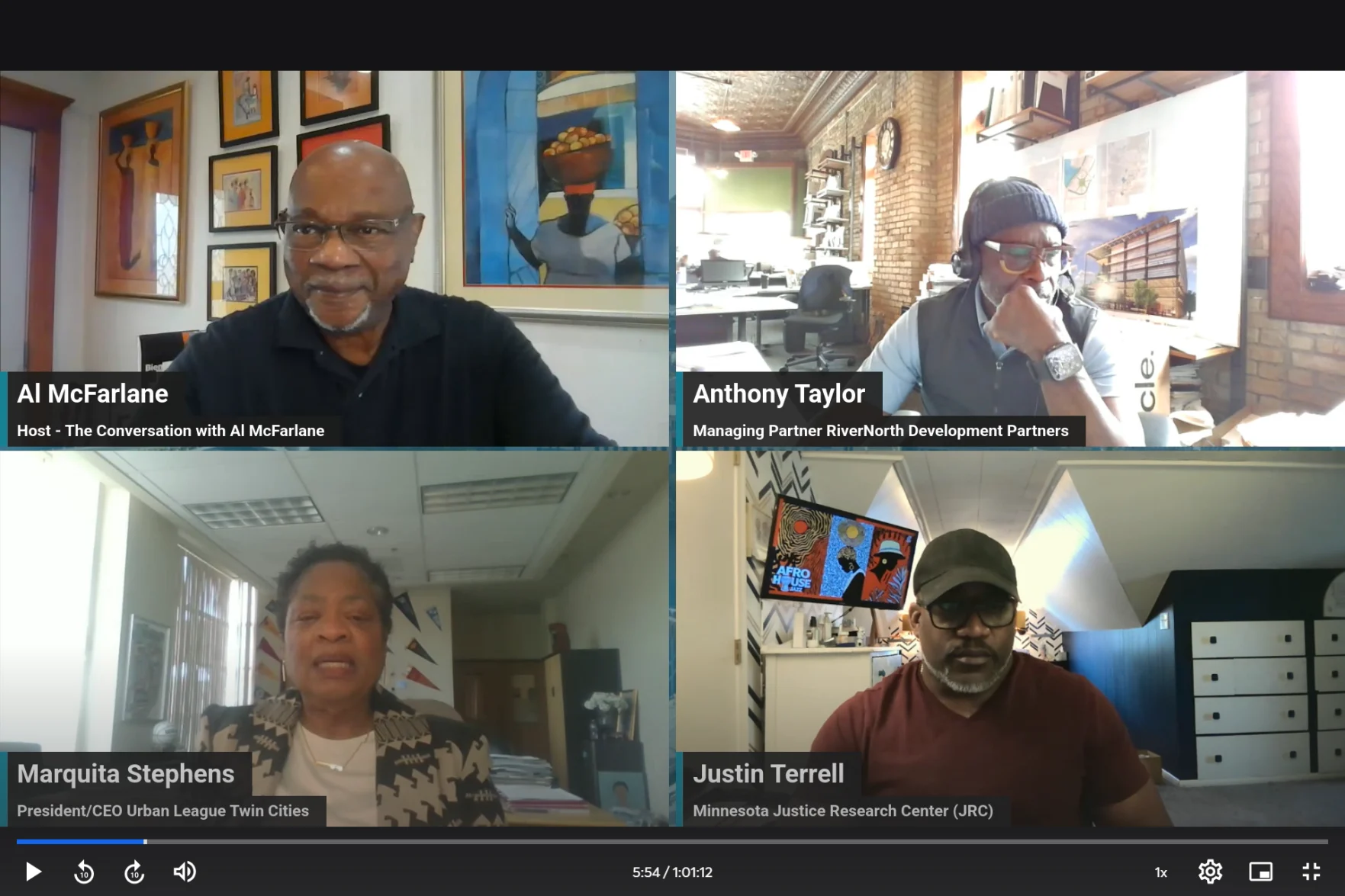
That tension became the foundation of a recent discussion on Radio KFAI 90.3FM’s The Conversation With Al McFarlane, where community leaders examined the growing pressure facing Minnesota’s legacy Black institutions. “There’s been a lot of fraud documented, adjudicated in the courts,” journalist and community leader Al McFarlane said during the conversation. “But the question is, has that air of accountability and responsibility also immobilized good thinking, right thinking, right work?” The issue resonated because Minnesota’s racial disparities remain among the nation’s most persistent despite the state’s reputation for economic prosperity and progressive politics. Black Minnesotans continue experiencing major gaps in homeownership, household income, educational outcomes and incarceration rates compared to White residents. Within that environment, many long-standing Black organizations evolved far beyond their original missions because communities themselves were navigating interconnected crises at the same time. A family facing eviction may also need employment assistance. Someone reentering society after incarceration may also need housing support, mental health resources and childcare access. Youth mentorship often overlaps with violence prevention, academic support and food insecurity.
As a result, institutions like the Urban League increasingly became centralized spaces where residents could navigate systems that often feel fragmented or inaccessible elsewhere. That role helps explain why conversations about nonprofit trust carry unusually high stakes inside historically underserved communities. “We celebrated our hundredth year anniversary last year,” said Marquita Stevens, president and CEO of the Urban League Twin Cities. “So we’re one hundred and one doing what we do.” Founded in 1925, the Urban League Twin Cities originally emerged during a period when Black residents migrating north frequently encountered barriers to housing, employment and economic opportunity. More than a century later, Stevens suggested many of those barriers still exist, though they now appear in more layered and institutional forms.
Most people know the Urban League through workforce development and housing programs, Stevens said, but the organization’s work increasingly intersects with family stabilization and child welfare support. “One of the things that we do is work with people that are at risk, families that are at risk, child protection claims, working with kids and families to make sure that doesn’t happen,” Stevens explained. “We’re looking at moving into foster care as a result of the work that we’ve done in family stability.”
That expansion reflects broader realities facing many families across Minnesota. Housing instability can increase the likelihood of child welfare intervention. Job loss can trigger housing insecurity. Incarceration or unresolved court involvement can interrupt employment and destabilize entire households. Community organizations often become first-place residents before problems escalate into larger crises.
Before joining the Urban League, Stevens led an African American adoption agency focused on helping Black children leave foster care permanently. “We were successful in moving over four hundred Black kids out of foster care and into permanency,” she said. Later, after the killing of Philando Castile intensified tensions between law enforcement and Black communities statewide, Stevens helped facilitate conversations between Roseville residents and police. That history of relationship building, Stevens suggested, is part of why legacy institutions continue holding trust even during moments of widespread public skepticism surrounding nonprofits.
“Why are our time slots full with people coming to us?” Stevens asked. “Because they do have other choices.” The answer, she said, goes beyond programming or funding. “They trust us,” Stevens said. “They can tell their story without fear of reprimand, without fear of shame, and they can leave whole.”
That issue of trust also shaped remarks from economic development advocate Anthony Taylor, who argued that conversations about nonprofit accountability cannot be separated from the underlying economic conditions many Black neighborhoods continue facing. “My very big focus is really looking at real economic measurement of success,” Taylor said. Taylor described his current work as an attempt to create long-term economic infrastructure in North Minneapolis through jobs paying roughly $55,000 annually, wages he believes create measurable shifts in family stability. “What I really see is that getting the fifty-five thousand dollars for a family increases voting,” Taylor said. “It increases educational outcomes. It increases health outcomes.” His point reflected a larger reality repeatedly referenced throughout the discussion: economic instability rarely remains isolated to finance alone. Lower income levels often correlate with reduced access to stable housing, healthcare, transportation and educational opportunities, conditions that can compound across generations.
Taylor contrasted those realities with broader citywide prosperity. “Median household income in Minneapolis is about eighty-nine thousand dollars,” he explained. “Median household income in North Minneapolis… is about thirty-nine thousand dollars a year.” He also connected today’s nonprofit debates to the longer history of Black self-sufficiency efforts in America. “The early mutual aid for Black institutions was really driven by the churches, the informal neighboring networks,” Taylor said. That historical context became important because speakers repeatedly distinguished between organizations accused of exploiting public systems and institutions that developed through decades of direct community relationships and local accountability.
The same theme surfaced when Justin Terrell of the Minnesota Justice Research Center discussed how Minnesota’s criminal legal system continues shaping economic outcomes for Black residents.
“The criminal legal system has had a disparate impact on our communities,” Terrell said. “It gets in the way, creates significant barriers to some of the economic goals that Anthony is talking about.” Terrell discussed his organization’s push to eliminate cash bail in Minnesota, arguing that the current system disproportionately harms lower-income residents unable to afford release while awaiting trial. “If you are arrested for a crime, accused of a crime, you sit in jail until they give you a bail hearing,” Terrell explained. “Those who can pay get to go home. For single mothers or fathers or whomever who can’t afford to pay, they sit there.” The consequences, he argued, extend far beyond the courtroom itself. Even a short jail stay can interrupt employment, destabilize childcare arrangements or lead to missed rent payments, pressures that often push families toward already strained community support organizations.
By the end of the conversation, the discussion had evolved beyond fraud allegations alone. Instead, it became a broader examination of what happens when public trust weakens around institutions operating in communities where many residents already feel disconnected from larger systems of support.
For Stevens, the significance of those organizations comes down to continuity and familiarity. “We’re the grandma,” she said. “And no community can do without the grandma.”