



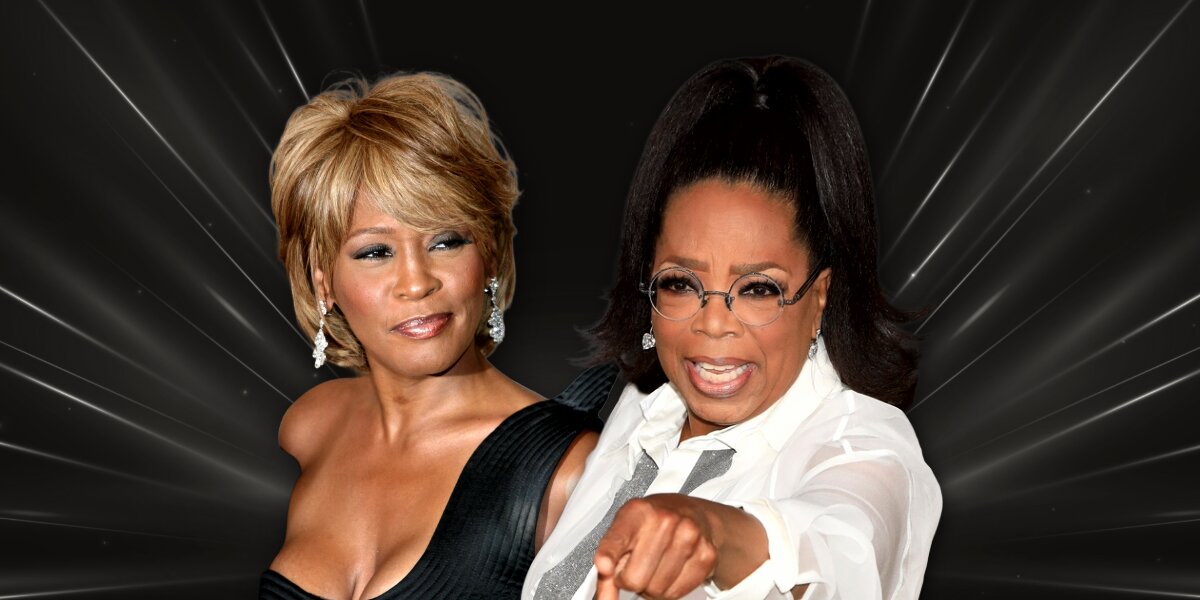
Y’all, listen to this.
Fourteen years after her tragic death, Oprah Winfrey wants credit for having once protected Whitney Houston from a humiliating moment that occurred on her show back in 2009. But in telling the story all these years later, she dragged that same embarrassing moment back into the light and did the very thing she once begged an audience not to do. She exposed Whitney all over again and then had the nerve to call it an “amazing” story about trust.
Ugggh.
So, the way Oprah tells it, Whitney came to her show. She was allegedly back on drugs and fell off the stage during the performance. Oprah knew that if the story got out, this would not be a good look. So Oprah begged the audience not to share any photos, and because her audience trusted her so deeply, they did not.

“I knew that if that story got out … she would be destroyed by that,” she said. “And so even though the audience was there and the audience had cameras, I begged them not to put those pictures out because it would ruin her life, and they did not. That would not happen today, I can tell you.”
And now, Whitney’s family has had to do what dead women cannot: defend her. Houston’s estate publicly disputed Oprah’s account, saying that yes, Whitney did fall. But it happened during soundcheck, in a dark and unfamiliar stage area, her family says she was “absolutely not high.” Pat Houston called Oprah’s version “inaccurate and unfair,” and said Whitney was sober that day. According to the estate, what the audience saw from Whitney was “discipline, talent, and commitment,” not the assumptions people keep projecting onto her. Imagine having to dig up your loved one to correct the record to remind folks that not every stumble in her life was about drugs.
But Oprah says this is an “amazing” story about trust. I don’t know about Y’all, but I heard something else.
I heard a Black woman with unimaginable media power retelling another Black woman’s humiliation as a parable about her own influence. I heard Whitney Houston’s body, pain, fear, and vulnerability turned into a shiny little anecdote about Oprah’s audience management. I heard a dead Black woman’s worst alleged moment dragged back into public view so a living billionaire could make a point about how much people used to obey her.
Yep, that’s what the hell I heard. And I sat at my desk thinking, Ma’am, this is not the flex you think it is.
Folks like Oprah keep narrating Whitney through collapse, addiction, and cautionary tales. Through the old familiar spectacle of a Black woman’s suffering being made useful to somebody else’s memory, brand, and lesson.
But Oprah could have left that story in the ground. If she truly believed she was protecting Whitney then, she could have continued protecting her now. She could have said nary a word. She could have just honored the silence she once asked an entire audience to keep. She could have remembered that discretion is not a souvenir or a trophy you pull down years later to prove how powerful you once were.
Because that is the part that feels so ugly. Oprah did not just tell a story about Whitney falling. She told a story about herself catching the story before the public could, and she made herself the moral center. Oprah the protector. Oprah the trusted one. Oprah the woman whose audience loved and respected her so much that they helped hide a secret.
And mind you, this comes during the same week the music world is busy canonizing Clive Davis, the powerful executive whose name has long been stitched into Whitney’s public mythology as mentor, architect, gatekeeper, and genius-maker. Whatever one thinks of Davis, we cannot talk honestly about Whitney without talking about the machinery around her: the men and institutions who shaped her image, profited from her brilliance, curated her sound, managed her marketability, and continued to draw meaning from her tragedy.
Whitney’s voice fed a whole empire. So did her beauty, crossover appeal, discipline, labor, obedience, charisma, and pain. That is why Oprah’s comments land so badly. They participate in a long tradition of turning Black women’s vulnerability into public property. We have seen this before. Black women are praised when they perform. Pitied when they break, blamed when they suffer, consumed when they are beautiful, and dissected when they are wounded. And then, when they die, people call it tribute while still picking through the ruins.
But folks didn’t love Whitney Houston because she was “clean.” Nobody sat in front of a television, bought an album, rewound a cassette, cried through “I Have Nothing,” or stood still when she sang the national anthem because they were conducting a fucking sobriety audit.
We loved Whitney because she was beautiful and vulnerable. Because made the air change when she opened her mouth. We loved her because her voice arrived from somewhere above language. We loved her radiance, the combination of church and pop, her breath, reach, gleam, and the impossible aliveness she gave to the world. Whitney Houston did not merely sing songs. She opened windows in people’s chests. She made us feel larger than grief, prettier than pain, more alive than whatever small rooms the world had put us in.
When I was 12 years old, I was a foster kid living in a group home for abused children near Trenton, New Jersey. I was small then in every sense of the word. Small in my body. Small in the world. Small in the way abused children learn to make themselves when adults have taught them that needing anything is dangerous.
One day, Whitney Houston who was Jersey, Newark-born, and East Orange-raised, sent a batch of concert tickets for a dozen abused foster kids to come see her perform.
Whitney Houston, Y’all.
MC Hammer was there too, with those wild pants. Other artists performed too. I remember the place was loud and electric. It was the first concert I had ever attended. I was so little I could barely see the stage. I remember stretching my neck, shifting from side to side, trying to find a clear line of sight between grown people’s shoulders. But what I remember most is not the view. It is the feeling.
We stood there stunned, buzzing, almost disbelieving. Whitney Houston knows about us? She knows we exist? This famous woman gave us tickets? A bunch of foster kids who always felt like we were just numbers in the state system? She wanted to be kind to us? With all our bruises and trauma and nightmares and grief and losses?
People who have not been thrown away as children may not understand what a thing like that does inside the body. They may think it was just concert tickets. A nice gesture or a charitable act. But for a foster kid like me, that kindness from a stranger can feel like proof of life. It can feel like somebody opened a window in a locked room. It can feel like a hand reaching through shame and saying, I see you. You are not garbage. You are not invisible. You are not what happened to you.
That night, Whitney Houston entered my body.
Not metaphorically. Not as celebrity worship. I mean she got into my blood and under my skin. She became part of the architecture of how I survived. Her voice, her beauty, her glamour, her impossible brightness . . . all of it reached places in me that adults had bruised, neglected, abandoned, and shamed.
I had grown up in a Pentecostal household where voices like Michael Jackson, Whitney Houston, and so many other Black artists were banned as “worldly” and “devil music.” So I did not come to Whitney the way other children did, through radio freedom and bedroom posters and Saturday morning videos. I came to her after prohibition. After shame. After being taught that joy itself might be sinful if it had a beat and made me dance.
And then there she was.
Whitney made Black sound feel sacred without asking permission from church people. She made beauty feel like defiance. She made breath feel like power. She took all the things I had been taught to fear, whether it was desire, rhythm, glamour, applause, Black aliveness, and made them radiant like I had never seen before. And I became an instant fan.
At that young age, I didn’t know anything about celebrity. Nor did I understand the machinery around her. But some part of me understood that this woman had reached across the gulf between fame and foster care and touched Black and Brown children nobody else was thinking about.
Whitney got me through the pain and trauma and shame of being adopted and being a child abuse survivor and foster kid. She got me through the loneliness of feeling like I belonged nowhere and to nobody. She got me through the silence children carry when adults have rewritten their stories for them. She got me through the humiliations of a wealthy boarding school moments in the 90s where white kids mocked Black music, Black style, and the sounds that had kept me alive before I even had language for survival.
By then, her voice had become a private country I could return to. A shelter and a pulse. A reminder that Blackness could be lush, disciplined, elegant, thunderous, soft, precise, and untouchable all at once. When she sang, she did not just hit notes. She gathered up every lonely child standing in the back of some room, too short to see the stage, and made us feel like we belonged somewhere higher.
So no, I didn’t give a shit about the stories people told about Whitney Houston. I did not care about the jokes. I did not care about the gossip. I did not care about the smug little morality plays people built around her addiction. I did not need Whitney to be clean in order for her to be holy to me. I did not need her to be perfect in order for her to be precious. I did not need her life to be tidy in order for her voice to be true.
While the world kept trying to reduce Whitney to her wounds, some of us had been healed by the parts of her that no tabloid could touch. Some of us had been kept alive by that voice. Some of us had stood in rooms we had no business surviving and carried Whitney with us like oxygen. Some of us knew that whatever pain she carried, she still gave us beauty. Whatever battles she fought, she still gave us breath. Whatever darkness surrounded her, she still lit something in us that has never gone out.
That is why I resent the hell out of these retellings. Because when Oprah reaches back and drags Whitney’s alleged worst day into the light, she is not just telling a story about a celebrity stumble. She is disturbing something sacred and putting her hands on the memory of a woman who meant life to people who were barely surviving.
Whitney Houston was not an addiction story to me and so many other folk. She was the first famous person who made a little Black foster girl feel seen. She was the sound of possibility. She was proof that a voice could leave “the bricks,” enter the whole world, and still find its way into a group home near Trenton where a dozen abused children stood in wonder, asking: She knows about us?
Yes, love. She knew. And because she knew, I lived a little differently.
Thanks for reading. If this piece resonated with you, then please consider becoming a paid subscriber. Paid subscriptions help keep my Substack unfiltered and ad free. They also help me raise money for HBCU journalism students who need laptops, DSLR cameras, tripods, mics, lights, software, travel funds for conferences and reporting trips, and food from our pantry. You can also follow me on Facebook!
We appreciate you!