





For Jessica Jackson, Minnesota’s legal cannabis market is not only about creating a regulated industry. It is also about how the state responds to cannabis enforcement that fell disproportionately on Black communities.
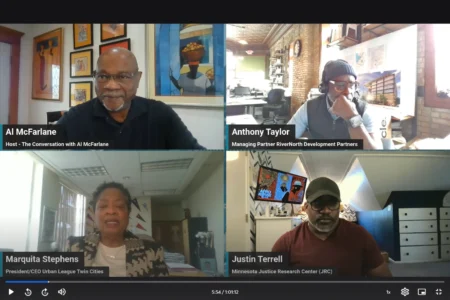
Jackson directs the Division of Community and Economic Development at the Minnesota Office of Cannabis Management (OCM). “We’re talking about injustice and systemic injustice,” she said Sept. 22 on KFAI 90.3 FM’s The Conversation with Al McFarlane, describing “the Black and brown communities that have been disproportionately criminalized for cannabis prohibition.”
“The way that the Division of Community and Economic Development looks at social equity is it is about repair.” — Jessica Jackson
She described her division’s view of social equity this way: “The way that the Division of Community and Economic Development looks at social equity is it is about repair. It is about responding to the needs of communities that have been disproportionately harmed from cannabis prohibition.”
That repair framework sits against a documented enforcement disparity. A 2020 ACLU report using 2018 arrest data found Black Minnesotans were 5.4 times more likely than white Minnesotans to be arrested for marijuana possession despite comparable usage rates.
Discussing federal drug policy of the 1930s and Harry Anslinger, Jackson said cannabis became an easy scapegoat because authorities could exploit racial hostility.
“They essentially just projected the hate around Black and brown communities into this plant,” Jackson said.
“I say, do you know that the root of that stigma is racism?” — Jessica Jackson
She said she confronts the resulting stigma directly. “I name it for what it is,” she said. “I say, do you know that the root of that stigma is racism?”
She described the issue through her own family. Of her grandmother, Jackson said: “She’s seen her son get arrested, she’s seen her community get broken apart because of the war on drugs, so it’s hard for her to trust and it’s hard for her to trust that there’s any good associated with the plant.”
“When we can start talking about the root of the stigma, then we can start addressing what the stigma is, and then we can start talking about potential benefits,” she said.
Minnesota’s cannabis policy has moved through several stages, including decriminalization of certain possession offenses in 1976, creation of the medical cannabis program in 2014 and enactment of the adult-use framework in 2023. Chapter 342 established social-equity provisions that open eligibility to people with cannabis convictions or family members with convictions, military veterans, longtime residents of heavily policed or economically strained areas, and small farmers.
Jackson said Minnesota built the system around legal proxies rather than an explicitly race-based licensing preference.
“If we wanted to make policy that targeted a certain racial demographic, what you’ve seen nationally is that that policy gets overturned very quickly,” she said.
“What Minnesota did smartly and also it has created barriers, right, is that it created a social equity program that has six big categories to participate in,” Jackson said.
On the market’s first year, she said: “We just closed out one year of adult use sales and this industry has created two hundred and fifty million dollars in revenue.” OCM’s Sept. 15 announcement put combined adult-use and medical sales over the past year at more than $250 million, about $150 million of it adult-use.
“As we look at what is the potential of reinvestment in dollars going into community, this industry creates those benefits,” Jackson said.
She also described a recent state grant round. “We’ve got over a hundred and forty applications in our last round to issue ten point nine million dollars,” she said.
Asked whether the effort will succeed this time, Jackson said the skepticism is fair. “This is a state-run grant program, which means that accessing the funds and the dollars means that you need to be able to navigate that process,” she said. A tier-one project, she said, lets groups without as much historic backing in Minnesota apply for smaller amounts with “less monitoring, but more support.”
“You need capital to begin with.” — Jessica Jackson
On the cost of entering the industry, Jackson said: “Cannabis is an industry like any other. And what do you need to run a successful, highly regulated business? You need capital to begin with.”
Jackson said she always gives prospective operators an estimate: “I always tell people it’s about two million dollars startup costs to start a cannabis business.”
She cited Section 280E of the federal tax code, which still applies to adult-use businesses, and heavy regulation as added pressures.
“The cost of running a cannabis business with no tax breaks because of 280E, the high cost of running a cannabis business because of the increased regulation, because it is a federally illegal substance,” Jackson said.
She said she created what she calls a Continuum of Readiness to help would-be owners prepare.
“If you’ve never run a business and cannabis is that first business you’re seeking to run, I’m saying you’re trying to go to college without a high school diploma,” Jackson said. “I say it’s about five years of learning before you’re fully ready.”
The state’s equity effort is also moving beyond business ownership toward employment. OCM is hosting its first Resource and Hiring Fair from 1 to 6 p.m. Thursday, Oct. 22, at the Robert J. Jones Urban Research and Outreach-Engagement Center, 2001 Plymouth Ave. N. in Minneapolis, for job seekers from social equity eligible communities.
Jackson said cannabis businesses and one municipality with 30 open cannabis-related jobs will be recruiting. She said OCM is looking to have the Cannabis Expungement Board and the state Department of Employment and Economic Development attend. The fair will also offer headshots, résumé reviews by appointment and interview preparation led by OCM’s human resources director, she said. Registration for job seekers and employers is on OCM’s website, mn.gov/ocm.
“It is about responding to the needs of communities that have been disproportionately harmed from cannabis prohibition,” Jackson said.
Editor’s note: This report focuses on U.S. and Minnesota history. It does not cover the longer global history of cannabis use in medicine, spiritual practice and industry.