






For most of my life, I only understood one way to make money. Get a job, and in exchange for working, you earn money. If you want more money, work more hours (if possible) or get a second job. And if you worked hard enough, long enough, you might get “rich.” This type of income, in which you exchange your time for pay, is called earned income.
Earned income usually requires you to do work for someone else. All the effort you put in comes back as a one-time payment (your paycheck).
As my curiosity about money and wealth-building grew, I learned there was another type of income I could earn: passive income. In this post, we will look at the pros and cons of both earned and passive income, and how to make them both work for you.

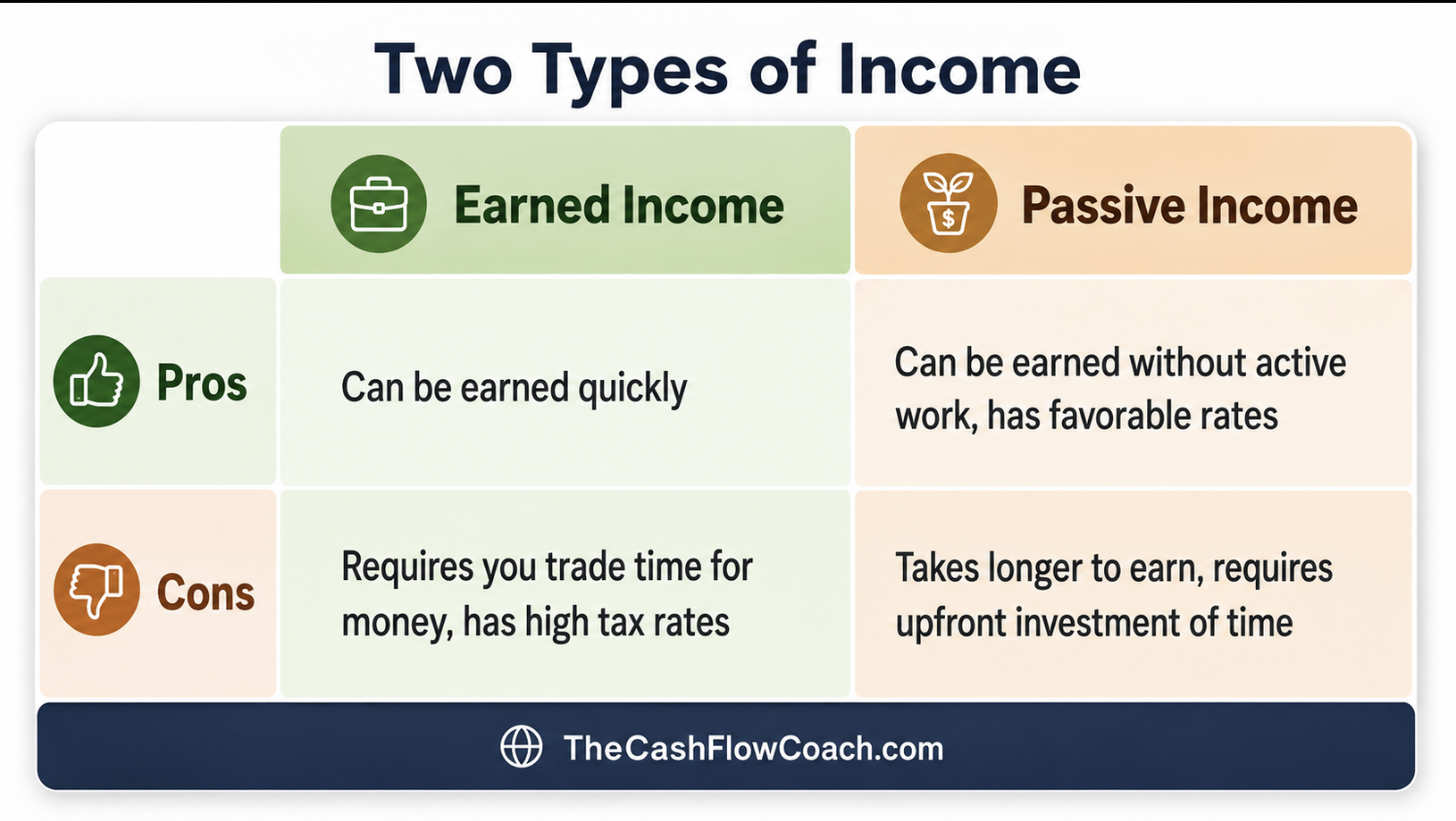
Earned Income
For most of us, this is the first type of income that we will make. We are introduced to this type of income at a very young age. We are told that if we do certain things around the house, we will be given a set amount of money. This is our introduction to earned income, and it sticks. We master trading our time for money.
Examples of earned income from childhood to adulthood:
- Babysitting
- Cutting grass
- Working as an hourly employee
- Working as a salaried employee
- Working as a consultant to corporations or clients
- Working as a gig worker or freelancer
The Pros
- The upside of earned income is that you receive payment relatively quickly. A typical job pays you weekly or biweekly for your work. And gig work like DoorDash, Spark, or Amazon delivery will pay you the same day. Earned income allows you to cover daily and weekly living expenses and begin your wealth-building journey.
The Cons
- A major downside of earned income is that you only have 24 hours in a day, which limits how much you can earn. And while you can work as many of those hours as you want, working 12 hours a day to make as much money as possible is not sustainable for very long, even if you are earning a higher-than-average wage or salary; most people burn out and sacrifice their health trying to build wealth this way.
- Unfortunately, one of the biggest problems with earned income is that when you stop working, the paycheck stops coming in. If you don’t prepare for this, it can seriously damage your finances and strip away years of financial progress and stability.
- Finally, there is the tax burden associated with earned income. No, it’s not your imagination; taxes love to eat earned income.
- Earned income is taxed at the ordinary income tax rates, which currently range from 10% to 37% at the federal level.
- Earned income is also subject to payroll taxes: Social Security and Medicare (FICA), which add roughly 7.65% and up to 15.3% if you’re self-employed, since you pay both the employee and employer shares.
Passive Income
This is the type of income you earn simply from owning assets. Here is a list of 25 ways to make passive income in 2026 if you are looking for ideas. My favorite form of passive income comes from financial investments, which include:
- Dividend-paying stock and ETFs: When a company generates profits, it can decide to reinvest those profits back into the business to grow it further, or it can pay out some of the profits in the form of dividends to investors. When you invest in a stock (or ETF) that pays dividends, you receive a dividend payment every month or every three months.
- Real estate investment trusts (REITs): Are companies or ETFs that own income-producing properties. When you invest in a REIT, you receive dividend payments either every month or every three months. This is another simple way to earn rental property income without enduring the headaches that often come with owning physical property.
- Bonds and Bond Funds: Are loans to the government, corporations and municipalities. Bonds and Bond Funds usually pay monthly distributions that can be paid directly to the investor or reinvested back into the fund to compound returns Just like stocks.
The Pros
- There is no limit to how much passive income you can earn. You can reinvest the passive income you receive and quickly start to compound your earnings. You only need to implement the reinvestment of your earnings once, and the compounding cycle will continue until you stop it.
- There are virtually no barriers to access. Unlike other passive income endeavors, equity investments don’t require large deposits; you can start with $1, you don’t need to be approved, and there is no waiting period.
- Passive income from investments held for at least a year offers the most favorable tax benefits. Taxed at 0%, 15% if you earn under $545,500/year, or 20% if you earn over $545,500/year.
- Finally, the greatest benefit of this type of income is that you earn it while you sleep. If you take the time to build a passive income portfolio that earns you $ 1,000/month in dividends, it continues to grow and pay those dividends even if you decide to stay in bed for a month. You may lose your job, but you won’t lose your dividends.
The Cons
- At the start, it requires consistent income to build passive income.
- It is not a quick process. It will take time to build the passive income that you need or want.
How to make Passive income your primary source of Income
Initially, earned income will be your primary source of income. However, it is your job to begin acquiring assets with your earned income. A portion of all your earned income and most of your unexpected income should be used to buy assets that produce passive income for you.
People who never make purchasing assets a priority eventually end up at society’s mercy. They never get off the treadmill of working to just pay bills. There is no end to their trading money for time.
By consistently investing even small amounts of money over time, you will have the option to leave an awful job or a bad relationship, or to pursue a dream.
Most people are chasing high income, but the real pursuit should be assets, no matter where you fall on the income spectrum. We all start out totally dependent on earned income, but we shouldn’t end that way. Initially, we work for money (earned income), but eventually, the money should work for us (passive income).