




On Thursday, July 16, at 1:30 p.m., Black Wall Street Minnesota will hold a press conference at the George Floyd Square Event Center with a straightforward but pointed request: that the City of Minneapolis produce a formal, independent economic accounting of what six years of occupation, construction, and policy decisions have cost the Black-owned businesses at 38th Street and Chicago Avenue.
Insight News received the organization’s press kit directly ahead of the event. It confirms the program: Angela Williams, the organization’s director, along with Pastor Curtis Farrar, PJ Hill, Reggie Ferguson, Marquise Bowie, Michael Healey, and Rev. Jerry McAfee. The stated purpose is to let business owners speak in their own words about operating in the corridor, followed by media questions.
The press kit’s opening statement argues that the businesses of 38th and Chicago are not asking for symbolism. They are asking, in the document’s words, for fairness — for the same standard of justice, it says, that the business community on Lake Street received during Operation Metro Surge.
Their argument does not rest on abstraction. It rests, in part, on a comparison the City of Minneapolis itself made available just weeks earlier.
What the city already knows how to measure
On June 10, Minneapolis Mayor Jacob Frey and city leaders released an updated impact assessment of Operation Metro Surge, the federal immigration enforcement operation that swept through the city from December 2025 through April 2026. The number they produced was precise: nearly $700 million in economic damage, broken out as $445 million in lost business revenue, $153 million in lost wages, and roughly $10 million in added costs to city operations, including police overtime.
That is a level of rigor — a named methodology, a dollar figure broken into components, a public news conference to announce it — that has never been applied to the two blocks surrounding the spot where George Floyd was murdered by a Minneapolis police officer in May 2020.
If the city can produce a $700 million accounting for one crisis, why has it never produced an equivalent figure for the businesses at 38th and Chicago?
That is the question Black Wall Street Minnesota is putting in front of the city on July 16. It is not a new question for this corridor. It is, business owners say, the question that has gone unanswered longest.
Construction, access, and the gap between the two
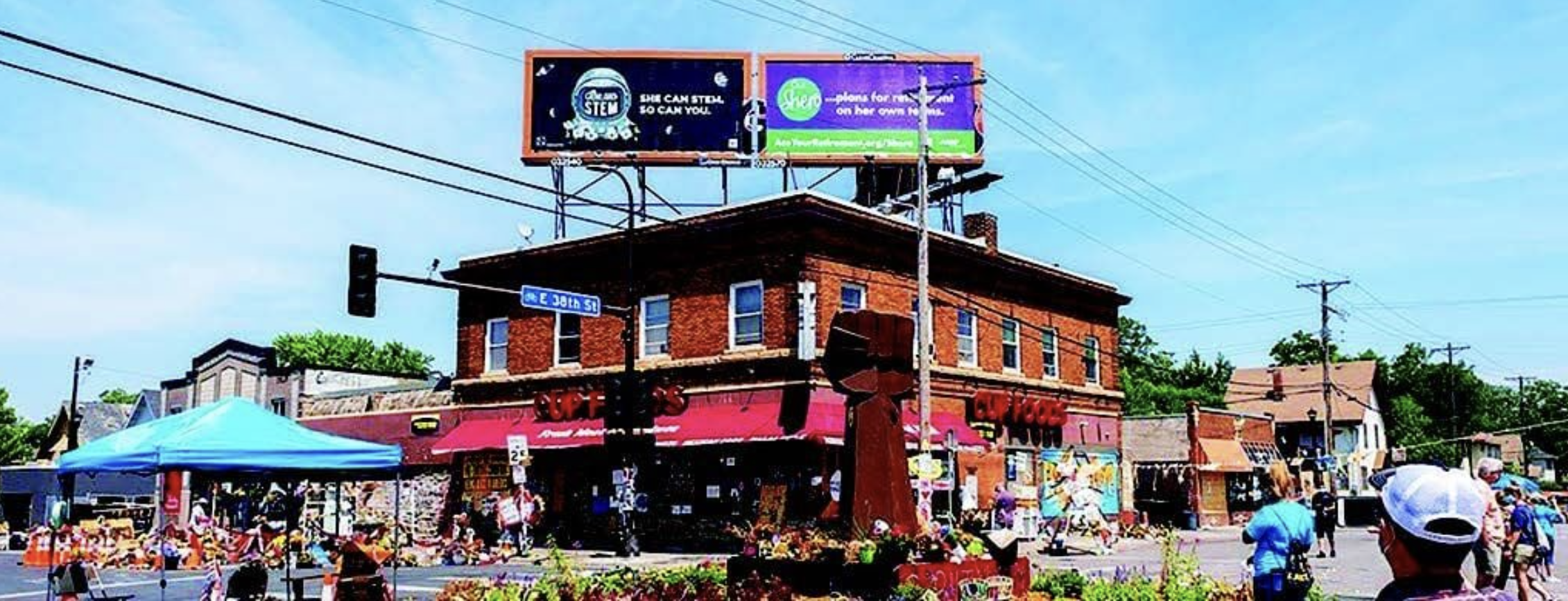
The city’s current reconstruction of 38th Street and Chicago Avenue began June 8, launching a two-year project that, per reporting in the Minnesota Spokesman-Recorder, is expected to run through the end of 2027 in its first phase. City officials describe the project as an effort to preserve the memorial while rebuilding streets, sidewalks, utilities, and public gathering space.
City officials maintain that homes and businesses remain formally accessible throughout construction. Business owners describe a different reality on the ground. Ini Augustine, owner of Mystic Healing Stones at the Square, told the Spokesman-Recorder her shop became effectively unreachable on the first day of construction, when traffic was closed in every direction.
That gap — between formal accessibility and the practical conditions commerce actually requires, including customer flow, deliveries, parking, and a sense of safety — is not new to this corridor. It has defined the last six years for the roughly two dozen businesses that operate inside George Floyd Square, several of them Black-owned, some tracing back to before Floyd’s murder.
The People’s Way: one site, two names, and a reset in June
On June 11, the Minneapolis City Council took three actions affecting the Square, and getting them straight matters for anyone trying to follow the money.
The council first voted unanimously to eliminate a special assessment — the tax the city charges nearby property owners when it reconstructs an adjacent street — that would have billed some businesses more than $40,000 apiece. The final figure eliminated was $636,446, according to the Minnesota Spokesman-Recorder; some accounts have rounded it to roughly $630,000 or $636,000. Council Member Soren Stevenson, who brought the motion, argued it was unfair to bill small Black-owned businesses for a project framed as the city’s investment in their recovery.
Second, the council voted 10-2-1 to reject Mayor Frey’s selection of the Minnesota Agape Movement for exclusive development rights over what is now called The People’s Way — the same parcel long known as the former Speedway gas station at the intersection, which the city purchased out of foreclosure in 2023. A city-commissioned 2025 survey of roughly 800 residents in four surrounding neighborhoods had shown majority support for a rival proposal, from the nonprofit Rise and Remember; Agape did not win a majority in any of the four neighborhoods surveyed. The council’s rejection effectively restarts the selection process for that site.
Third, the council directed city staff to produce an expedited progress report on implementation of the 38th Street THRIVE Strategic Development Plan — a signal, city watchers say, that the council wants investment measured across the whole corridor, not just at the memorial parcel.
Taken together, the three actions are being described by some outlets as the most significant policy reset at the Square since the city acquired the former gas station site in 2023. What none of the three actions does, notably, is produce the kind of independent economic study Black Wall Street Minnesota is now demanding.
The businesses’ own numbers, and a math question worth asking
The press kit includes profiles of three corridor businesses, each with dollar figures attached. Ralph’s VIP Barber Lounge is listed as having earned $82,300 in profit in 2019, falling to $48,000 by 2022 — a single-year gap of $34,300 that the document projects across ten years to arrive at $343,000 in claimed lost profits, on top of a separate $500,000 sought for a shooting owner Ralph Wilson suffered that resulted in the loss of a testicle. Sincere Detailing Pros, owned by Ed Reed, is listed as having grossed $343,218 in 2018 before closing; the document projects that figure across ten years to claim $3,432,180 in lost profits. Smoke In the Pit is listed as falling from peak revenue of $344,726 to $176,854 by 2022, a gap the document likewise multiplies by ten to claim $1,678,720 in lost revenue.
Insight News is reporting these as the businesses’ own stated claims, not as an audited economic finding. Each figure is built by taking a single year-over-year revenue or profit decline and multiplying it by ten, rather than by measuring what actually happened across a full decade. That is a method for calculating a damages demand in litigation — the press kit itself references a pending lawsuit — and it is a different thing from the kind of independent, methodologically documented assessment the city produced for Operation Metro Surge. The businesses and the underlying hardship they describe are real; Ed Reed, for one, has been quoted in prior Star Tribune and NPR reporting about the corridor and about a lawsuit he joined against the city. The specific dollar totals in the press kit, however, have not been independently audited, and Insight News is not presenting them as verified figures.
What the organization is asking the city to do
Beyond the press conference itself, the press kit lays out six specific requests to the City of Minneapolis and its elected officials: commission an independent economic impact assessment of the corridor since 2020; release a full public accounting of every dollar spent on George Floyd Square since 2020, across planning, consulting, redevelopment, public safety, and recovery efforts; develop a measurable Black business economic recovery plan with capital access and technical assistance; establish a standing, formal process for the city to engage directly with affected business owners; make a long-term funding commitment to Black economic development in the corridor; and create a permanent Black Business Advisory Council to weigh in on future redevelopment and procurement decisions.
Notably, the organization’s first request — an independent economic impact assessment — is exactly the kind of study the city has never produced for this corridor, even as it produced one for Operation Metro Surge within months.
The historical ledger: Plymouth Avenue and the pattern that repeats
Since Freedom’s Journal, the first Black-owned newspaper in the United States, declared its founding purpose in 1827, the Black press has existed in part to document what official records omit, minimize, or delay. Insight News’s role in covering the July 16 press conference is to place it inside a much longer continuum of Black communities insisting that public policy be judged by its consequences, not its intentions.
Minneapolis has its own version of that continuum. In July 1967, three nights of unrest broke out along Plymouth Avenue in North Minneapolis, following a police confrontation with Black teenagers at the Aquatennial Torchlight Parade. Roughly 600 National Guard troops were deployed to the neighborhood; historical accounts documented arson, looting, dozens of arrests, and $4.2 million in property damage. The University of Minnesota’s Board of Regents cited that crisis, and the one that preceded it in 1966, as the impetus for founding the Center for Urban and Regional Affairs in 1968.
The lesson from that history, as Black Wall Street Minnesota and others frame it, is consistent: after a racial crisis, institutions tend to produce studies, task forces, and advisory bodies. The harder, unresolved question is whether any of it restores Black wealth, or simply manages Black pain until public attention moves elsewhere.
What the name is asking Minneapolis to become
The phrase “Black Wall Street” invokes Greenwood, the Tulsa, Oklahoma district destroyed by a white mob in the 1921 massacre. In Minnesota, business owners and community members have invoked the name for years as an aspiration, not a memorial — a shorthand for Black business ownership, land control, capital access, and self-determination that George Floyd Square could become but has not yet become. Black Wall Street Minnesota’s July 16 event frames its campaign in those terms: turning the Square into a site of economic empowerment rather than a permanent site of crisis management.
What Insight News is committing to verify
This article opens a new Insight News investigative series examining the economic aftermath of the murder of George Floyd, the years of occupation and construction that followed, and the public dollars that have and have not reached the businesses of 38th and Chicago. The event details, speaker lineup, and organizational leadership in this installment are confirmed directly from Black Wall Street Minnesota’s own press kit, provided to Insight News ahead of publication. The specific dollar figures attached to individual business claims, by contrast, remain the businesses’ own unaudited estimates tied to pending litigation, and are reported here as claims rather than as findings. Insight News will continue verifying Black Wall Street Minnesota’s organizational filings, funding sources, and the underlying business records as this series continues, and will update or correct this record as new documentation becomes available.
Insight News is committed to documenting the economic realities of this corridor with the same rigor the city applied to Operation Metro Surge. Readers with records, data, or firsthand accounts relevant to this series are invited to contact the newsroom.