





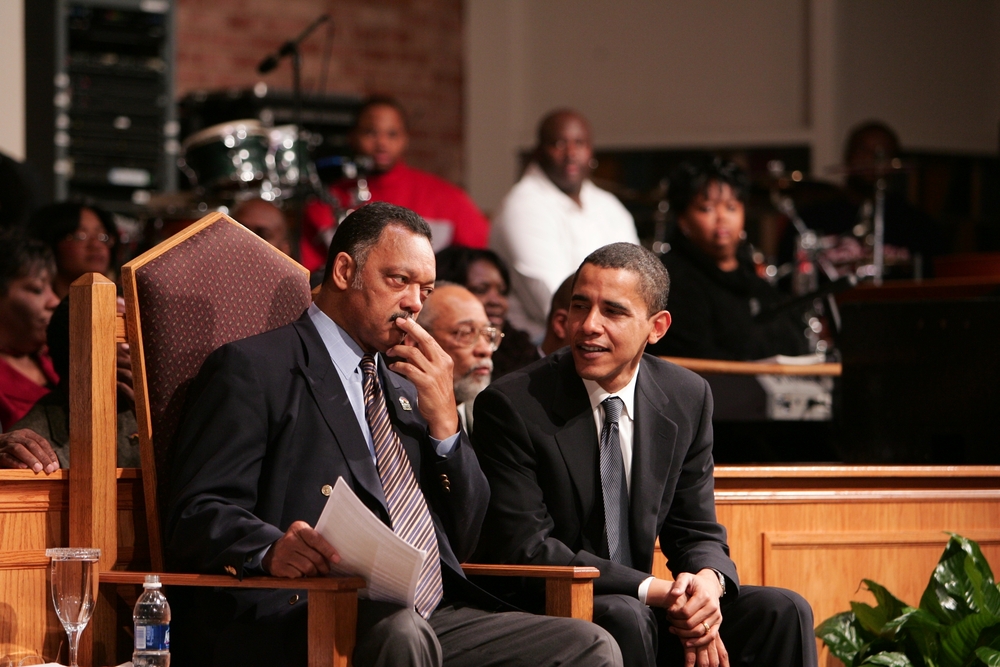
In 1984, when Reverend Jesse Jackson launched his presidential campaign, many viewed him primarily as a protest candidate who lacked the requisite political support for a serious bid for the Democratic nomination.
However, by the time of his 1988 run, he had transformed his campaign strategy from a “symbolic gesture” into a well-organized operation aimed at winning delegates.
Jackson transitioned from an “insurgent” to a “competitor” by building a National Rainbow Coalition that expanded his appeal beyond the Black community to include labor unions, farmers, Latinos, Arab Americans and progressive whites, a strategic pivot accompanied by the establishment of a robust political infrastructure. He hired experienced staff and included a mix of operatives from diverse backgrounds, enhancing his image as a mainstream candidate. He also focused on economic populism, addressing the concerns of working-class voters and advocating for policies on income inequality and union support, which resonated particularly in key states like Michigan.
His years of grassroots voter registration efforts resulted in millions of new, often marginalized, voters, creating a solid base of support that bolstered his candidacy. By shifting from a purely protest-oriented message to one grounded in policy discussions, covering issues like universal healthcare and poverty reduction, Jackson positioned himself as a vital player in Democratic Party politics. Internal changes to party rules, particularly the move from a “winner-take-all” delegate system to a proportional one, allowed him to translate his popular support into a more significant delegate count. Ultimately, these strategic adjustments led to a remarkable doubling of his vote total from 1984, with him winning 13 contests and securing about 7 million votes in 1988, solidifying his status as a key power broker within the Democratic Party.
Although Jackson didn’t win, coming in second in the 1988 primary, his campaign opened the door for many Black Democrats to run for office. It also showed that white voters, too, were willing to support a Black presidential candidate for the first time.
During an interview with The New York Times, Carol Moseley Braun reflected on the impact Jackson had on her own political journey, noting that his campaign also laid the groundwork for future candidates like her. Back in ‘88, as an Illinois state representative and a supporter of Jackson’s presidential bid, she witnessed firsthand how a Black candidate could break through barriers that previously confined Black politicians to predominantly Black districts.
The move not only changed the perception of electability for Black individuals but also paved the way for Braun herself, who, with Jackson’s backing, made history as the first Black woman elected to the U.S. Senate just four years later.
“Jesse Jackson provided a building block for campaigns and efforts like mine to be successful,” she said. “Nobody thought a Black person could get elected to anything but a Black district. Before Jesse, that was true. What he showed is that Black candidates with the right campaign can reach across racial boundaries.”
As many of us are aware, in 1972, Shirley Chisholm made history as the first Black candidate for president from a major political party, paving the way for future political aspirants. Rev. Al Sharpton’s campaign in 2004 marked another milestone. But it was not until Barack Obama clinched the presidency in 2008 that Jackson’s 1988 campaign was truly acknowledged for its impact because it was the only one to gather enough delegates to be considered a serious contender at the time.
Following his efforts, a wave of progress emerged for Black politicians in the U.S. In 1989, L. Douglas Wilder became the first Black governor of Virginia, while David Dinkins and Norman Rice were elected as the first Black mayors of New York and Seattle, respectively. That same year, Ron Brown made history by becoming the first Black individual to chair a major national party, leading the Democratic National Committee. The early ’90s saw further advancements, including Carol Moseley Braun’s election to the Senate and a notable increase in the representation of people of color in the House between 1990 and 1992.
Plus, President Obama’s path to clinching the 2008 Democratic primary could have been even more of an uphill battle if not for some crucial shifts in delegate assignment rules that were put in place by the Democratic National Committee, thanks to the advocacy of Jackson’s supporters back in the 1988 convention in Atlanta.
“Without Reverend Jackson, there never would have been Barack Obama,” Donna Brazile, who was a key organizer for the Southern states during Jackson’s 1984 campaign and later became the acting chairwoman of the D.N.C., told The Times.
During Obama’s 2008 presidential campaign, a bit of drama unfolded when Jackson was caught on a “hot mic” making some pretty harsh remarks about him. Jackson accused Obama of “talking down to black people,” which stirred up quite the controversy and put a spotlight on the complexities within the African American community regarding support for the candidate. The fallout was immediate; Jackson issued a quick apology, but not before his own son publicly condemned his father’s comments. The Obama campaign, while clearly taken aback, accepted Jackson’s apology; and swiftly moved past the incident to refocus on the campaign.
Still, Jackson’s influence extended far beyond inspiring Black candidates to enter the political arena. As noted by The Times, his 1988 campaign also played a pivotal role in shaping the careers of several prominent white figures. For instance, Paul Wellstone, a liberal college professor and the Minnesota state director during Jackson’s campaign, went on to make waves in 1990 by defeating an incumbent Republican senator. That same year, Bernie Sanders, then the mayor of Burlington, Vermont, was elected to the House, marking him as the only democratic socialist in Congress at the time.
Jackson’s legacy continued to pulse in subsequent elections, notably in 1992 when Bill Clinton ascended to the presidency with vital backing from a coalition of Black and Latino voters, many of whom were inspired by Jackson’s groundbreaking campaigns. Figures like President Obama and Bernie Sanders, who followed in Jackson’s footsteps, sought to expand their reach to a broader electorate, echoing Jackson’s belief in the power of grassroots engagement.
Gerald Austin, who managed Jackson’s 1988 campaign, aptly pointed out that, “Jackson showed that if you wanted to win, you should not just depend on statistics from previous elections that show who votes — you go out and find new supporters and get them to vote.”
This approach has seen a revival in recent campaigns, such as Zohran Mamdani’s successful bid for New York City mayor last year, which Austin described as a continuation of Jackson’s legacy.
Mamdani truly took a page out of Jackson’s playbook, showing that winning isn’t just about having the flashiest campaign; it’s all about inclusivity and reaching out to everyone. By connecting with diverse communities and actively listening to their needs, Mamdani created a genuine sense of belonging that connected deeply with voters.
He also modernized Jackson’s approach by combining it with, as The Guardian noted, a “hybrid” strategy of using TikTok and Instagram for rapid, humorous and viral content that mirrored the way the Rainbow Coalition used the media in the 1980s to shift the political conversation.
The approach not only broadened Mamdani’s support base but also fostered a collaborative spirit that made people feel like they were part of something bigger.