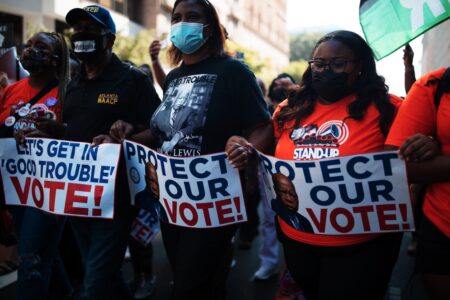





The number of Black representatives in Congress could decrease as the Supreme Court deliberates on a redistricting case involving the Voting Rights Act.
First reported by NPR, according to an analysis, at least 15 House district seats currently occupied by a Black Congressmember are under threat if the Supreme Court were to vote in favor of weakening the Voting Rights Act. A majority of these seats are in Southern cities, including Montgomery, Jackson, Baton Rouge, Atlanta, Miami, Charlotte and Columbia.
If these seats are no longer protected by the Voting Rights Act, analysts predict a record drop in the number of Black representatives. Currently, the record drop for the least representation in Congress is held by the 45th Congress, which saw a decrease in Black representation amongst four House districts.
The Supreme Court now has the ability to weaken the Voting Rights Act through a Louisiana case. Known as Louisiana v. Callais, Supreme Court oral arguments for the case were first heard on March 24 as part of what was then considered to be a racial gerrymandering case. The map that is now being contested is the map presented by the legislature that included two new majority-Black districts. A group of “non-African American” voters is attempting to argue that race-based redistricting should no longer be allowed since race-based affirmative action was ruled against by the Supreme Court.
The Supreme Court was initially set to rule on the case in Spring 2025, but decided to move their decision to the next term. A second round of oral arguments was heard in October, as the Supreme Court has not yielded to calls to expedite its decision.
A ruling is now expected during the late spring. As a result, the existing map is set to be used, as there is no time to redraw the districts. This is due to the switch to a closed party primary system, with candidates for each party expected to be chosen by February for the November 2026 primaries.
If the Voting Rights Act is eventually weakened, according to Fair Fight Action and Black Voters Matter Fund, 11% of the Congressional Hispanic Caucus and up to 200 Democratic-held state legislative seats, a majority of which are held by Black representatives, are at stake.
“We could see a very rapid, effective dismantling of Black representation at the congressional level and possibly at the state legislative level in a couple of states,” said Fair Fight Action CEO Lauren Groh-Wargo per NPR. “I think other states may hold off and wait to do their gerrymandering.”
Section 2 of the Voting Rights Act has been key to protecting redistricting. Passed in 1965, Section 2 of the Voting Rights Act prohibits voter discrimination based on “race or color” through qualification processes or other prerequisites. Through Section 2, majority-minority districts were created, allowing for a fair chance at election for Black, Latino, Native and Asian American politicians.
Since its passage, the act has been significantly amended. In 2021, the Supreme Court ruled to “constrain” the reach for Section 2 when it comes to who has access to voting, leading to restrictions in how the law is interpreted, according to Vanderbilt Law School.
If the Supreme Court votes to further restrict the scope of protections under the Voting Rights Act, Section 2 could be eliminated entirely.
“If adopted, Section 2 cases would still exist on paper but would be nearly impossible to win,” said George Washington University law professor Spencer Overton, per Reuters. “Courts could dismiss claims before trial, giving state legislatures free rein to entrench their power and sideline voters of color.”