




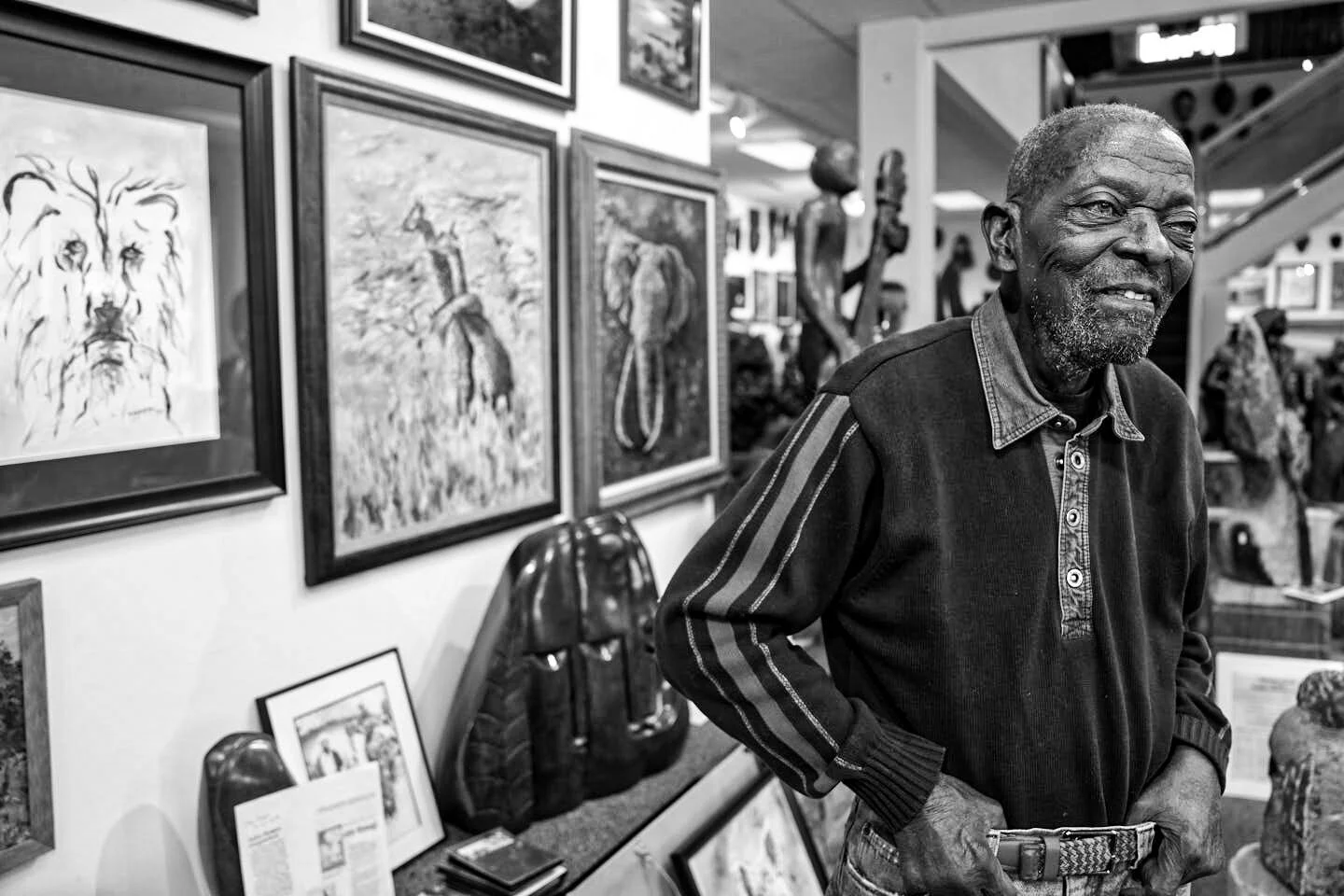
“Mhiripiri Gallery, is being listed for sale (the building and the inventory) but until it sells, it is open for business by appointment (952-285-9684) so that the public can continue purchasing art.”
Rex Mhiripiri’s life was marked by hardship, intellect, struggle, reinvention, faith, and extraordinary perseverance. Born in 1935 in colonial Rhodesia, now Zimbabwe, he grew up in rural poverty in a close-knit village community where life was simple, communal, and demanding. He herded cattle, walked barefoot for much of his childhood, learned to make do with very little, and watched both the ingenuity and tensions within his family shape his early life. His mother pushed education and cleanliness; his father, though largely self-taught, was skilled with his hands and deeply grounded in the Bible. Mhiripiri loved school and quickly distinguished himself as bright, curious, and academically gifted.
That love of learning opened doors. He advanced from missionary schooling to boarding school and then to Goromonzi, one of the most respected schools of its time. There he was introduced to a world far different from the one in which he had been raised: uniforms, electricity, toothbrushes, knives and forks, English literature, and the codes of British colonial education. He excelled academically, but he also developed a rebellious streak that would follow him into adulthood. Mhiripiri was sharp, ambitious, proud, and often resistant to authority. After school, his path took many turns. He taught in rural schools, trained in teacher’s college, worked for tobacco and mining-related companies, and later held jobs in hotels, electricity, shipping, oil sales, and broadcasting across southern and eastern Africa. His intelligence, polished English, and adaptability made him employable and often brought him into influential circles, but his growing appetite for alcohol and his impulsive nature repeatedly disrupted his progress.
By the late 1950s and early 1960s, Mhiripiri had become something of a cosmopolitan exile, living and working in places like Zambia, Tanzania, Uganda, Ghana, and Kenya during a period of enormous political change across Africa. He moved among emerging leaders, high-ranking officials, business executives, and diplomats, at times rubbing shoulders with heads of state and other prominent figures. He enjoyed privilege, travel, and social access, and he became increasingly confident in worldly settings. But beneath the appearance of success, his life was becoming more unstable. Alcohol, womanizing, and self-indulgence deepened their hold on him. Though he retained an underlying fear of God and a sense that his life had meaning, he often lived in contradiction to the values he had inherited.

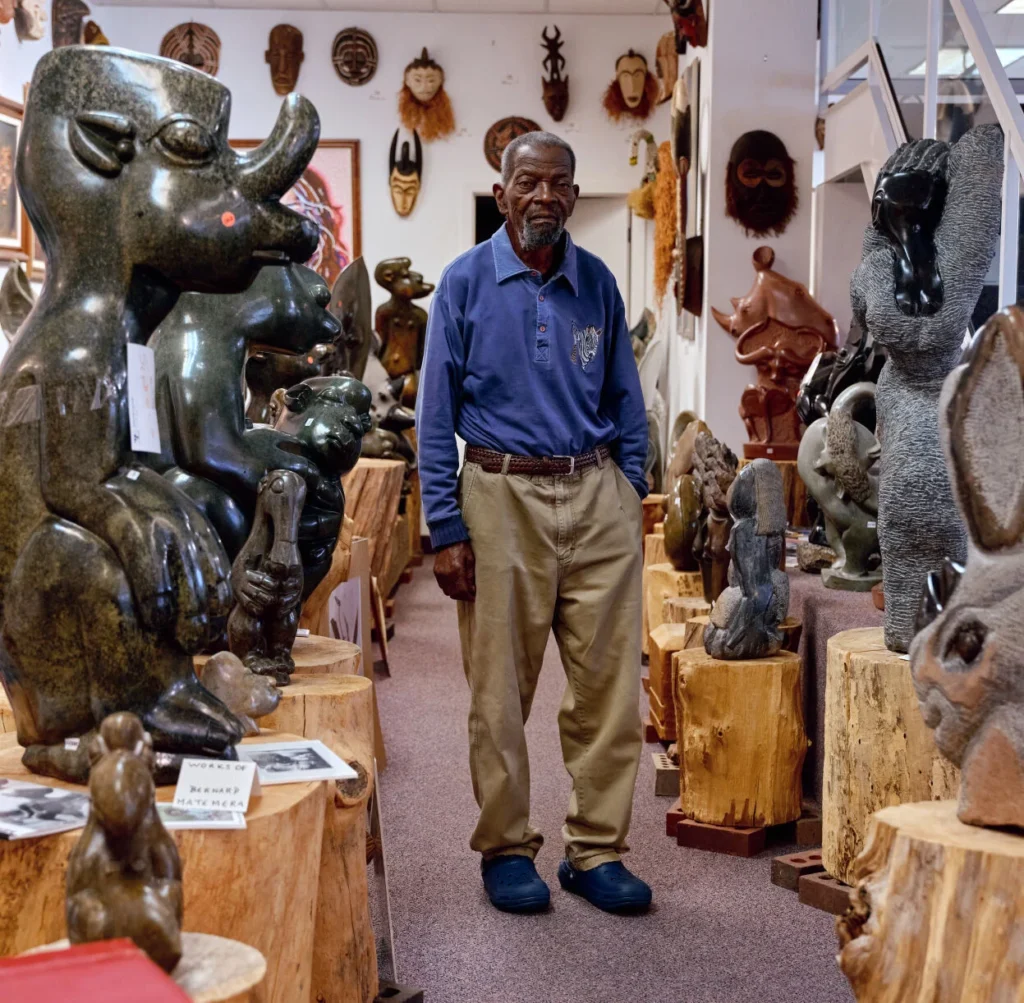
In 1966, Mhiripiri emigrated to the United States on scholarship and eventually attended the University of Minnesota during a turbulent time in American history. He was older than many of his classmates, worldly, charismatic, angry, and still struggling with alcohol. It was in Minnesota that he met Julie, who would become his wife and life partner. Their relationship began in the midst of the upheaval of student life, racial tension, war protests, and personal uncertainty. After college and graduate study, the couple set out for Africa with their young daughter, hoping to build a life there. They spent time in Rome, Ethiopia, and Kenya, where Mhiripiri taught, painted, and tried to provide for his growing family. Yet his alcoholism worsened, and eventually his wife Julie fled Kenya with their children for safety, with the help of others and without his knowledge. That loss shattered him.
What followed was the lowest point of his life. Homeless, drinking heavily, and estranged from his family, he drifted through Nairobi, painting when he could, surviving however he could, and descending further into despair. He later made his way to Montreal, where he arrived broken and addicted, and entered Welcome Hall Mission, a gospel rescue mission for people struggling with homelessness and alcoholism. There, in one of the most significant turning points of his life, he began to sober up, rebuild himself, and encounter the life-changing grace of Jesus Christ in a deeper way. He painted, sold his work, sent money home, and slowly regained stability. Over time, he was able to reunite with Julie and his children in the United States.
Back in Minnesota, Mhiripiri committed himself to a different life. Though he still wrestled with anger, pride, and the weight of his past, he increasingly saw his story through the lens of God’s mercy and protection. He gave up alcohol and smoking, embraced Christian faith more fully, and poured himself into supporting his family through art. What began as selling paintings in malls, on sidewalks, in churches, hospitals, and public spaces gradually turned into a thriving business. He founded and grew Mhiripiri Art Gallery, eventually operating from several locations and finally building his own gallery at 90th and Penn in Bloomington. Along the way, he became known not only as an artist and entrepreneur, but also as a man who had remade his life through discipline, vision, and faith.
Mhiripiri’s later life was defined by family, work, and redemption. He and Julie raised nine children and delighted in their grandchildren. He took pride in having built a close family, in having helped his children pursue education and meaningful lives, and in having achieved a level of stability and ownership he once thought impossible for a Black man from rural Rhodesia. He also reconnected with Zimbabwe, supported relatives, invested in the education and well-being of extended family, and helped bring Zimbabwean stone sculpture to a wider audience through his gallery. Looking back, Mhiripiri saw his life not simply as a story of survival or success, but as evidence of the hand of God: protecting him, humbling him, rescuing him, and teaching him that people can change. His was a life of many chapters, but the final word, in his own understanding, was grace.
Obituary
Rex Mhiripiri, beloved husband, father, grandfather, artist, businessman, and man of deep Christian faith, passed away on March 9, 2026. After 90 years of a full life, Mhiripiri is leaving a remarkable legacy of perseverance, redemption, creativity, generosity, and love. Born Stanlake Mhiripiri in 1935, in what was then Rhodesia, he was shaped by humble beginnings, a sharp mind, and an early love of learning. From walking long distances to school and excelling academically, to attending Goromonzi, one of the most respected boarding schools of his time, Rex carried throughout his life both a fierce intelligence and a determination to rise beyond circumstance.
In 1966, Mhiripiri emigrated to the United States, bringing with him a rich life story that had already spanned southern and eastern Africa, where he had worked as a teacher, salesman, analyst, and broadcaster. His path had been marked by adventure, hardship, giftedness, and struggle, but also by the steady hand of God. A fierce and kind believer, Rex loved the Lord and devoted himself to serving Him, often reflecting on how grace had changed him and how no life is beyond redemption.
Mhiripiri built a beautiful life with his wife, Julie, and together they raised a large and loving family. He was the proud father of nine children: Dave, John, Rhoda (Frank), Mudzingwa (Ebony), Rugare (Mark), Maruva (Steve), Regina, Titus (Angela), and Maria (Jason). He was also the cherished grandfather of ten grandchildren: Nick, Jonah, Isaiah, Ava, Laura, Kaleb, Sterling, Nyla, Maddie, and Reese, each of whom brought him tremendous joy and pride. Though he was known as a strong and disciplined patriarch, he was also deeply devoted to his family and committed to helping them build lives of purpose, education, faith, and service.
For more than 25 years, Rex made his home in Bloomington, Minnesota, and later lived in Lakeville for 20 years before moving back to Bloomington. He became widely known through his art and entrepreneurial spirit, most notably as the owner of Mhiripiri Art Gallery which he operated for over 40 years, first at Butler Square in downtown Minneapolis, and then at 90th and Penn in Bloomington since 2005. Through his gallery, he shared beauty, culture, and vision with the wider community, while also creating opportunities to support artists and loved ones in Minnesota and in Zimbabwe. His work stood as a testament to his creativity, resilience, and refusal to let adversity define him.
Mhiripiri will be remembered as a man of testimony: a man who lived many chapters, who knew hardship and success, and who ultimately gave glory to God for the life he had been given. He treasured time, prayed earnestly for the protection of his children and grandchildren, and believed that a person could change through faith. His life was not simple. It was full. His legacy will live on through his beloved Julie, his children, his grandchildren, his art, and the many people who were touched by his story.
A Celebration of Life will be held on Saturday, March 28 at Grace Church in Eden Prairie (9301 Eden Prairie Road). The 10:00am visitation will be followed by a one-hour service at 11:00. Following the service, all are invited to the Mhiripiri Art Gallery (9001 Penn Ave S, Bloomington) for an Open House in Rex’s honor from 1:00 – 5:00, with catering provided by the gallery’s neighbor, Gyropolis.
The service will be livestreamed: Grace.live/memorial. In lieu of flowers, donations may be made in Rex’s honor to support extended family in Zimbabwe, including education tuition, medical expenses, clean water wells, and subsistence farming. Rex would be honored to know that on March 28, 2026, his family and friends continued his spirit of generosity.