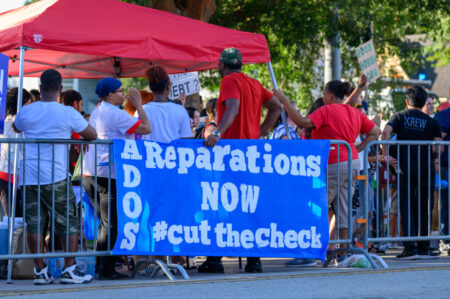







The Illinois African Descent-Citizens Reparations Commission released a new report last week, tracing the lasting effects of historical harms among Black Illinoisans.
Titled “Taking Account: A History of Racial Harm & Injustice Against Black Illinoisans,” the report was generated in partnership with the University of Illinois Chicago’s Institute for Research on Race and Public Policy. Approximately nine categories were studied.
These categories include the effects of enslavement, racial terror, political disenfranchisement, stolen economic labor, policing and the legal system. Housing, education, family and health were also studied.
Throughout their findings, the group highlighted the state’s reliance on the labor of enslaved people for the early economy, the lack of voting rights and gerrymandering. The report also emphasized the disparities in income for Black Illinoisans when compared to white Illinoisans. Black residents make approximately $40,000 less annually and are three times more likely to be impoverished.
Black Chicagoans are also more likely to be tied down to predatory lending models when it comes to purchasing homes. From 1950 to 1970, they were victims of loans that left them with little to no protections, high interest rates, inflated purchase prices and large down payments. Amongst housing projects, they were most likely to live in homes that were neglected and underfunded. As a result, Black residents are more likely to be unhoused. They are also more likely to receive low-quality healthcare while also dealing with higher rates of cancer, adult asthma, overdose deaths, maternal and infant mortality as well as premature deaths.
“The idea that racial inequity simply dissolved after the end of formal segregation is a myth,”
said the project leader and associate professor of Black Studies and Gender & Women’s Studies at the University of Illinois Chicago, Dr. Terrion L. Williamson, per a press release. “Redlining, chronic school underfunding, discriminatory lending, and over-policing were not isolated injustices. They were policy decisions that structured opportunity along racial lines and continue to shape the experiences of Black residents in Illinois today.”
Illinois has been the setting of several significant events in Black history. These events have had not only a local effect on Black Illinoisans, but on Black Americans across the nation.
After he was forced out of Missouri, abolitionist Elijah Lovejoy moved to Illinois, where he established a new printing press and advocated for the end of enslavement. After an armed pro-enslavement mob set fire to Lovejoy’s warehouse and killed him by gunfire, his death and work in Illinois helped galvanize the North to fight more ardently against enslavement while also establishing a stronger base for freedom of speech pertaining to the press.
In 1908, after two Black men were accused of separate sexual assault and murder crimes, a mob of white citizens looted and damaged Black-owned businesses and destroyed homes as they attacked Black neighborhoods. Considered one of the largest riots in U.S. history, the violence lasted for days and resulted in the deaths of two prominent members of the community, William Donegan and Scott Burton.
Decades later, Illinois became the site of the Chicago Freedom Movement. Organized by Rev. Dr. Martin Luther King Jr and the Southern Christian Leadership Conference, the civil rights movement included demonstrations against segregation in education, housing and employment. Alongside nonviolent protests, initiatives such as Operation Breadbasket, launched by the late Rev. Jesse Jackson, addressed companies’ racist hiring practices.
The latest reparations report examines the effects all these events continue to have on Illinois’ Black community.
“Black Illinoisans have endured generations of devastating injustice,” said State Rep. Sonya Harper per a statement. “While the law may no longer explicitly sanction discrimination, systemic inequities remain deeply embedded in our institutions. From jobs and education to housing, health care, public safety and economic opportunity, the disparities persist because the root causes were never fully addressed.”