



It’s standard issue to see a host city’s or state’s “finest” immaculately dressed in uniforms providing security at today’s major sporting events. The lion’s share carry out their duties withlittle fanfare, cloaked in relative anonymity, but a select few, for predicates unfamiliar, seem“gung ho” to enter the limelight.
A SIGN OF TURBULENT TIMES
In sports, there have been displays of excessive force exerted upon athletes in game settings. Occasionally, those actions have resulted in detainment and arrest.
On December 23, 1970, Virginia Squires guard Charlie Scott, a high-scoring American Basketball Association (ABA) rookie averaging 27 points per game, found himself in the midst of an all-out skirmish on the road against the host Indiana Pacers. Like any competitor, he intuitively defended his teammates. As fists were flying, hostile, inebriated Indianapolis spectators entered the fray, and police joined in, ostensibly as peacemakers. One overzealous “fan” made a beeline toward the visiting team’s head coach, grabbing him aggressively. Scott reacted, peeled him off his coach, and slammed the “fan” unceremoniously onto the court. The altercation concluded, and order was ultimately salvaged, or so it seemed.

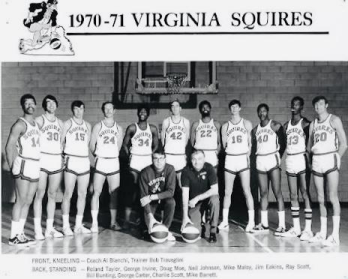
Despite sporadic flare-ups, players league-wide were (generally) fairly tight and amicable off the court in the ABA. Veteran Indiana Pacers guard Freddie Lewis, out of concern, warned his young rival.
LEWIS: “Charlie, you’d better get out of here [quickly] at the end of the game.” SCOTT (chuckling): “No, it was a fight; it happens.”
Hindsight is indeed 20-20. Scott (now a Basketball Hall of Famer), reminiscing years later, stated that “Indiana [among players] was known as the home of the KKK, and it turned out the guy [who attacked] our Virginia coach was an off-duty policeman [Officer Richard Craig]. He felt insulted that he was ‘thrown down by one of those [Black] basketball players’. In addition, his father was a lawyer, so at the end of the game, the police came to the locker room and locked the players from Virginia up.” [1]
The melee, according to local papers, reportedly involved “[fifteen] uniformed policemen, and about a half dozen spectators who jumped out of the stands.” [1] In typical law enforcement fashion, 10 cops and nine squad cars were used to haul off two Squires players (Scott and Jim Eakins) and their head coach, Al Bianchi. They were later released on a $100 bond, posted by the opposition’s management (the Indiana Pacers), after being fingerprinted and having their mugshots taken. All three were charged with assault and battery, along with resisting arrest. The Squires’ management stated that the police had entered the fracas “on behalf of the hometown Pacers”. Initially, the police had attempted to arrest the “suspects”—immediately—on the basketball court, in the middle of the game!
To add insult to injury, the police apprehended the wrong player. One of their targets was Virginia guard Mike Barrett. Barrett had entered the brawl, but soon found himself in a “stranglehold” courtesy of a local cop. For his unnecessary roughness, a few of the Squires administered a beatdown on behalf of Barrett. When the dust settled, law enforcement handcuffed and booked 6’11“ Jim Eakins (dubbed “Jumbo”), who was nine inches taller and 50 lbs heavier than his point guard.
Although slapped with felonies, three months later, Municipal Court Judge Valan S. Boring reduced the charges (against Scott, Eakins, and Coach Al Bianchi) to misdemeanors along with a small fine.
In January 1972, during a competitive and heated NCAA hoops contest between the number 2-ranked Marquette University Warriors, predominantly African American, and the all-white South Carolina Gamecocks (ranked number 4, very talented but with a well-deserved reputation for being very dirty underneath the glass), a fight broke out with one minute remaining, nearly precipitating a riot on national television. Players threw lethal blows, chairs were brandished as shields and weapons and blood was spilled. Some folks from the student section also ventured onto the floor. At the height of the battle, the South Carolina band, which had rhapsodically performed “Dixie” during the pregame, began playing the national anthem to bring calm and lower the collective temperature. It didn’t work. If any of the melanated (or socially conscious) Warriors were familiar with the latter hymn’s third verse, they would’ve fought even harder.

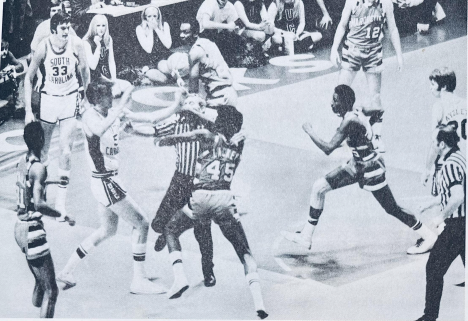
Damn the musical selections: the “Boys In Blue” had other ideas. One charged directly for 6’11” Marquette All-American center Jim Chones, and another (a state trooper) went after 6’5” Marquette forward Bob Lackey. Both players were tall, Black and proficient in hand-to-hand combat. Each cop —allegedly—quickly reached for their guns after unholstering them. Tensions eventually simmered down. Marquette escaped with a one-point win and their collective lives, hastily exiting town in the aftermath.
Chones recalled, “I actually got [South Carolina big man] Danny Traylor pretty good. Popped him on the chin, actually. Soon after, a security guard from the arena peeled me off of him. The guard then opened his jacket and pulled a gun on me, and then I knew the fight was over. But we whipped the crap out of them.” He said, “[Throughout the contest] the fans kept calling us racial names because we were [predominantly] Black, and they had only white players. [2]
Breaking up a slugfest is one thing. The act of drawing one’s service weapon as if by neurological impulse, against the tall, visiting, Black opponent (when everyone else is also throwing haymakers), is another. Now that’s no way to treat company: so much for Southern Hospitality!
Chones stated, “[Those were] the times, you know?” [2]
ANGER MANAGEMENT ISSUES
At the November 2025 football contest between the visiting South Carolina University Gamecocks and the then-undefeated Texas A&M University Aggies, a brief incident eventually transcended what transpired on the gridiron.
Some individuals are easily provoked. They sit, stewing, rewinding, and rehashing scenarios over and over in their minds. When it sparks them, their emotions, never analyzed or checked, can fluently boil over. Toss in a badge, service weapon, cuffs and inherent biases, and quagmires are inescapable. Yet in this instance, there was no brawl, no riot. In addition, there were no gestures or lexical provocations by the Gamecock players. There were no bonnets, durags, pajamas or sagging slacks. No Spirit flights, no grape soda, no can of Murrays in sight, no line-stepping, no loud music, no excessive rejoicing. None of the above was apparent to the naked eyes of millions, but such abstractions and impetus may have coalesced–perhaps–in the psyche of a Texas DPS trooper.
Maybe it was Nyck Harbor’s academic prowess (which parallels his athletic skill), the 4.3 speed, or perhaps a cheerleader or attractive (in the officer’s mind) nearby spectator leered a minute too long at the bronzed 6’5”, 230-pound specimen gliding by with ease. But wait, there was seemingly no apparent upheaval; just another score by the opposition. Perchance—anticipating excessive endzone choreography—he felt the need to seize dominion: that overbearing attitude is something that goes beyond the pale. Anyone with a modicum of common sense saw his actions as abhorrent.
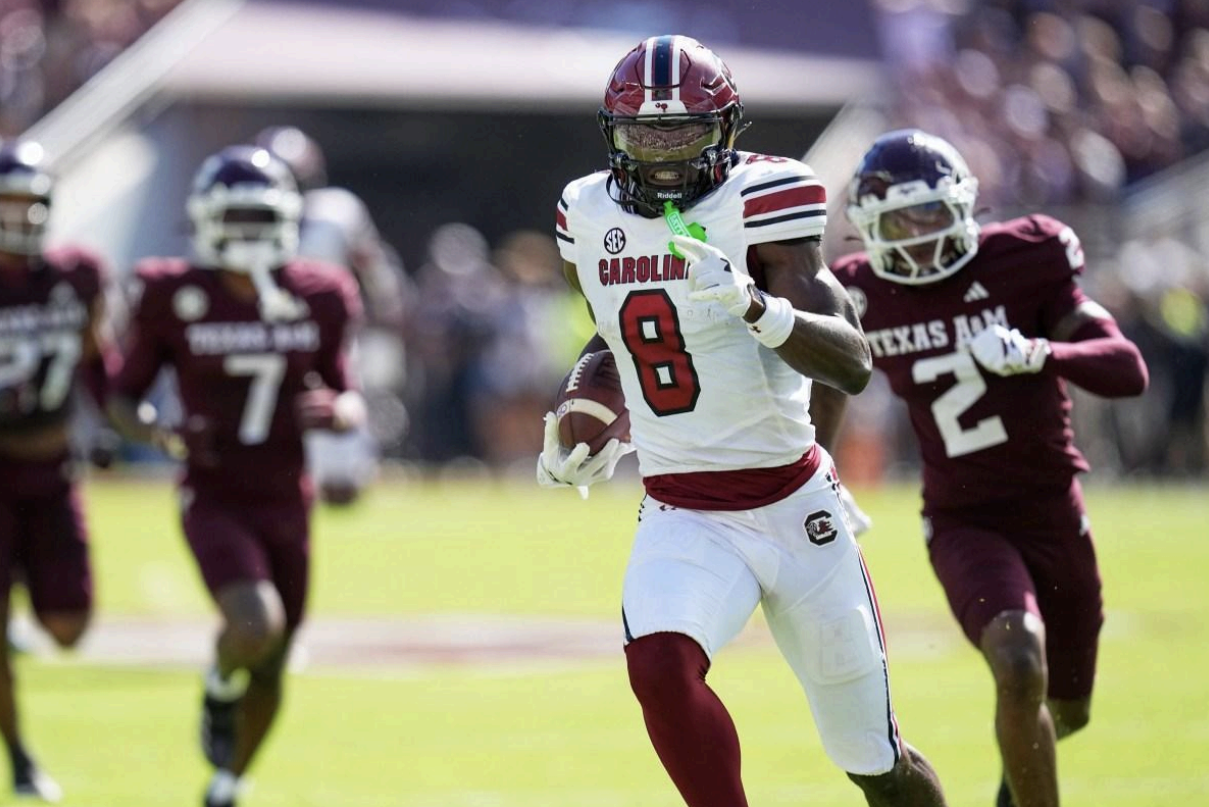
South Carolina jumped out to an early lead, and a sizzling sprint to the end zone by wideout Nyck Harbor widened the gap even further: South Carolina 26, Texas A&M 3, before the extra point.
What followed was something out of a Hollywood movie.

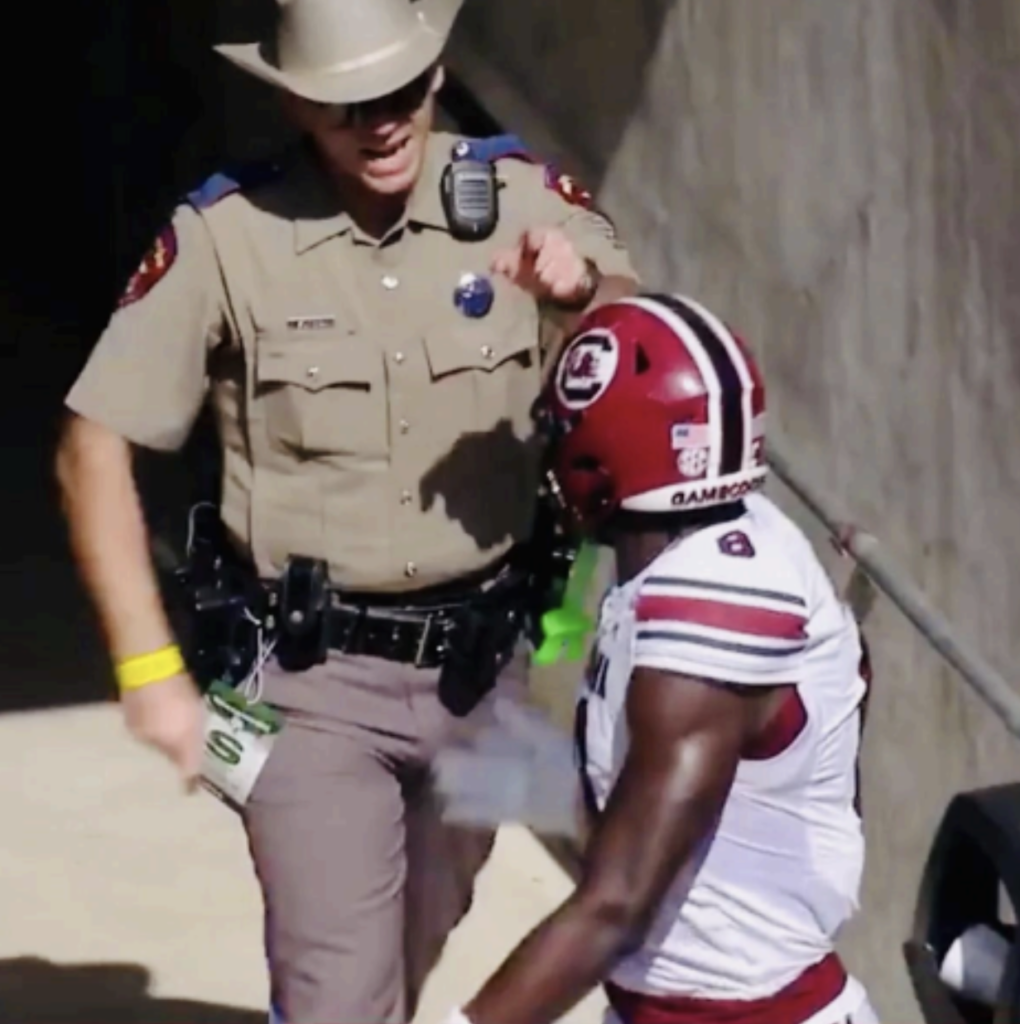
“Late in the second quarter of the fiercely contested match at Kyle Field, South Carolina wide receiver Nyck Harbor sprinted 80 yards for a touchdown that shifted momentum in favor of the Gamecocks. Clutching his hamstring in apparent pain, Harbor headed towards the tunnel, closely followed by running back Oscar Adaway III to offer support.” [3]
As the duo turned to rejoin their teammates on the field, the unnamed Texas Department of Public Safety trooper approached from the opposite direction. In a move witnesses described as deliberate, the officer extended his arms, bumping into Adaway as he forced his way between the two players. He then pivoted sharply, pointing accusatorily at them and appearing to berate the young athletes for obstructing his path.” [3]
Regardless of what triggered the officer, it is evident that he was considerably out of line. The trooper was abruptly removed from his duties; nevertheless, he received more than adequate cover. To date, his name remains undisclosed. Furthermore, Brazos County Attorney (TX) Earl Gray stated that he would not criminally charge the trooper after (South Carolina running back) Oscar Adaway III filed a formal complaint. Gray’s reasoning: their office wanted “to protect and not embarrass the trooper.” While seemingly at a stalemate, Adaway’s attorney, Keith Jackson, is determined to press forward to achieve justice for his client. Jackson is earnestly seeking the officer’s identity so he can file civil charges. Brazos County’s hasty opinion and terse statement did not amuse him. Of note, after the incident, Adaway missed the final two games of the Gamecocks’ regular season while consulting with the team psychiatrist.
This situation is far from finished.
“INNER~VISIONS” vs. REALITY
There’s no greater feeling than awakening to the actual discovery of oneself. The unveiling of a soul’s mission. The sense of ascertaining one’s purpose or lifeblood, and realizing that the gifts needed to obtain ingress to that narrow path may have been procurable all along.
By the same token, privileged persons who may never have been piloted or corrected in life and who are in a heightened state of well-being are prone to adopt paternalism as an integral part of their character. It’s either “my way or the highway,” and “my way” is sovereign. Anyone encountering these individuals is in for a less-than-pleasant interaction.
When a Texas state trooper literally charged from his assigned post to engage the visiting South Carolina wideout, one could only imagine what was simmering in the bedrock of his cerebrum. Was he a supporter of the Aggies? Did the latest Gamecock score ruin his parlay? Could he not resist a moment in the spotlight, or did he feel compelled to thwart the touchdown celebration, which in reality was never intended to take place, as a means to “keep these young ‘boys’” in line?
In addition, for those omnipresent skeptics, the player in question, Mr. Harbor, is a stand-up human being and a student-athlete (dual sport).
Etan Thomas wrote: “Before they try to ‘no angel’ Harbor, it’s important to note that he won the 2023 Franklin D. Watkins Memorial Award, a prize which honors African-American high schoolers who excel in athletics, academics, and charity work. Aside from his football career, Harbor has won national titles in track, volunteered at a soup kitchen, and worked with Generosity Global, which campaigns to improve women’s health in Africa. Harbor is majoring in public health and has been on the SEC Academic Honor Roll two years in succession.” [4]
Immediately, as a result of his conduct, the law enforcement officer was removed from the game. What’s similar to many in law enforcement (or a “frozen” facsimile thereof) who overstep
their bounds, his identity remains shrouded to date. A large swath of officers abide by the rules. Still, as with any entity (law firm, medical facility, corporation, etc.), there will always be an employee more than willing to show their entire ass.
Based on this nation’s current trajectory, with resentment over N.I.L. and professional salaries, without magisterial intervention and overhaul, the day will inevitably arrive when an athlete vs. officer confrontation goes awry in the worst possible manner. Who knows? Maybe maskedagents are already scouring baseball, soccer and basketball rosters in search of their next victims, cherry-picked by dialect, skin tone, surname or the audacity to contest their unsanctioned deputization. Or imagine them attempting to apprehend the so-called sons ofb%*&#es–I mean NFL players—at the behest of their near-octogenarian overlord. Good luck with that.
It’s not too far-fetched.
It’s just a sign of the times, you know?!?
REFERENCES
1. Hawkins, Eric. “At The Buzzer, You’re Under Arrest.” (excerpt from)
Knubia/Knarrative.com. October 2, 2021
2. 24/7 Sports. “OT: Carolina vs. Marquette Basketball Fight Back In The Day.” The Big Spur (247sports.com). January 10, 2024
3. David, Rohit. “Tensions Rise As Texas State Trooper Was Caught Harassing South Carolina Player During College Football.” International Business Times. November 16, 2025.
4. Thomas, Etan. “A Trooper’s Shove Showed Stardom Doesn’t Protect Black Athletes From Police.” The Guardian. November 18, 2025