





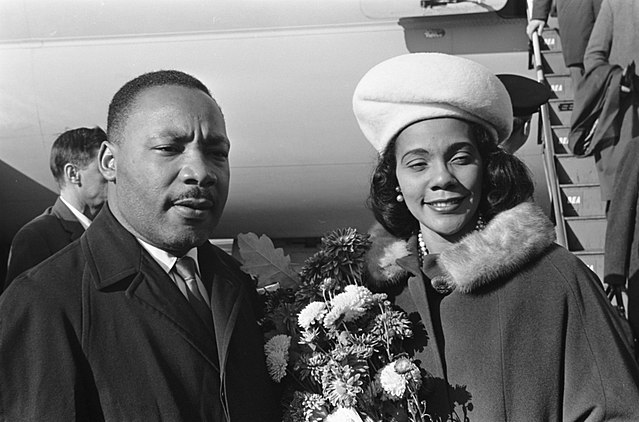
On Jan. 30, 2006, Coretta Scott King, an author, activist and civil rights leader who carried forward the work of her husband, the Rev. Martin Luther King Jr., died at age 78.
King, born Coretta Scott on April 27, 1927, in Heiberger, Alabama, became a central figure in the American civil rights movement, first alongside her husband and later as a leader in her own right. She was also a singer who incorporated music into her public work.
She was the third of four children of Obadiah Scott and Bernice McMurry Scott. Her father ran businesses, including a general store and a lumber mill, that was burned after he refused to sell it to a white logger. Her mother, known locally for her musical ability, drove a school bus and served as a church pianist.
King graduated as valedictorian of Lincoln Normal School in 1945. She attended Antioch College in Yellow Springs, Ohio, where she studied music and joined the campus chapter of the NAACP, along with Race Relations and Civil Liberties Committees. She later transferred to the New England Conservatory of Music in Boston on scholarship to study voice and piano.
In Boston, she met Martin Luther King Jr. while in graduate school. They married on June 18, 1953, on the lawn of her mother’s home in Alabama, in a ceremony performed by his father, Martin Luther King Sr. King had the vow to obey removed from the ceremony. After completing her degree, she moved with her husband to Montgomery, Alabama, in 1954, when he became pastor of Dexter Avenue Baptist Church.

As the civil rights movement grew in the 1950s and 1960s, King became a visible advocate for African American equality. She also faced threats during the Montgomery bus boycott era. In January 1956, the King home was bombed while she and their infant daughter were inside. No one was hurt. She continued public work that included concerts blending music and civil rights messaging.
King maintained relationships with prominent political figures, including John F. Kennedy, Lyndon B. Johnson and Robert F. Kennedy. Her 1960 telephone conversation with Kennedy during the presidential campaign has been credited by historians with mobilizing African American voters.
After Martin Luther King Jr. was assassinated in 1968, she took on a larger leadership role, including in the women’s movement. She founded the King Center in Atlanta and led years-long efforts to make her husband’s birthday a national holiday. President Ronald Reagan signed legislation establishing Martin Luther King Jr. Day on Nov. 2, 1983.

In later years, she broadened her advocacy to include LGBTQ rights and opposition to apartheid.
In August 2005, King suffered a stroke that left her paralyzed on her right side and unable to speak. Five months later, she died of respiratory failure due to complications from ovarian cancer.
Her funeral drew about 10,000 mourners, including Presidents George W. Bush, Bill Clinton, George H.W. Bush and Jimmy Carter. She was temporarily buried at the King Center before being interred next to her husband. She was inducted into the Alabama Women’s Hall of Fame and the National Women’s Hall of Fame, and she was the first African American to lie in state at the Georgia State Capitol. She has been referred to as the “First Lady of the Civil Rights Movement.”