




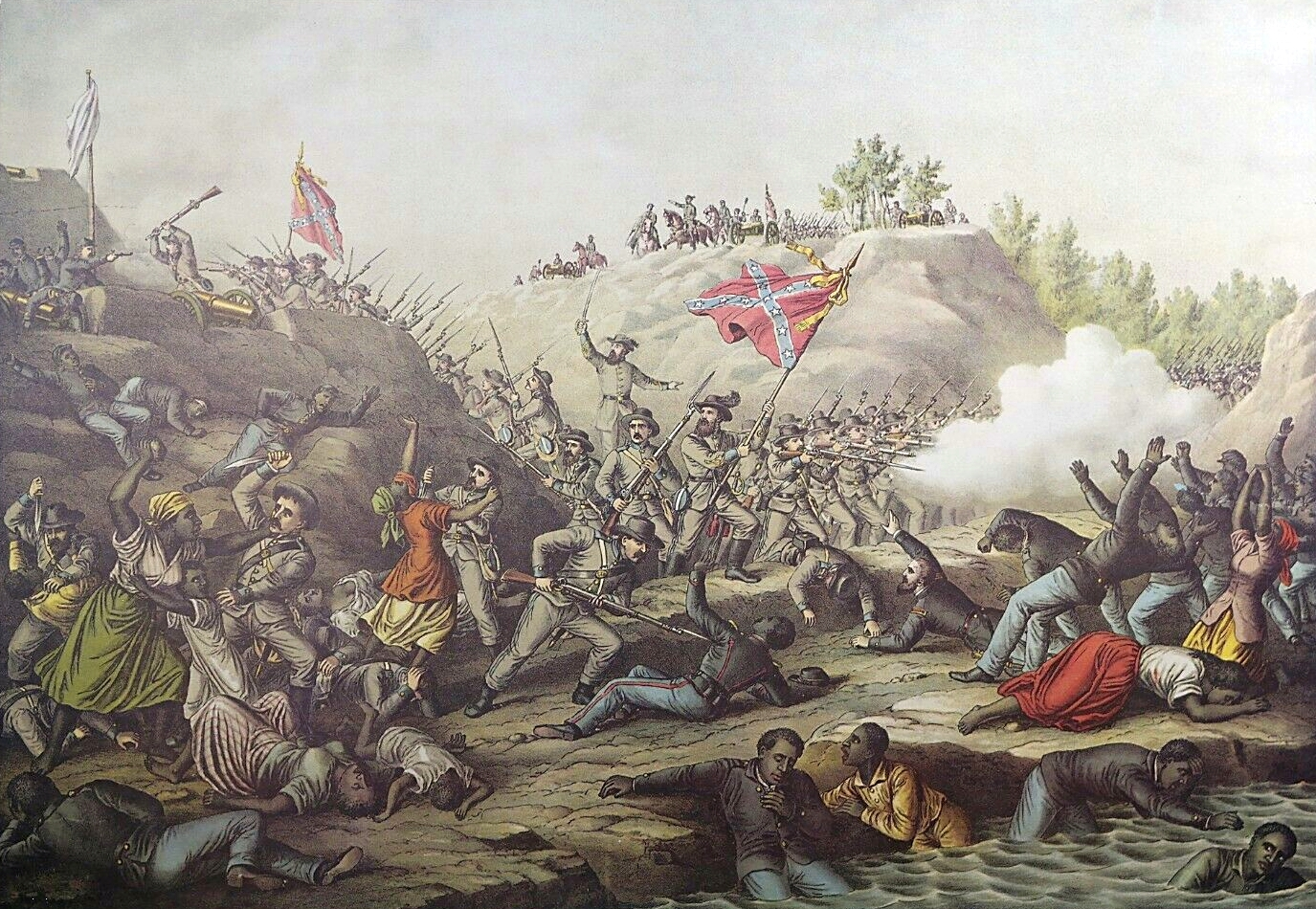
On April 12, 1864, Confederate troops commanded by Nathan Bedford Forrest stormed Fort Pillow, a Union outpost on the Mississippi River north of Memphis. By nightfall, hundreds of Union soldiers were dead, many of them killed after the fighting had ended.
The fort’s garrison consisted of roughly 600 men, divided almost evenly between white soldiers and Black troops from the 6th U.S. Colored Heavy Artillery and the 2nd Colored Light Artillery. Many of the Black soldiers had formerly been enslaved. They knew that capture carried particular danger. The Confederacy had already declared that Black Union troops would not be treated as legitimate prisoners of war.
Forrest arrived at the fort early that morning with an estimated 1,500 to 2,500 Confederate troops. His men quickly occupied the higher ground overlooking the fort and subjected the defenders to heavy fire. Maj. Lionel Booth, the Union commander, was killed, leaving Maj. William Bradford in charge.
By midafternoon, Forrest sent a demand for surrender. He promised that the garrison would be treated as prisoners of war if it gave up the fort. But he also warned that if his troops were forced to storm the position, he would not be responsible for what followed, but Bradford refused.
The Confederate assault began shortly afterward. Within minutes, the Union line collapsed. Soldiers fled down the bluff toward the Mississippi River, where they hoped to reach a Union gunboat.


Instead, according to survivors and later congressional investigators, many of the men were shot as they ran, after they had thrown down their weapons or while they were attempting to surrender. Black troops appear to have been singled out. Survivors reported hearing Confederate soldiers shout, “No quarter,” as they fired into groups of men who were no longer resisting.
The scale of the killing was even more shocking by the standards of the Civil War. Of the roughly 600 Union soldiers at Fort Pillow, between 277 and 297 were killed. Black troops suffered the heaviest losses. Only a small fraction survived to become prisoners, while white soldiers, by contrast, were far more likely to be taken captive.
Within days, newspaper accounts in the North described the attack as a massacre. A congressional investigation reached the same conclusion, finding that Confederate troops had continued killing after the fort had fallen.