




Y’all, they will not let that man rest.
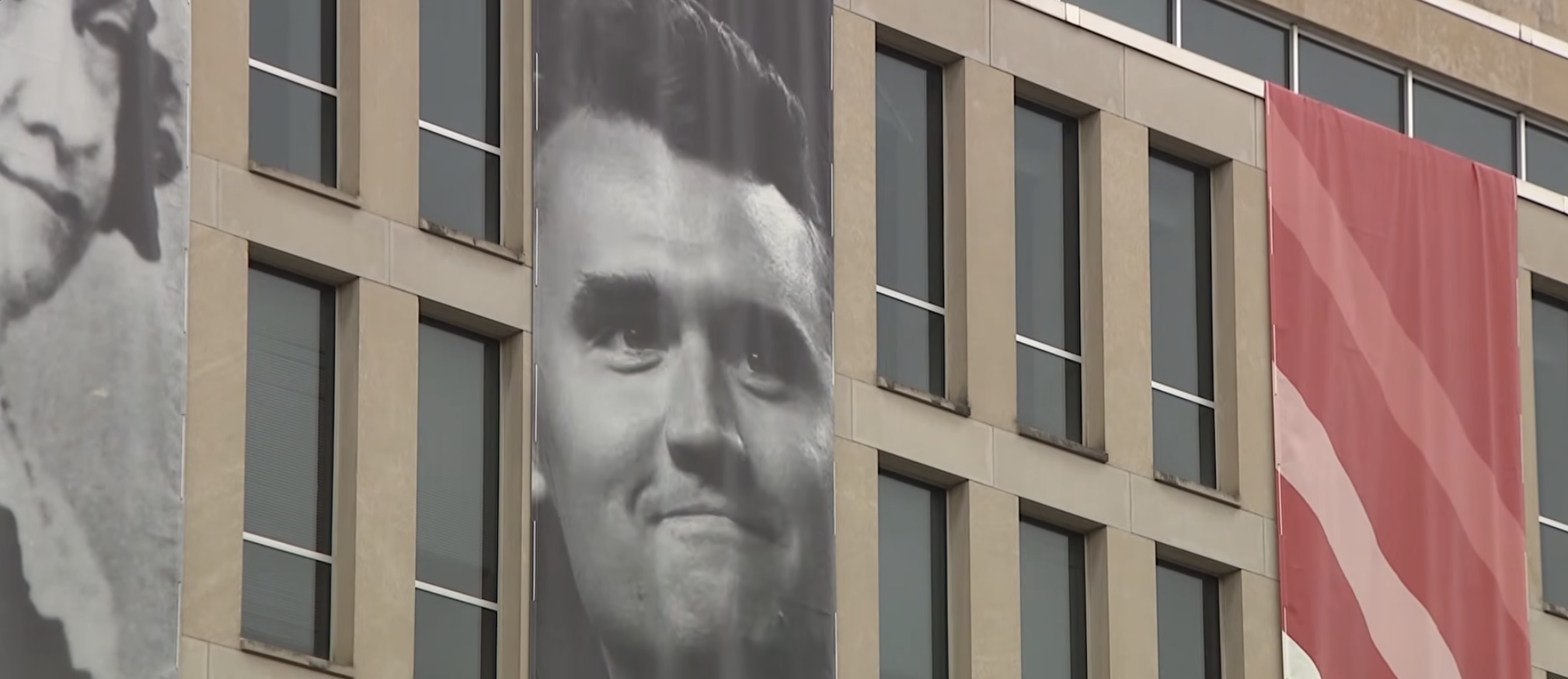
Charlie Kirk ain’t been dead in the ground for six months yet, and already those people at the Department of Education are working overtime to staple his smug face to the American founding like he ghostwrote The Common School Journal for Horace Mann.
Look at him.
Up there alongside nineteenth-century reformer Catherine Beecher and Tuskegee Institute founder Booker T. Washington. These people love trying to bully history into compliance.
And note the timing. Just days before this new banner went up, the Department of Education posted a sepia-toned classroom photo with the slogan: “Make Education Great Again.”


The post features a room full of white children with their hands over hearts and the America flag centered. There’s no mention of segregation or of who wasn’t in those classrooms. There’s no mention of the students locked out of the so-called “greatness.” The slogan echoes MAGA branding and is doing ideological framing. It signals nostalgia, rollback, and a very specific version of “great” that predates desegregation, student loan expansion, disability rights, multicultural curriculum, and federal oversight.
And now, this week, we get Charlie Kirk on a banner.
Three faces. One frame. No hierarchy. No context. Just visual equivalence. Apparently, for Charlie Kirk, the “P” in R.I.P. now stands for Pillar. Or perhaps, Rest In Propaganda.
Because what else do you call it when a sexist, racist white man whose entire public career was built on attacking higher education, demonizing professors, waging war on diversity programs, and turning campuses into culture-war battlegrounds, gets hoisted into the visual company of people like Beecher and Washington?
You call that shit revisionist theater and legacy inflation. That’s what you call it. You say, this is what happens when white grievance politics tries to cosplay as nation-building.
This is what it looks like when demolition crews demand to be remembered as architects. This is what it looks like when outrage merchants want their names etched beside people who actually built some important shit under pressure, under threat, and under history’s weight. This is a movement full of insecure people are so desperate to sanctify its culture warrior that it drapes him in the visual language of brick, mortar, and moral authority.
FOH!
What you’re seeing is not national remembrance or legit memorialization. Nah. This is what you call narrative laundering. And if you really want to understand why that banner feels so absurd and pathetic, you have to sit with the juxtapositions.
Let’s start with Catherine Beecher.
Beecher believed schools were the backbone of this country. She pushed to train teachers when half the nation was still arguing about who even deserved to learn. Her whole project was build more. Build more schools. Train more teachers. Make education a civic responsibility instead of a luxury.
Charlie Kirk built a whole brand telling students the university was corrupt. Beecher wanted more classrooms. Kirk treated classrooms like enemy territory. Beecher worked to professionalize teachers. Kirk made a career out of telling students not to trust them.
And let’s not romanticize Beecher. She was a racist who was anti-slavery but supported the idea that freed Black people should be sent to Africa rather than integrated into American society. She wasn’t fighting for racial equality. So in that sense, she and Kirk had something in common.
But the one line you cannot blur is that Beecher expanded educational infrastructure and all Kirk did was build resentment. That ain’t the same tier of legacy, no matter how high you hang the banner.
Now, talk about his juxtaposition against Booker T. Washington.
Washington built Tuskegee in the wreckage of slavery. Brick by brick, lumber and sweat. He built it in a country where teaching Black folk to read had once been a crime and where Black ambition could get you lynched. He understood education wasn’t abstract. It was protection, leverage, and a way for Black folks to survive in a nation that wanted to destroy you every which way.
And yes, he was debated. W. E. B. Du Bois challenged him hard. Du Bois argued that Washington was too accommodating to white power and that by emphasizing industrial education and economic self-help, he was conceding too much politically. Du Bois wanted agitation, full civil rights, a “Talented Tenth” pushing for leadership and intellectual advancement.
But understand this clearly, they were arguing over strategy. They were not arguing over whether Black education should exist. And they were not arguing over whether institutions like Tuskegee mattered. They were debating how to secure power in a violently racist country, not whether to tear down the schoolhouse. Washington was trying to plant roots in hostile soil. Du Bois demanded the full orchard. That was the fight.
Now, look at Charlie Kirk.
He built a movement attacking diversity programs inside universities. These programs were meant, however imperfectly, to widen access to the very institutions Washington fought to secure. Kirk framed modern campuses as corrupt and cast suspicion on the academic project itself.
Washington carved out space for Black survival inside white supremacy. Kirk rallied against the frameworks attempting to broaden inclusion inside those institutions. Washington moved carefully because Black schools could be burned down. Kirk moved loudly because outrage paid big money. Washington was building something fragile that needed protection. Kirk was attacking something he believed needed dismantling. That is not the same category of work.
One man was trying to secure education for a people just freed from chains. The other was mobilizing resentment against universities he said were ideologically captured. You can debate Washington’s tactics. Scholars have for over a century. But you cannot deny he built something that endured. And that’s the difference that banner is trying to blur.
Brick is not the same as backlash. Institution-building under threat is not the same as culture-war provocation under cable lights. And no amount of fabric can make those two labors equal. Once again, Kirk and Washington are not in the same tier of historical labor.
That ridiculous banner tells us exactly what this moment is about. This is a movement that is actively working to hollow out higher education while trying to drape itself in the visual language of institution-building. It wants legitimacy and lineage. It wants to look like architecture instead of demolition.
Just look around . . .
Student loan access is under attack. Debt relief has been stalled, gutted, and litigated into paralysis. Academic programs, especially in the humanities, Black studies, ethnic studies, and gender studies, are being consolidated, defunded, or quietly eliminated. Diversity offices have been shuttered and tenure protections have been weakened. Faculty are being surveilled and harassed. Curriculum is policed. State legislatures are dictating what can and cannot be taught about race, gender, and history.
None of this is expansion. It’s contraction. And in the middle of all that contraction, the Department of Education posts a sepia-toned “Make Education Great Again” classroom on Facebook and then turns around and hangs that Kirk banner. That ain’t no coincidence, Y’all. That’s messaging. First they show you the past they want to resurrect and then they show you the hero of the rollback.
They want today’s war on so-called “woke education” to read like yesterday’s educational reform movements. They want backlash to look like legacy.
I kept wondering why they didn’t remove Beecher and Washington from the wall. But they would never take Beecher or Washington down, because they need them. They need the gravitas of nineteenth-century reform to sanctify twenty-first-century retrenchment. Beecher supplies the language of “moral education.” Washington supplies imagery of resilience and brick-and-mortar endurance. Kirk supplies the culture war. Together, the image manufactures continuity. It says we are not breaking from the tradition of American education, we are fulfilling it.
But look at the policies.
There is no expansion happening here. No new institutions being built for the excluded. No broadening of intellectual inquiry. No serious reinvestment in public higher education. What we see instead is narrowing. Narrowing what students can learn. Narrowing which programs survive. Narrowing whose histories are centered. Narrowing who feels safe and protected in the classroom.
And they want this era remembered not as the period when higher education was policed and politicized, but as the period when it was “saved.” They want attacks on diversity programs reframed as preservation. They want the rollback of student protections reframed as discipline. They want intellectual contraction reframed as moral clarity.
That is why Kirk is on that building. Not because he built an institution that endured, but because he symbolizes a war against the one we have. But you cannot defund, consolidate, censor, and shrink your way into being remembered as a builder. Tuskegee endured Jim Crow. Beecher’s reforms reshaped teacher training for generations. Their legacies survived scrutiny, criticism, and time.
Charlie Kirk won’t because outrage does not age into infrastructure. Cable-news heat does not cure into brick. Trending clips do not calcify into campuses. Mobilizing resentment is not the same thing as constructing institutions that outlive you.
When the culture war cools, and it always cools, what remains is what you actually built. Things like endowments, scholarships, libraries, classrooms, and alumni who carry something forward. Charlie Kirk did not build the house. He didn’t draft the blueprint. He didn’t lay the foundation. He stood outside it with a megaphone, ejaculating from his mouth and called it rotten.
Megaphones rust, Y’all, and history does not immortalize volume. It measures endurance. It remembers the people who left structures standing when the noise died down. History remembers architects and footnotes agitators.
Thanks for reading. If this piece resonated with you, then please consider becoming a paid subscriber. Paid subscriptions help keep my Substack unfiltered and ad free. They also help me raise money for HBCU journalism students who need laptops, DSLR cameras, tripods, mics, lights, software, travel funds for conferences and reporting trips, and food from our pantry. You can also follow me on Facebook!