






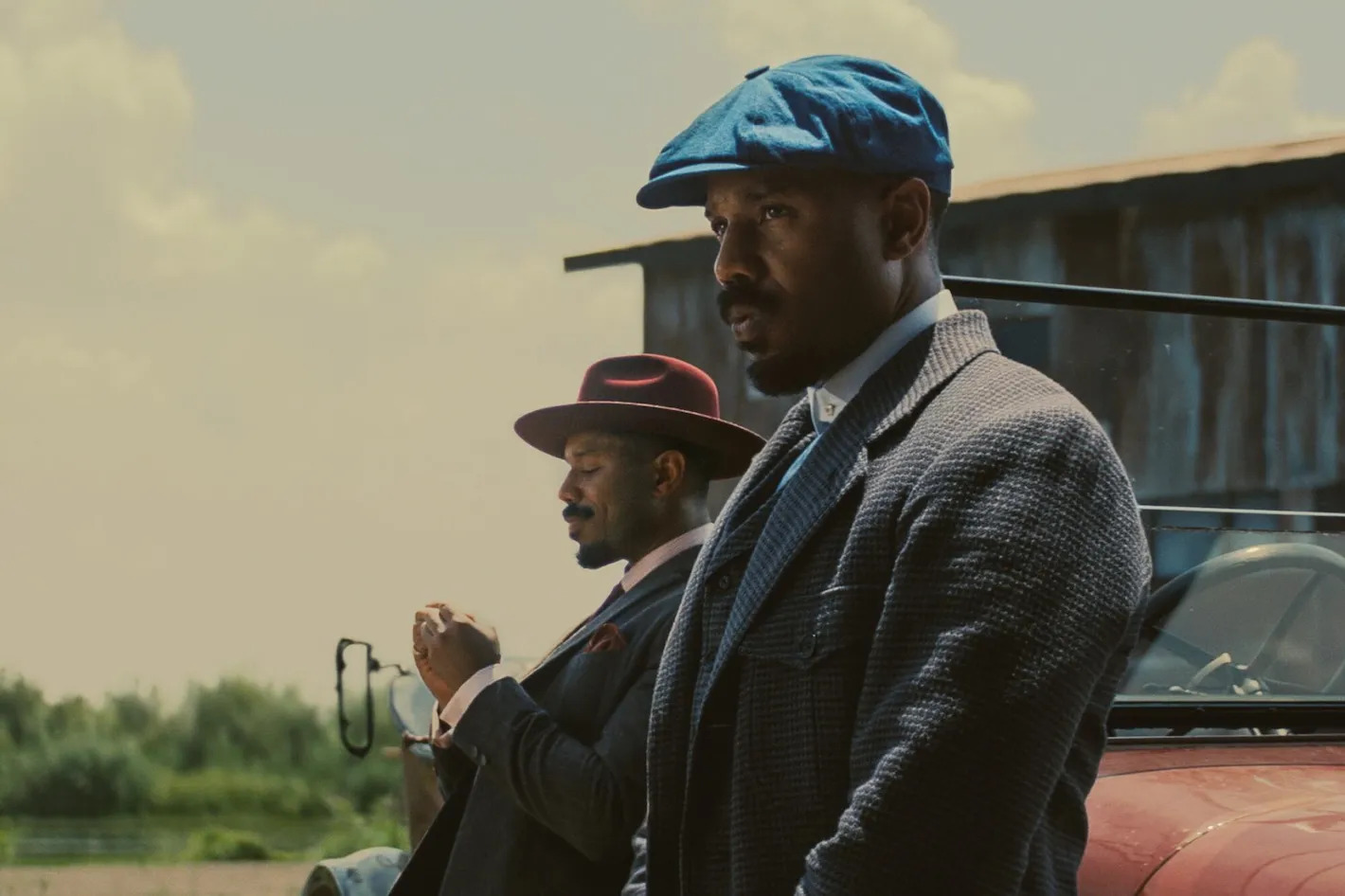
“Music ain’t the only thing that echoes.”
— Ryan Coogler, on Sinners
March 15, 2026. The Dolby Theatre in Hollywood. Ryan Coogler walks to the podium to accept the Oscar for Best Original Screenplay — the first of his career, only the second Black man ever to win it, following Jordan Peele in 2018. The room rises. A standing ovation before he says a word.
He opens his mouth and the Oakland comes out: “I grew up in Oakland, California, and we can talk a lot.” Laughter. Then the gravity of the moment settles over everything. He thanks his cast, his collaborators, his wife Zinzi, his parents, his children at home. He closes with something that sounds less like an acceptance speech and more like a prayer, or a blues lyric: “Memories are all we have. I hope I’ve given you some great ones.”
Elsewhere that night, Michael B. Jordan becomes the first Black man to win Best Actor in years, standing on the shoulders of Sidney Poitier, Denzel Washington, Jamie Foxx, and Forest Whitaker. Autumn Durald Arkapaw wins Best Cinematography — the first woman in the Academy’s nearly 100-year history to do so. Ludwig Göransson takes Best Original Score for a film whose soundtrack is itself an argument about the African roots of all American music.
The headlines called it a historic night. They were right, but they didn’t know the half of it.
Because Sinners is not simply a movie that won awards. It is a cultural event that connects — with living tissue, like a root system under the earth — to more than a century of Black artistic resistance, spiritual knowledge, and the long, unbroken struggle by African people everywhere to tell their own stories, own their own creations, and insist on their own way of knowing the world.
To understand what Sinners means, you have to go back. Far back. Past Hollywood. Past the civil rights movement. Past slavery. All the way to the source.
—
## Part One: What the Film Actually Is
On its surface, Sinners is a vampire horror film set in 1932 Clarksdale, Mississippi, in the heart of the Jim Crow Delta. Twin brothers — Smoke and Stack, both played by Michael B. Jordan — return from Al Capone’s Chicago with blood money and a dream: to open a juke joint, a sacred Black social space where the community can eat, drink, dance, and hear the blues. Their young cousin Sammie, a musical prodigy played by newcomer Miles Caton, provides the sound.
On its first night open, the juke joint is besieged by vampires — led by an Irish immigrant named Remmick, backed by a freshly turned KKK couple. The film becomes a siege narrative, a survival story. But it is also, and more profoundly, something else entirely.
As Britannica put it in its cultural analysis, the film “incorporates the vampire mythos to produce a fitting thematic antagonist who threatens the erasure of freedom, cultural history, and communal memory. It comments on the appropriation of Black art by mainstream culture and draws parallels among vampirism, organized religion, and colonialism.”
That’s the thesis. But Coogler himself gave us the key. During the film’s opening narration — voiced by Wunmi Mosaku, who plays Annie, the Hoodoo practitioner — we are told that among the Irish, the Choctaw, and the West Africans alike, there are legends of musicians so gifted they can “pierce the veil between life and death, past and future.” Coogler was not merely setting up a horror film. He was announcing an epistemological claim: that music is a technology of trans-temporal connection, a form of knowledge that Western rationalism cannot contain or commodify.
This is where the film ascends to something no mainstream Hollywood production has dared attempt before.
In the film’s pivotal musical sequence — a five-minute ecstatic eruption that film critics have called one of the greatest scenes in recent American cinema — young Sammie plays the blues, and the veil tears open. Through the breach come B-boys from the 1990s, contemporary dancers twerking, and most stunningly, West African performers doing the Zaouli dance of the Guro people of Ivory Coast, a tradition more than 200 years old practiced to honor feminine beauty and ancestral connection. Past, present, and future collapse into one sacred moment. The ancestors are present. The descendants are present. The music is the bridge.
This is not horror. This is African cosmology made cinematic.
Part Two: The Untold Story — Ownership as Rebellion
The critical acclaim, the box office ($370 million worldwide against a $90-100 million budget), the record-breaking 16 Oscar nominations — these are the told stories. The untold story is the deal.
Before a single frame was shot, Ryan Coogler walked into a studio bidding war — Warner Bros., Sony, and Universal all competing for his film — and made three demands that, as one Hollywood executive told Vulture, “could be the end of the studio system.” He demanded: first-dollar gross (meaning he earns from ticket one, not after the studio recoups), final cut privilege, and ownership of the film reverting to him in 25 years — in 2050.
Hollywood “freaked out.” An unnamed senior executive called it “very dangerous.” The New York Times ran a piece noting that Coogler “will then own it, despite not paying for it” — a framing The Hollywood Reporter’s Richard Newby called “a gross miscalculation,” pointing out that Coogler’s own production company Proximity Media invested in the film, and that the suggestion a Black creator should not own what he creates is its own kind of colonial logic.
The deal carries enormous generational weight, as Black wealth manager Belva Anakwenze observed. “It changes the money story of his children, his grandchildren, his great grandchildren. We’re going to know about George Lucas for 200 years. We’re going to know about Quentin Tarantino. And now we’re going to know about Ryan Coogler.”
The meta-narrative here is impossible to miss. A film literally about the theft of Black cultural production — vampires feeding on a juke joint, trying to consume a blues prodigy’s gift — was made under a deal designed to ensure that same theft could not happen to its maker. The art and the business deal were the same statement, made simultaneously.
This places Coogler in a tradition going all the way back to the very first Black filmmakers. As scholar Ana-Christina Ramón of UCLA noted, “The one thing that I found interesting is the fact that [the details] were leaked for an African American filmmaker.” White directors negotiate similar deals in silence. For Coogler, it became a national conversation — which tells you everything about whose ownership America considers natural and whose it considers threatening.
Part Three: The River and Its Source — 100 Years of Black Cinema
To trace the lineage of Sinners is to travel a river that has been flowing for more than a century, often underground, often through hostile terrain, always moving toward the sea.
Oscar Micheaux (1884–1951), born to formerly enslaved parents, was writing, producing, directing, and self-distributing films by 1919 — before Charlie Chaplin’s The Kid came out. Working entirely outside a Hollywood system that excluded him by race, Micheaux understood instinctively what Coogler would formalize contractually a century later: that ownership is survival. “One of the greatest tasks of my life has been to teach that the colored man can be anything,” he said. His 1920 film Within Our Gates was a direct cinematic rebuke to D.W. Griffith’s white-supremacist. Birth of a Nation. He made 44 films in conditions of near-total economic deprivation, distributing them personally, carrying prints in his car. His very existence as a filmmaker was an act of resistance.
The Race Film era of the 1920s through 1940s created an entire parallel cinema — films produced by and for Black audiences, showcasing Black talent, humanity, and complexity in defiance of Hollywood’s minstrelsy. These films were shown in “colored” theaters, in churches, in lodge halls. They constituted a Black counterpublic sphere made of celluloid.
Then came the LA Rebellion of the 1960s and 70s — a movement of Black and Third World film students at UCLA who, influenced by Italian neorealism, African cinema, and the anti-colonial thought of Frantz Fanon and Aimé Césaire, rejected Hollywood grammar entirely. From this movement came Charles Burnett (Killer of Sheep, 1978), Haile Gerima (Sankofa, 1993), and crucially, Julie Dash.
Dash’s Daughters of the Dust (1991) is the film that, more than any other, prefigures the spiritual and aesthetic architecture of Sinners. Set on the Gullah Geechee Sea Islands of South Carolina at the turn of the 20th century, it follows a family descended from the Ibo people of West Africa who maintained their African cultural retentions more intact than almost anywhere else in the Americas. Dash employed a non-linear, dreamlike narrative structure — past, present, and future interpenetrating — rooted in African conceptions of time where ancestors are not gone but present, where the dead and the living share the same space. The film, shot by the visionary Arthur Jafa (who coined the concept of “Black Visual Intonation”), was the first feature film by an African American woman to receive wide theatrical distribution in the United States.
Daughters of the Dust nearly didn’t get made, requiring years of fundraising. It was dismissed by distributors before finally finding its audience. Beyoncé’s Lemonade visual album drew so heavily from it that Dash received a co-writing credit and a new generation discovered the film. The through line from Dash to Coogler is not incidental. Both are making the same argument: that African Americans carry Africa inside them, and that Black American art is a living archive of ancestral memory.
Melvin Van Peebles deserves his own paragraph here. His 1971 Sweet Sweetback’s Baadasssss Song is the most radical act of Black film ownership before Coogler’s Sinners deal — Van Peebles financed it himself, distributing it independently, keeping all profits, building an entirely self-sustaining Black commercial cinema infrastructure from nothing. It launched Blaxploitation, a complicated genre. Gordon Parks’ (Shaft 1971) and (Sounder1972) — the latter a film of heartbreaking beauty about a sharecropping family in Depression-era Louisiana that anticipates Sinners ‘ Delta setting — showed that Black stories could find enormous mainstream audiences without compromising their humanity.
Super Fly (1972), directed by Gordon Parks Jr., with its iconic Curtis Mayfield score, was another template: Black genre filmmaking that worked simultaneously as entertainment and social commentary, in which the “criminal” protagonist was a more complex figure than any Hollywood villain.
Spike Lee— who arrives on this timeline like a force of nature — synthesized all these traditions and exploded them into mainstream consciousness. She’s Gotta Have It (1986), made for $175,000 in two weeks, announced that Black independent cinema could be urban, sexy, intellectually rigorous, and commercially viable. Do the Right Thing (1989), Malcolm X (1992), Crooklyn (1994), Bamboozled (2000) — Lee’s filmography is a sustained argument, sometimes furious, sometimes elegiac, always urgent, about Black identity, representation, and the relationship between art and power. His production company 40 Acres and a Mule has been one of the longest-running examples of Black creative infrastructure in Hollywood.
The 1977 television miniseries Roots, based on Alex Haley’s family history, was perhaps the single most impactful act of Black storytelling in the mass media era. An estimated 130 million Americans watched it. For many Black Americans, it was the first time they saw their full humanity, their full history — not as slaves but as people with names, cultures, families, and African origins — reflected in mainstream media.
The Color Purple (1985), directed by Steven Spielberg but adapted from Alice Walker’s Pulitzer Prize-winning novel, with performances by Whoopi Goldberg, Danny Glover, and the great Oprah Winfrey in her film debut, was another seismic event in Black cultural life — a film about Black women’s interiority, suffering, and transcendence that the Black community claimed as its own, whatever its complicated relationship with its director.
A Raisin in the Sun — first a 1959 Broadway play by Lorraine Hansberry, then a 1961 film with Sidney Poitier and Ruby Dee — is perhaps the definitive text of Black American aspiration against structural denial. Its title taken from a Langston Hughes poem, it asked: what happens to a dream deferred? Does it dry up, or does it explode? Poitier, Dee, and Ossie Davis — a triumvirate of Black theatrical and cinematic royalty — embodied in their very lives and careers the answer: you do not defer. You create. You insist. You endure.
Putney Swope (1969), Robert Downey Sr.’s radical satire in which a Black man accidentally takes over a white advertising agency and turns it into a vehicle for Black power, anticipated the critique of cultural appropriation that sits at the center of Sinners. Long overlooked, it belongs in this conversation.
12 Years a Slave (2013), directed by Steve McQueen, written by John Ridley, and starring Chiwetel Ejiofor, was the film that finally — 88 years after the Oscars began — brought a Best Picture award to a story about American slavery. Its unflinching refusal to soften the horror of the institution while maintaining the full humanity of Solomon Northup was a moral act as much as an artistic one.
Fruitvale Station (2013) is where Coogler himself enters this river. Made when he was 26, based on the 2009 police killing of Oscar Grant on an Oakland BART platform, it starred Michael B. Jordan in his breakthrough role. A film made for almost nothing, shot with documentary intimacy, it asked the oldest question in Black American art: how do you hold the full dignity of a Black life in a medium and a culture that has so consistently denied it? From that film to Sinners is a 12-year journey, but it is a single continuous artistic statement.
Black Panther (2018) and Wakanda Forever (2022) require extended treatment here, because they represent the apotheosis of something that had been building in the culture for decades: the arrival of an unapologetically African-centered imagination at the absolute center of global popular culture. Wakanda — a fictional African nation that was never colonized, that maintained its own technologies, its own spiritualities, its own epistemological frameworks — was not just a superhero movie. It was a theological and philosophical provocation. For the African diaspora globally, it was a declaration: we existed before they arrived. We existed differently. And we remember.
The film’s cultural impact was staggering. It grossed $1.35 billion and won Marvel its first Best Picture nomination. But more than box office, it created a phenomenon: Black audiences wearing traditional African dress to theaters, families using the film as an entry point to African history and culture, children playing at being Wakandan citizens rather than American superheroes. Chadwick Boseman’s T’Challa became one of the most important cultural figures of our time, and his death — and Coogler’s decision to mourn him publicly in Wakanda Forever rather than recast the role — was one of the most genuinely moving moments in contemporary cinema.