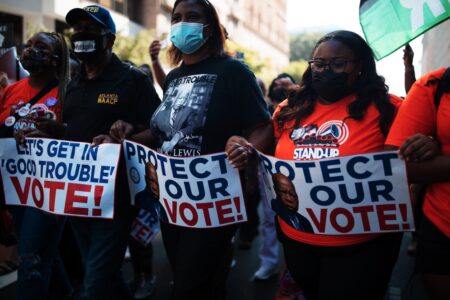






Black voters are turning to the polls in high numbers this election cycle, according to a new study.
Released by VoteHub, a data-focused election organization, the study looked at data across 78 Southern counties with large Black populations. Compared with 2024, approximately 77 out of 78 Black Belt counties voted majority left. The counties also recorded an increase in voter participation.
Of all the counties, Greene County in Alabama recorded the largest turnout increase. According to the study, there was a turnout difference of approximately 28 percentage points compared with 2024.
Other Alabama counties that had strong turnout included Bullock, Lowndes, Macon and Montgomery. Bullock had the third-largest voter turnout. The county is more than 70% Black. The districts were all previously targeted by Republican legislators.
Louisiana also reported an increase in its voting population. Approximately 31% of Black voters cast ballots in the primary election. They were the demographic that marked the highest turnout rate, even as the overall turnout rate increased in this primary electorate.
The increase in voter turnout comes as district maps continue to be contested as Republicans seek to gain control.
South Carolina, Georgia, Alabama, Louisiana, Mississippi and North Carolina all presented redrawn maps to dilute Black political power by targeting majority-Black districts. In a landmark ruling in the case Louisiana v. Callais, the Supreme Court moved to weaken the 1965 Voting Rights Act by voting against Section 2. Section 2 prohibits any action that discriminates based on race or color.
The Louisiana v. Callais case was brought to the Supreme Court on April 29 this year. A group of plaintiffs filed the lawsuit after the map was redrawn to include a second majority-Black district, alleging that it was a case of racial gerrymandering.
The map was redrawn after Black voters and organizations challenged the initial map because it diluted the voting power of Black voters in the state. The 5th U.S. Circuit Court of Appeals ruled that the map could be redrawn to remedy decades of voter dilution.
“After the Court’s ruling in Louisiana v. Callais, the creation of majority-minority districts will be extremely difficult,” said Harvard Kennedy School professor of public policy Maya Sen following the Supreme Court’s ruling. “I think it’s going to likely have repercussions throughout our political system, from the way in which districts are drawn to the number of minority representatives across tiers of government.”
In response to the redistricting efforts to dilute Black voting power, several organizations have ramped up efforts to increase the turnout of Black voters, particularly in the South.
Early last month, the NAACP announced a $20 million campaign to get voters to show up at the polls for the November midterm elections.
The campaign is set to recruit 20,000 volunteers to encourage 6.5 million Black voters to vote across 14 states and 33 congressional districts.
“By turning out the vote, we can all help put an end to Donald Trump’s assaults on our communities and the rights we’ve secured through immense struggle, and begin to build a future that actually serves our needs — from having accessible healthcare, affordable housing, and getting a good education,” said Derrick Johnson, president and CEO of the NAACP, per a press release. “We’re launching this campaign on our nation’s 250th anniversary — and investing more than we’ve ever invested in a midterm cycle — because this is a pivotal moment for our democracy.”