






NOTE TO READERS: This piece was originally published on NewsOne July 13, 2026.
The longtime Republican Senator Lindsey Graham is dead at age 71. The DC Medical Examiner’s Office has reported that his death was caused by an aortic tear due to cardiovascular disease.
Predictably, as soon as word of Graham’s death hit the political streets, Washington started the familiar work of embalming his reputation. Politicians and major news outlets eulogized him as a charming, patriotic senator, a foreign-policy statesman fiercely devoted to American power, and a witty bipartisan dealmaker.
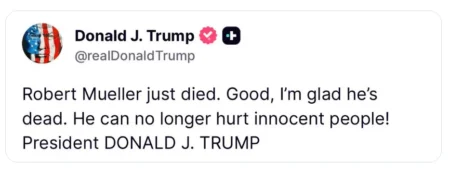
Donald Trump posted: “Senator Lindsey Graham, one of the greatest people and senators I have ever known is dead! He was always working, and was a true American Patriot. Lindsey will be greatly missed. So sad.”
Meanwhile, right-wing conspiracy merchants like Laura Loomer, Indiana state senator Mike Delph, and other pro-MAGA accounts were peddling conspiracy theories suggesting that the Russians had poisoned Graham following his trip to Ukraine and called for an investigation.
Rev. Al Sharpton logged onto Facebook and gave the Black clergy version of reputation laundering by offering condolences, recalling Graham as “quick-witted and funny,” and noting that they had shared laughs about James Brown. Sharpton also reduced Graham’s record to “stark political differences,” which is a mighty polite way to describe a career spent helping empower a racist right-wing movement.
On the other end of the political spectrum, pundits described how Graham went from being one of Donald Trump’s loudest critics and then spent the final and most consequential chapter of his career as one of the president’s most loyal lieutenants. He called Trump dangerous and dishonest, a “kook,” “bigot,” “xenophobic,” and said he was “unfit” for office and then made himself useful to the same dangerous man he had warned the country against voting for. Some are treating this aspect of his political evolution as an embarrassing act of hypocritical subordination. In that telling, Graham is a kind of cautionary tale about authoritarianism, democratic decay, ambition, political cowardice, and the Republican Party’s wholesale surrender to Trump.
But Graham’s surrender to Trump is not just a story about Graham, about one white man’s ambition, humiliation, cowardice, and lost dignity, or how he made himself useful to a dangerous man. This is also a political story about what Trump and Graham together made dangerous for Black people once that usefulness was converted into power.
Almost nobody is asking some critical questions: What did Graham’s surrender do to Black people? What about the times he defended Trump against allegations of racism? Where is the sustained accounting of the voter suppression he enabled, the racist president he repeatedly sanitized, the judges he helped install, the civil-rights protections he helped weaken, and the racial grievance he converted into respectable Senate politics?
Lindsey Graham’s story is not about one of those good Republicans who lost his way. This is a story about a white politician who knew exactly what racism looked like, understood the danger it posed, and gave Trump’s racial demagoguery a Southern gentleman’s accent, a law degree, and Senate respectability. No, he was the kind of theatrical, slur-spewing, hood-wearing segregationist. But Graham’s great sin was not just that he debased himself for Donald Trump. It was that he used his proximity to power to help turn Trump’s racial project into policy, law and a legacy that harmed Black folks.
Continue reading on NewsOne.
THIS CONTENT IS WRITTEN IN THE AUTHOR’S PERSONAL CAPACITY. ANY OPINIONS EXPRESSED ARE THE AUTHOR’S OWN AND SHOULD NOT BE ATTRIBUTED TO HOWARD UNIVERSITY OR MORGAN STATE UNIVERSITY.
Thanks for reading. If this piece resonated with you, then please consider becoming a paid subscriber. Paid subscriptions help keep my Substack unfiltered and ad free. They also help me raise money for HBCU journalism students who need laptops, DSLR cameras, tripods, mics, lights, software, travel funds for conferences and reporting trips, and food from our pantry. You can also follow me on Facebook!
We appreciate you!