



Crocodile. The first time I ate one, no crocodile tears were shed for the carnivorous critter impaled on a Maasai sword skewer and carried by two servers to our table. The large reptile had been skinned and slow-roasted, rotated over coals. The chunks of crocodile meat sliced onto my plate were pleasantly charred; the meat was tender. I wondered how the croc would have felt knowing he was served up with potato salad and greens.
That was prior to 2004, which is when Kenya imposed a ban on the sale of game meat. I assume that was a wild croc. These days the giraffe and wildebeest are gone from the then-menu at Nairobi’s Carnivore Club. These days, any crocodile meat served there is farmed.
Fast forward to not long before COVID. That time the crocodile dish, according to the menu, had been marinated overnight in thyme and mustard. It was then wrapped in bacon, pan-fried and placed on a bed of crushed carrots, sweet potatoes and mussels in brandy. This was at a high-end eatery that the time was a Hilton hotel in central Durban.
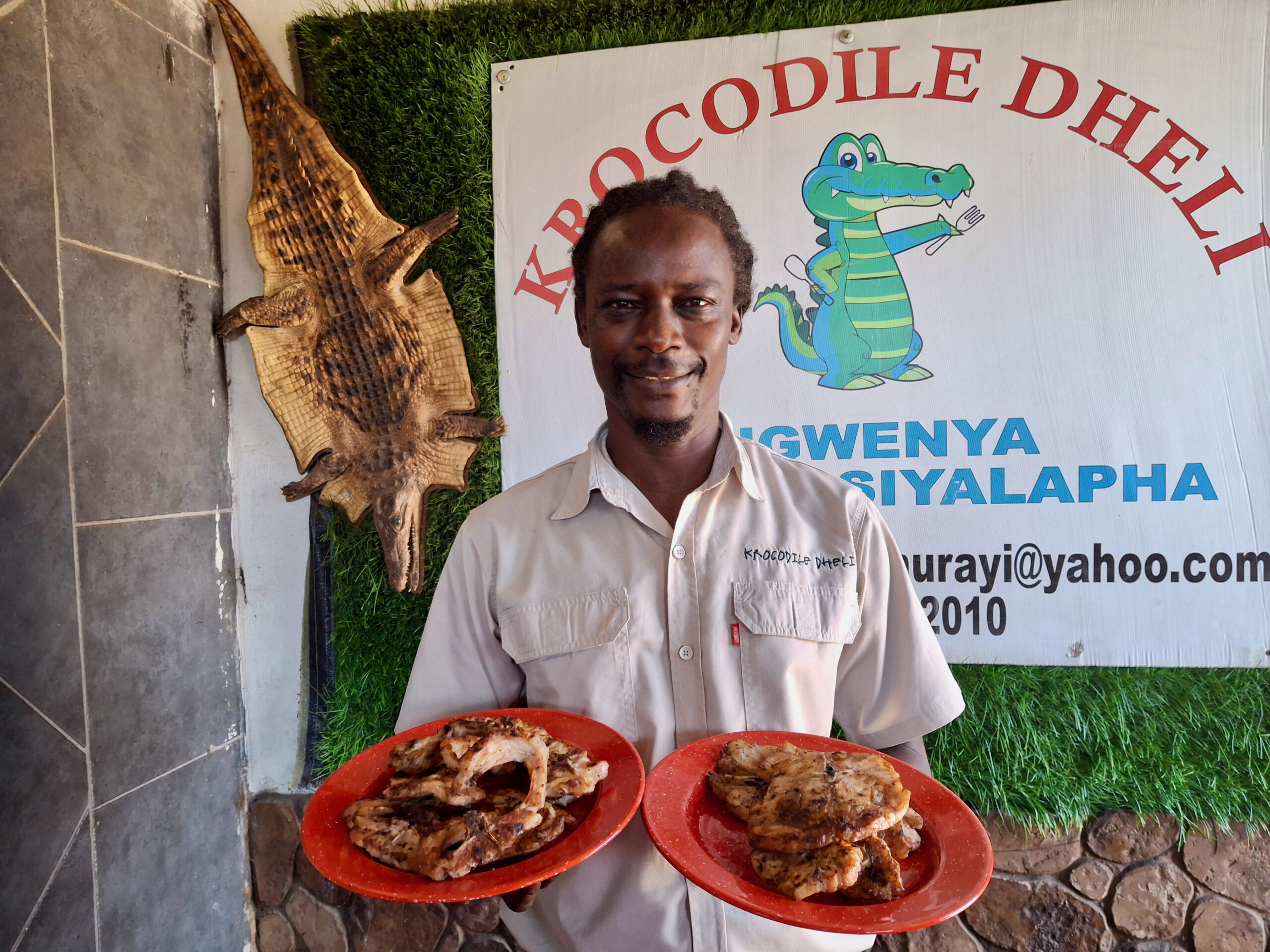
On the day this story dawned, eating crocodile meat and meeting Raphael Tsaurayi, a friendly crocodile crackerjack turned culinary crocodile aficionado, were not what I was expecting when I asked my farmer friends Lynn and Mike if anything interesting food wise was going on in their neck of the woods. Their “woods” being a remote timber, sugar cane and macadamia farm “in the middle of nowhere” in KwaZulu-Natal, South Africa.
They live up a rutted dirt road, way off the beaten track about a 90-minute drive from Durban where, many years ago, Lynn and I met at high school and became besties. I love to make the trek to visit them, but do have some hesitancy these days. Rather wish they hadn’t told me about the large puff adder, an extremely venomous snake, Lynn found curled up on the pillow my head had laid on just a few hours earlier during a recent sleep over.
Mike ponders my foodie question, for not too long. Then tells me about this elderly Zulu woman who, most days, lights a fire in a small rickety grill she has knocked together and sets up on the grass verge near the turn-off to their farm.
“People traveling to work place orders for the crocodile meat she sells. She has it cooked and waiting for them to pick up on their way home.”
“And there is a crocodile meat café in Pietermaritzburg (PMB),” Lynn pipes in, PMB being the closest large city to their farm.
By morning when I am set to leave to drive home to Durban, they have made a plan. Thinking our isiZulu-speaking roadside crocodile meat purveyor may not speak English or want to talk to a camera-wielding stranger — and to make sure I find the PMB crocodile establishment — Mike has asked the farm induna (foreman), Vusi Zuma, to accompany me (after which, he will taxi home).
Culinary Crocodile Meat
The day might have flopped like a disappointing soufflé without Zuma because the crocodile woman was not in her spot. But, “Do you know where the crocodile farm is?” I ask Zuma, Mike having said her crocodile meat came from a farm.
Turns out Zuma is game and adventurous. He points me along the well-used narrow asphalt road in the direction of Pietermaritzburg. I drive until he points and says: “There,” indicating a dirt track, which leads to: a locked gate.
After a couple more false starts and bumping along through some fields of veggies, we come upon a clearing with a shed, a small house and a man in a van.
A long conversation ensues between this man and Zuma, interjected with my, “Is the crocodile farm here?” No.
“Is there a farm?” Yes.
Zuma’s gesticulations, plus lots of pointing and head-nodding indicates he is checking and confirming directions.
Our new route doubles us back from where we came and after not too long leads us to another dirt road, which ends at a No Entry, Crocodile Abattoir, By Appointment Only sign. I tell the gate man, in English, that I am a food writer interested in crocodile meat. What Zuma tells him, in isiZulu, is likely of more relevance. Because, suddenly friendly and welcoming, he signs us in.
By Wanda Hennig