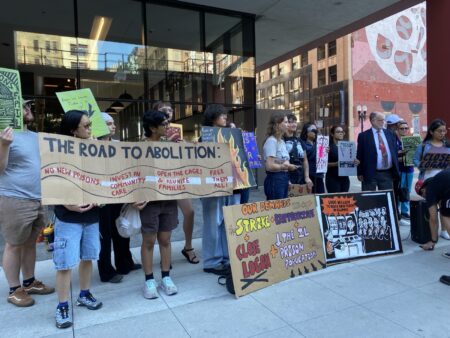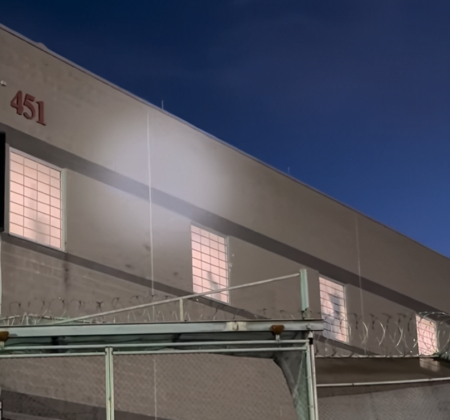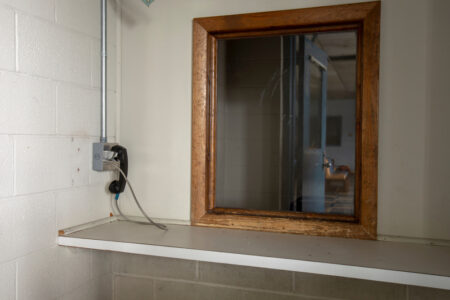






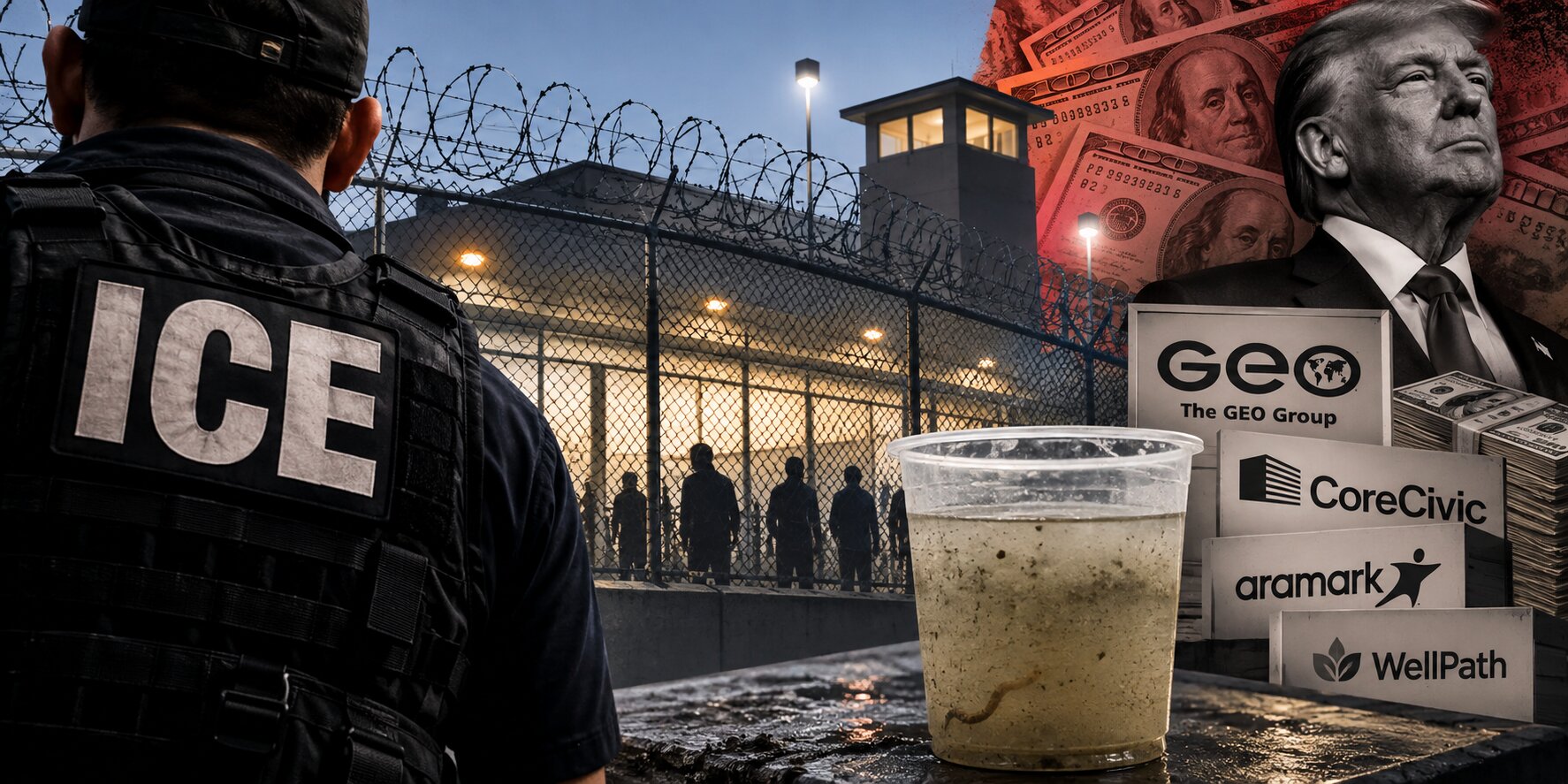
The medical neglect and contaminated drinking water experienced by detained TikTok journalist Carlitos Ricardo Parias in ICE detention are part of a problem that stretches beyond punitive government policies designed to crush those in its custody.
Both are glaring examples of an often-overlooked component of one of the current administration’s top priorities: financial profiteering. Of course, detainees should have free access to clean water. But beyond asking why Parias’ free water is so dirty, we should ask why clean water is so expensive.
Since retaking office, President Trump and his MAGA-aligned associates have raked in billions. Recent financial disclosures show that Trump has added $2.2 billion to his overall wealth, including $1.4 billion in new revenue from businesses that directly benefited from his actions as president.
Trump’s immigration enforcement policies are a significant part of this picture. ICE’s arrest and detention operations have generated billions for private corporations like GEO Group and CoreCivic that construct and operate detention centers for DHS.
These for-profit corporations are driven by fiduciary obligations to maximize shareholder profits above everything, including healthcare and other necessities for those held at their facilities. That includes clean water.
Parias, based in Los Angeles, was shot in the arm by an ICE agent nearly one year ago. Since that time, he has been detained at the Adelanto ICE processing center in California, where he has reportedly been denied medical treatment for his injuries.
Recently, Parias and other detainees at the facility discovered worm-like creatures swimming in their drinking water. Rampant denial of medical care and contaminated food that makes people violently ill have also been reported at other ICE facilities across the country.
This alarming neglect at ICE facilities is equally common in other correctional facilities operated by for-profit corporations. They keep operating costs low on one end, while driving more revenue-generating commerce on another by forcing incarcerated people to overpay for basics.
For-profit corporations responsible for providing healthcare services to detainees are not held to the same level of transparency as government agencies. Medical staff prioritize “cost-efficient” healthcare practices that are not shaped by a patient’s medical needs. This approach ultimately results in detainees recovering from serious injuries, like Parias’ gunshot wound, being issued ibuprofen and Bengay for the pain.
At the same time, poor-quality food and contaminated drinking water force detainees to buy bottled water and edible food from the prison’s commissary at substantially marked-up prices to avoid starvation or dehydration.
According to a recent report by the Prison Policy Initiative, incarcerated individuals like Parias and their loved ones spent over $5.5 billion in 2025 alone for such services. The PPI states that at least 4,000 companies profit from incarceration in the U.S.
Private prison profiteering corporations fall into four distinctive groups.
First, there are the telecommunications and media providers, like Securus, ViaPath and GTL.
According to a 2025 report by the Appeal, these prison profiteering corporations “routinely charge incarcerated people and their families egregious rates for rudimentary communication services.” One 15-minute phone call could cost upwards of $8 and a single email 50¢. The report also reveals how these corporations rake in additional revenue from media services like “movies, songs, and games at a price for above market rates” for prison-issued tablets.
PPI reports that Securus generates roughly $700 million in revenue annually.
“These companies deliberately prevent people from communicating with their family,” Soumaya Hamdi, the wife of Sami Hamdi, a British-Palestinian journalist who was also held in ICE detention, said in an interview. “They just take your money repeatedly and the functions never work.”
The second group is the food and prison commissary vendors like Aramark and Keefe Group.
These for-profit corporations receive lucrative contracts to provide free meals to detainees and sell essential items like toothpaste, snacks and bottled water. It is not unusual for the same corporations to provide both services at one facility, creating an inescapable monopoly and conflict of interest.
Recently, incarcerated individuals in West Virginia filed a lawsuit against Aramark challenging this unethical practice. The suit alleged that Aramark—a Fortune 500 company that holds both contracts at the facility—intentionally served inedible food in the prison’s cafeteria to increase sales of edible items in its commissary.
According to the suit, since Aramark took control of the prison’s food service and commissary contract, the free food distributed in the cafeteria has become scarcer, recycled and lower quality. Conversely, incarcerated individuals are allowed to buy higher-quality items through Aramark’s “food-for-purchase” program.
For $16.99, plus a $2.49 handling charge, an incarcerated individual can order a double cheeseburger, onion rings, cookies and a Crystal Light package.
An investigation conducted by The Appeal found that, because there is no marketplace fairness, these prison-profiteering corporations engage in acutely oppressive and unscrupulous practices. Products, including hygiene, food and religious items, are marked up as much as 600% over what people outside would be charged at a place like Walmart. The investigation also found that Aramark hauled in $18.5 billion in 2025.
Oftentimes, these same for-profit corporations create subsidiaries to corner other markets for detainees.
For example, Keefe Group’s parent company HIG Capital also owns WellPath, a correctional healthcare provider.
Private for-profit healthcare providers like WellPath, VitalCore, and Correct Care Solutions make up the third group of prison profiteers. These companies are awarded government contracts to provide healthcare services.
The recent hunger strike at ICE’s Delaney Hall detention center in Newark, NJ—which GEO Group operates—illustrates the lack of investment by these profiteering corporations in quality health care.
U.S. Senator Andy Kim visited the facility and discovered numerous detainees who were not receiving the medical care they needed. In an interview with Pod Save America, Sen. Kim pointed to GEO Group’s decision to hire only one full-time doctor for Delaney Hall’s 800 detainees.
“GEO Group got nearly a billion dollar contract,” Kim told Pod Save America’s cohost Jon Favreau, “so they can hire more doctors tomorrow, today, but that’s going to be less profit for them.”
The billion-dollar contract Sen. Kim mentioned was part of the $170 billion package Congress passed in Trump’s Big Beautiful Bill for immigration and border enforcement. Congress allocated $75 billion to ICE and immediately began handing out contracts to the fourth group of for-profit prison profiteers, including GEO Group and CoreCivic.
In addition to constructing and operating detention centers, the Brennan Center for Justice reported that GEO Group has also made millions of dollars off surveillance of Americans.
Through its SmartLINK technology, GEO Group is currently monitoring around 180,000 people in the U.S. That number is expected to grow to 460,000 by 2027, according to GEO Group’s own forecast.
Recent earnings reports revealed that GEO Group’s revenue grew 15%, or $730 million. CoreCivic’s earnings were equally impressive. In the first quarter of 2026, CoreCivic reported a 27% increase, or $680 million.
Many of these same corporations also profit from manufacturing tasers, chemical agents, guns, handcuffs, body armor, facial recognition software, electronic monitors and license plate readers.
The disgusting and unhealthy treatment Parias and others in ICE custody are enduring is not mere happenstance. For-profit corporations are making these well-thought-out, economically sound business decisions to take full advantage of Trump’s second term.