



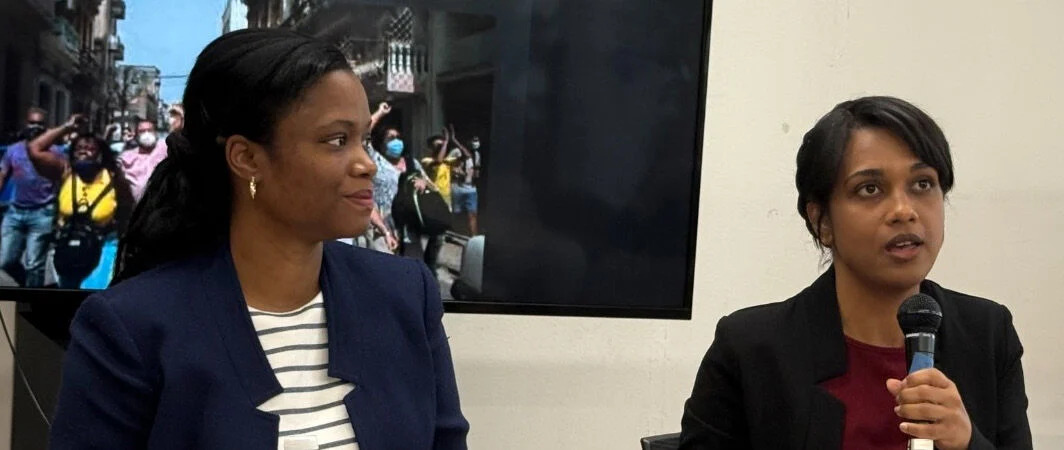
Community members gathered last weekend for an “Eyes on Cuba” conversation with two representatives of the Cuban embassy in the United States, focusing on the terrible suffering inflicted on the Cuban people by the intensified U.S. blockade and also discussing the historic connections between Black freedom movements in the U.S. and struggles for justice in Cuba.
Held in downtown Oakland Saturday, Aug. 22, at the office of Oakland Rising, the event featured presentations by representatives of the Cuban embassy in Washington, D.C., First Secretary Sulia Páez Chacon and Second Secretary Gabriela Castillo, who spoke and answered questions about the harsh realities of conditions on the island, with a population of about 11 million, while also highlighting the historic resilience and perseverance of the Cuban people.
The gathering was held in honor of the annual commemoration of Black August, a month of remembrance, education, and reflection on Black resistance, political prisoners, liberation movements, and the continuing pursuit of justice.
For more than 60 years, Cuba has faced a blockade designed to cripple its economic growth and overthrow its government, going back to the 1959 revolution against the colonial regime imposed by the U.S. But the recently intensified blockade has cut off the island’s fuel supply, creating an energy and humanitarian crisis that is strangling the country.
With the lack of oil previously supplied by Venezuela and the U.S. threat of high tariffs on countries that dare to ship petroleum to Cuba, the impact on water, sewage, healthcare, food, and medical supplies has been devastating for the country, according to the speakers.
“There are 100,000 patients now waiting for healthcare services,” said Chacon.
“There are 32,000 pregnant women whose care has been disrupted. This is criminal and a collective punishment. This is genocide – If this blockade continues, it will lead to a silent Gaza,” said Castillo.
Organizers framed the conversation around humanitarian conditions, international solidarity and the importance of building connections among Black communities across national borders.
The speakers shared that the country now experiences 12-48-hour blackouts that affect the transportation of goods, hospital services, and even people’s sleep patterns.
“This is impacting the lifesaving (kidney) dialysis services, special needs kids lacking hearing aids, and even supplies crucial for fixing machinery such as ultrasound machines,” said Castillo.
“Cuba is a Black country,” said Castillo. “Even if you are blond-haired and blue-eyed, your genetic heritage is African.”
Cuba has long held a unique place in conversations about race, revolution and international Black solidarity. Its history has intersected with African liberation movements, anti-colonial struggles and debates about social equality throughout the Americas.
“Eyes on Cuba” offered participants an opportunity to explore those connections while discussing the current crisis.
“We have 7,000 containers of supplies already paid for by Cuba, but the companies now refuse to send the shipments for fear of U.S. sanctions on their countries,” said Chacon.
Chacon and Castillo spoke about how the country has rebuilt itself since the 1990s and created healthcare and education systems so robust that they rival and even surpass those of many so-called advanced countries.
“We are from a generation born in crisis, and we rebuilt, but today the pressure we are under is extraordinary,” said Chacon.
Castillo explained that the relationship between Cuba and the U.S. government “has always been very complicated.”
“(But) the relation between the people of Cuba and the people of the U.S. is something that we cherish, that we carry in our hearts, that is way older than the Cuban revolution itself: the cultural ties, the social ties, historical ties, the political ties. We’ve always had a lot in common.”
Castillo said that the blockade on Cuba is more than economic; it seeks to erase the people’s identity.
There are, she said, worldwide disinformation campaigns against Cuba and its people, “mainly centered in the lie that Cuba is a threat to the U.S. “
The mainstream media says that “Cuba is a country on the brink of collapse, that our government is not competent enough to run the economy,” she said. “But they almost never say that the root of everything is the blockade. They don’t say that despite the hard situation right now, the country is not paralyzed. We have reorganized the whole economy.”
“For many young people, for Black people in Cuba as well, if it weren’t for the revolution, we wouldn’t be here,” said Castillo. “My grandmother from my father’s side, when the revolution triumphed, was 12 years old, and she was cleaning houses with her mom. She only had the possibility to study through elementary school. (After the revolution), she had the possibility to go to high school, and because of the revolution, she was able to study at the university and become a professional. I think that most of us in Cuba have the same story.”
At the close of the event, speakers recommended that, for more information, people watch the recently released documentaries on Cuba, “Teresita’s Dream” and “Cuba After Castro.” Local organizers will schedule follow-up discussions to plan solidarity actions.
By Carla Thomas and Ken Epstein