



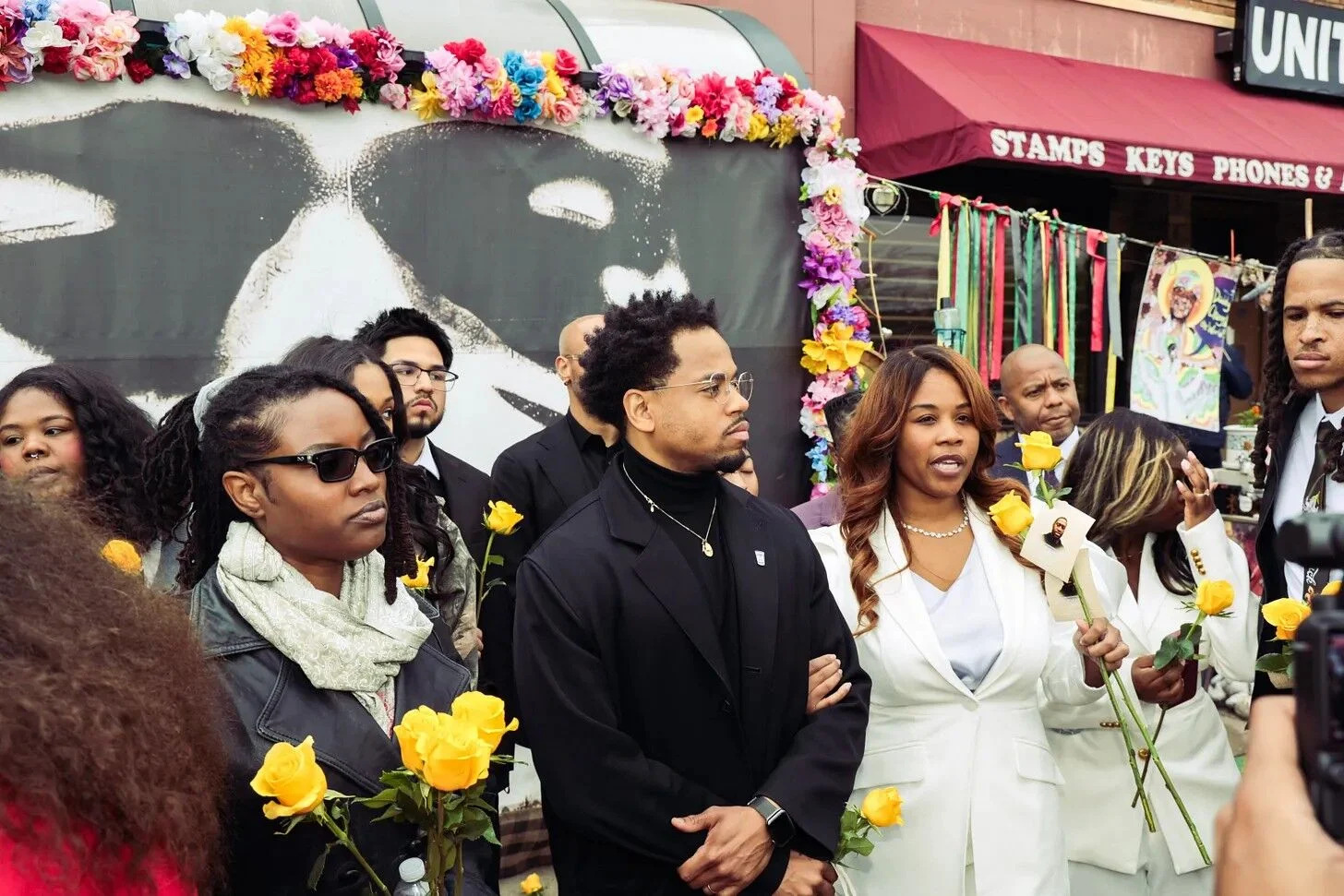
Just days ago, we stood at George Floyd Square in silence, remembering the life of George Floyd and the humanity that was stolen from him. Just days later, the Minnesota Republican Party stood in silence for Derek Chauvin, the man convicted of murdering him. If there was ever a tale of two cities, two visions, and two moral compasses, this is it.
Six years ago, the world watched George Floyd take his final breath beneath the knee of former Minneapolis police officer Derek Chauvin. We watched.
We heard him call for his mother.
We heard him say he couldn’t breathe.
We watched humanity leave his body in broad daylight.
A jury watched the evidence.
The courts reviewed the appeals.
The justice system, imperfect as it may be, rendered its verdict.
Derek Chauvin was convicted of murder. He later pleaded guilty to violating the constitutional rights of George Floyd and a 14 year old child.
These are not opinions.
These are facts.
And yet, just days after the sixth anniversary of George Floyd’s murder, the Minnesota Republican Party chose to hold a moment of silence for Derek Chauvin.
Not for George Floyd.
Not for his children.
Not for the family members who continue to carry unimaginable grief.
Not for the countless Minnesotans whose lives were forever changed by what happened on May 25, 2020.
Not for the communities still working toward healing.
Derek Chauvin.
A moment of silence is never neutral.
It communicates whose pain matters.
It communicates whose humanity deserves recognition.
It communicates who we believe is worthy of our empathy.
The question is not whether someone has a right to hold a moment of silence.
The question is why.
Why, six years later, after convictions, appeals, and a federal guilty plea, would anyone choose to center the man responsible for George Floyd’s death rather than the life that was taken?
The answer tells us more than many people are willing to admit.
For months now, I have been asking myself what is happening in this country.
Just days before our Day of Remembrance, George Floyd’s name was used as a punchline in a Netflix comedy special.
Then came a moment of silence for Derek Chauvin.
Different actors.
Different stages.
The same message.
Forget.
Move on.
Stop caring.
Stop remembering.
Stop resisting.
Stop believing that Black life deserves dignity, even in death.
But memory itself is an act of resistance.
That is why we gather.
That is why we pray.
That is why we tell the stories.
That is why we remember.
Because what we do not remember, we repeat.
In 2012, I had the opportunity to meet President Barack Obama.
At the time, I told him that I hoped we could one day live in a country where people were not divided into teams that blindly defended everything their political party did. I hoped we could become a nation that asked a simpler question: What is best for people? What is best for humanity? What is best for the world we are leaving behind for future generations?
President Obama smiled and told me that I would make a great judge someday.
At twenty years old, I assumed he meant a judge in a courtroom.
Today, I understand something different.
Like Deborah in the Bible, our responsibility is to discern truth in moments when confusion is being sold as clarity, when cruelty is being sold as courage, and when injustice is being repackaged as patriotism.
Because this moment is not really about Derek Chauvin.
It is about whose side we are on.
History teaches us that every generation is confronted with the same question.
Will you stand with the oppressed or the oppressor?
Will you stand with the enslaved or the slave catcher?
Will you stand with the victim or the person who harmed them?
Will you stand with truth or with power?
Too many people imagine that if they had lived during slavery, they would have been abolitionists.
Too many people imagine that if they had lived during Jim Crow, they would have marched.
Too many people imagine that if they had lived during the Civil Rights Movement, they would have stood with Dr. King.
History suggests otherwise.
Many people choose comfort.
Many people choose proximity to power.
Many people choose silence.
Many people convince themselves that survival is more important than solidarity.
And when they do, they become participants in systems they claim they would have opposed.
This is why we must pay attention.
Not because we need to become consumed by outrage.
But because we need clarity.
We need to know who is standing with us.
We need to know who is willing to tell the truth.
We need to know who believes in justice only when it benefits them and who believes in justice because it is right.
It is not a coincidence that George Floyd’s case resulted in accountability.
If we are being honest, it was not supposed to happen.


We were not supposed to have Attorney General Keith Ellison leading the prosecution.
We were not supposed to have Chief Medaria Arradondo willing to testify against one of his own officers.
We were not supposed to have a movement strong enough to demand accountability.
We were not supposed to have communities organized enough to force the world to pay attention.
We were not supposed to win.
The same can be said for so many victories throughout history.
People like Marvin Haynes were not supposed to come home.
People serving life sentences were not supposed to be exonerated.
People from our communities were not supposed to become attorneys, judges, organizers, ministers, and leaders capable of challenging the status quo.
And yet, here we are.
That is precisely why there is always resistance.
Because every gain toward justice is met with an attempt to reclaim what some believe was never supposed to be shared.
Power rarely surrenders willingly.
History has taught us that.
Frederick Douglass once asked, “What, to the American slave, is your Fourth of July?”
As America approaches its 250th birthday, perhaps we should ask ourselves a similar question.
What does freedom mean when some people’s humanity remains negotiable?
What does liberty mean when memory itself is under attack?
What does justice mean if we are asked to honor those who committed injustice while forgetting those who suffered it?
And perhaps most importantly:
What are we going to do about it?
Because despair is not a strategy.
Giving up is not an option.
Professor Akati once shared something with me that I have never forgotten.
He said, “One good thing about the darkness is that it makes it easier for the lights to see each other.”
I have held onto those words this year.
Because if there is one gift in moments like these, it is clarity.
The darkness reveals who is who.
It reveals who is willing to stand.
It reveals who is willing to speak.
It reveals who is willing to remember.
It reveals who is willing to fight for a future that is more just than the past.
Six years later, we are still here.
The Floyd family is still here.
The movement is still here.
The truth is still here.
And no moment of silence can silence that.
Because what we do not remember, we repeat.
And what we choose to remember has the power to change the world.
Don’t Complain, Activate is a space for leadership, history, faith, and civic responsibility – moving beyond outrage into action by connecting today’s events to history and calling for courage and conscience.