





May marks the celebration of Haitian Heritage Month.
Established in 1998, it was created to coincide with Haitian Heritage Flag Day on May 18th. The month-long celebrations pay tribute to the country’s history and figures.
In honor of Haitian Heritage Month, here are five notable Haitians who have helped shape global history and the arts.
Jean Baptiste Point DuSable
Believed to have been born in St. Domingue (present-day Haiti) around 1745, DuSable’s life is generally unknown until the 1770s. From 1769 to 1770, accounts allege that he was shipwrecked while traveling to New Orleans with a friend. After arriving in New Orleans, DuSable began traveling North in search of new opportunities. Eventually, he made his way into what would become Chicago, establishing relationships with Native American tribes and helping preserve peace.
With his relocation, DuSable became the first non-Native American person to stay and establish a permanent residence in what is now Chicago. As a result, he is often credited as a founder of the city. After marrying his wife Kitihawa in 1778, his permanent estate included a modest-sized home, a back house, a smokehouse, a poultry house, a workshop, a barn and a stable. In 1800, he sold all his property and moved to Peoria, Illinois. On Aug. 28, 1818, he died in St. Charles, Missouri.

Elsie Suréna
Born in Port-au-Prince and raised in southern Haiti, Suréna. A writer and artist, she studied at the Ecole Nationale des Arts, the Boca Raton Museum of Art, the Cambridge Center for Adult Education and the Boston Center for Adult Education throughout her career. Through her art, Suréna focused primarily on black-and-white photography, mainly of people and other compositional pieces. As for her writing, she became notable for her work celebrating Haiti. Published in Haitian Creole, English, French and Spanish, her poems are primarily haikus that cover everyday life in Haiti. For her work, Suréna has been published in multiple anthologies and has won the Les Belles Provinciales competition as well as the Prix Belleville Galaxie. In 2023, she was also a finalist for the Prix Alain-Thomas.

Jean-Michel Basquiat
Born in New York City, Basquiat was of Puerto Rican and Haitian descent. Early on in his life, his mother, Matilde, instilled a love of the arts into him and encouraged him to use his creativity. In the late 70s, Basquiat began his professional art career by working alongside fellow artist Al Diaz. The duo mainly took part in New York graffiti, using buildings around lower Manhattan and Brooklyn as their canvases and tagging their works of art with the logo “SAMO©.” He gained notoriety in the art scene as he transitioned to painting on canvas. His work has been associated with themes such as Black identity as well as historical and political consciousness.
By 1980, Basquiat’s work was featured in his first exhibit, titled “Times Square Show.” Two years later, he had his first solo exhibit at the Annina Nosei Gallery. That same year, his art was displayed globally and, at the age of 21, he became the youngest artist to be exhibited at Documenta 7 in Kassel, Germany. Throughout his career, Basquiat was also featured at the Whitney Museum of American Art and in a traveling exhibit organized by the Fruitmarket Gallery in Edinburgh. In 1984, the artist joined the Mary Boone Gallery. Four years later, at the age of 27, Basquiat passed away from a heroin overdose.

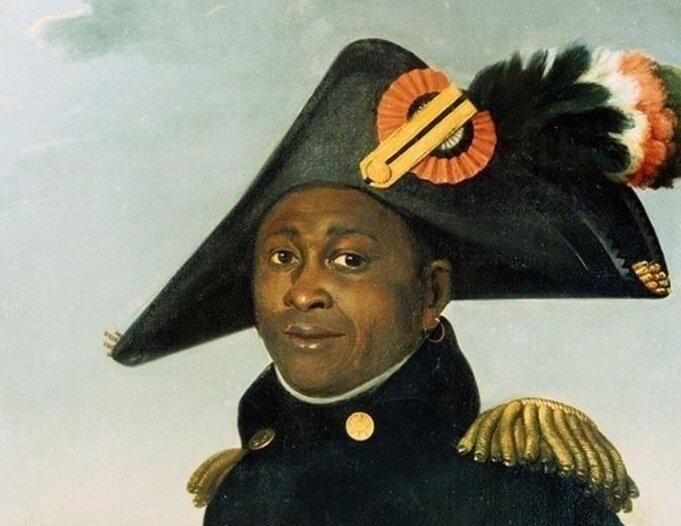
Toussaint Louverture
Recognized as one of the “Fathers of Haiti,” Louverture is considered to be the leader of the Haitian independence movement throughout the French Revolution. A few weeks after the revolt by enslaved people in the northern province, he joined the cause. Using his skills as a negotiator and a communicator, Louverture joined the Spanish-allied military forces, rising up to the position of leader. By the early 1790s, he changed his allegiance to the French after they outlawed enslavement. He became notable for outsmarting the Spanish, French and English forces and pitting them against each other as a general. After conquering areas such as Hispaniola, he united the island and named himself as governor. Although he died before Saint-Domingue gained full independence and became Haiti, he set the stage for Haiti’s sovereignty.

Toto Bissainthe
Born in Cap-Haitien, Haiti, Bissainthe was an actress and singer who combined elements of the Vodou religion with contemporary arrangements. She left Haiti from an early age to become an actress and studied theatre at the Les Griots company which was the first African theatre company in Paris. Throughout her career, Bissainthe worked with playwrights and directors such as Samuel Beckett and Roger Blin. Following a 1973 Paris performance, she officially established herself as a singer-songwriter-composer with a rendition of a standard that featured her own commentary on the struggles and spirituality of working-class Haitians. From then on, she was heralded as a champion of Haitian music. Her career, however, coincided with the Duvalier regime, a strict dictatorship that made media criticism forbidden. As a result, Bissainthe was allowed to return to Haiti for one concert only. She held the concert two months before the regime fell and was met with a standing ovation for her message of unity and hope. After the regime ended, Bissainthe returned to Haiti for the rest of her days. In 1994, she passed away at the age of 60 due to cirrhosis.